Picking the right digital marketing services for small businesses in 2026 comes down to matching the channel to your sales cycle, not chasing whatever platform is trending this quarter.
TL;DR
Local SEO and Google Business Profile work still deliver the best long-term return for small businesses in 2026 — start there.
PPC wins when you need leads inside 30 days; budget at least $1,500/month to get usable data.
B2B service companies need LinkedIn and content, not consumer social — treat them as separate disciplines.
Franchise and multi-location brands need centralized systems, not one-off campaigns run by individual owners.
Trifecta Business Group pairs digital marketing services for small businesses with funding, so campaigns don’t stall for cash reasons.
Why this matters
Most small business owners buy marketing services the way they buy office supplies — reactively, when something breaks. That's backwards in 2026, when customer acquisition cost across paid channels keeps climbing and organic visibility takes months to build.
The businesses that win aren't the ones spending the most. They're the ones matching budget to the right channel for their sales cycle, then giving it enough runway to actually work. A lot of that runway question comes down to cash flow, which is why marketing and funding decisions are rarely separate conversations — see how to get business funding to scale a small business if budget is the real blocker, not strategy.
This guide ranks the core categories of digital marketing services for small businesses by what they actually do, who they fit, and what verdict each one earns for 2026 budgets.
How this list is ranked
Each category below is scored on three things: time-to-result, cost predictability, and fit for a small business budget rather than an enterprise one. Categories that require six-figure minimum spend to show signal get marked down even if they're effective at scale, because that's not the audience here.
The order runs from fastest-to-implement to most specialized. It's not a popularity ranking — it's a fit ranking for owners deciding where the next marketing dollar goes.
The ranked list
1. Local SEO and Google Business Profile optimization — the compounding asset
Local SEO is the closest thing to a marketing asset a small business can own outright instead of renting. A fully optimized Google Business Profile with consistent reviews and accurate categories routinely outperforms paid ads for local service searches by 2026 benchmarks, because it captures buyers already searching with intent.
It takes 60 to 90 days to see meaningful ranking movement, which is the tradeoff: slow start, low ongoing cost, durable result. Verdict: Buy — for any business with a physical location or service area, this is the first dollar spent.
2. Pay-per-click (PPC) advertising — the fast lane
PPC is the only channel on this list that can generate qualified leads within days instead of months. Google Ads and Meta Ads both work, but they need a real budget to produce statistically useful data — under $1,500 a month, most small businesses are just paying for noise.
The risk is obvious: turn off the budget and the leads stop the same day. Verdict: Buy as a complement to organic work, not a replacement for it.
3. Social media management and paid social — the trust builder
Social content builds the credibility layer that makes PPC and SEO convert better, but it's a slow-burn channel that rarely produces direct leads on its own in 2026. Businesses that treat it as a standalone lead generator usually get frustrated and quit within three months.
The better use case: consistent posting plus a small paid boost budget to keep the brand visible between purchase cycles. Verdict: Consider — good supporting channel, weak as a primary strategy.
4. Email marketing and CRM-driven follow-up — the profit multiplier already in your list
Most small businesses have a database of past customers and leads sitting untouched, and email remains one of the highest-ROI channels precisely because the audience already knows the brand. A structured follow-up sequence recovers revenue that paid channels never touch.
The cost is low — most platforms run under $100 a month for small lists — but it needs someone actually writing and sending, which is where DIY plans stall. Verdict: Buy if there's a real list; Skip the investment in fancy automation until the list exists.
5. B2B marketing programs for service companies — the specialist track
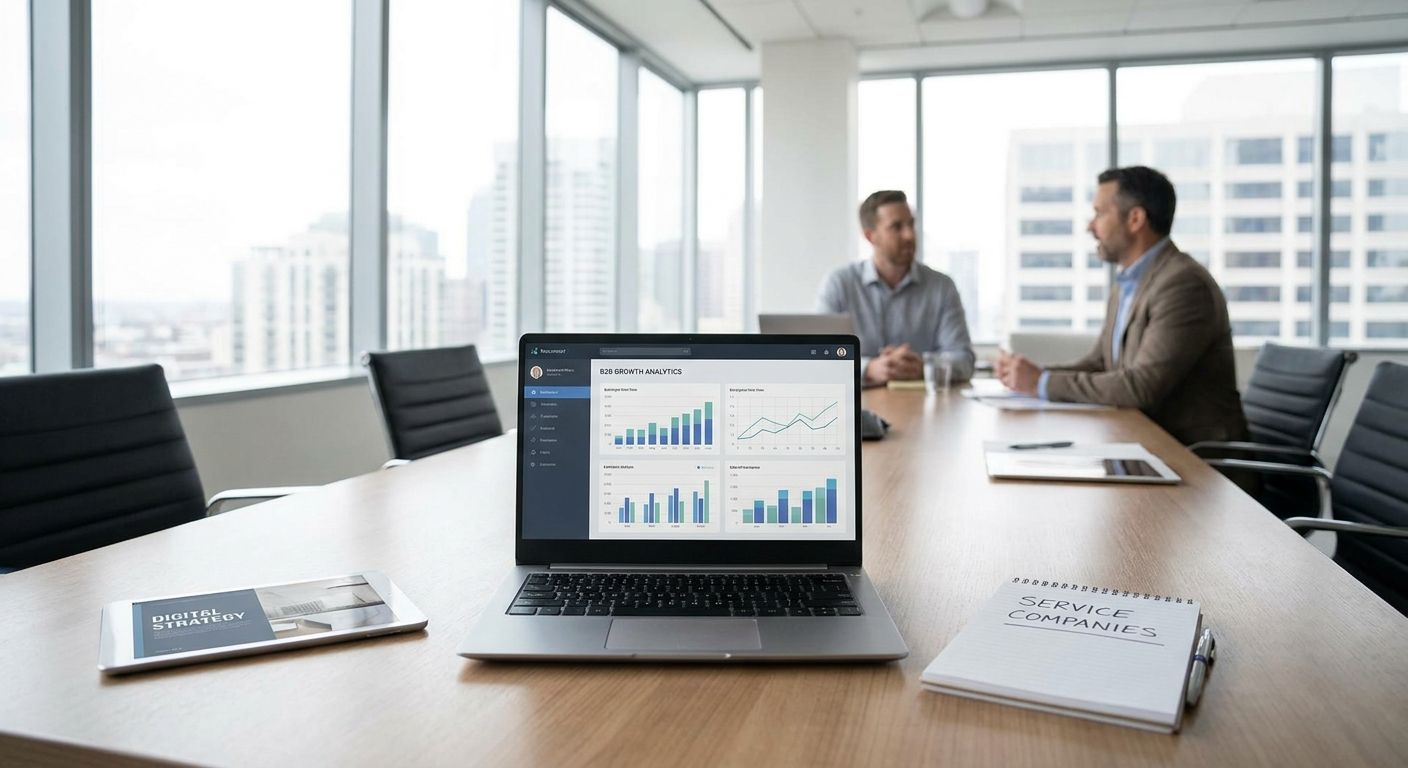
B2B buyers research longer, involve more decision-makers, and don't respond to consumer-style social ads. Digital marketing for B2B service companies requires LinkedIn presence, case-study-driven content, and often account-based outreach rather than broad targeting.
Sales cycles here run 60 to 180 days depending on contract size, so the marketing plan has to match that patience. Verdict: Buy, but only from a provider that separates B2B strategy from consumer playbooks — the two don't transfer.
6. Franchise marketing systems — the multi-location fix
Franchise brands and multi-location operators can't run marketing location-by-location without losing brand consistency and wasting spend on duplicated setup work. Digital marketing for franchise businesses centralizes strategy while still localizing execution for each market.
The failure mode without this: 15 franchisees each hiring a different freelancer, producing 15 different brand experiences. Verdict: Buy for any brand past three locations.
7. Real estate agent marketing — the referral accelerant
Real estate is a relationship business first and a marketing business second, but agents who skip digital entirely lose deals to competitors who show up in local search and social proof. Small business marketing for real estate agents focuses on listing visibility, local search, and reputation — not generic lead-gen funnels that don't fit how buyers actually shop for agents.
Verdict: Buy for agents building a personal brand beyond referrals alone.
8. Home services marketing — the seasonal-demand play
Home services businesses — HVAC, plumbing, roofing, landscaping — live and die by local search timing and seasonal demand spikes. Small business marketing for home services companies combines local SEO with seasonal PPC pushes timed to demand cycles rather than running flat budgets year-round.
Verdict: Buy, and pair it with a seasonal funding plan so ad spend doesn't get cut during slow months when it's needed to build the next season's pipeline.
Comparison table
Channel
Time to Result
Budget Fit
Best For
2026 Verdict
Local SEO / GBP
60-90 days
Low, ongoing
Local/service businesses
Buy
PPC advertising
Days to weeks
$1,500+/mo minimum
Fast lead generation
Buy
Social media management
3-6 months
Low-moderate
Brand trust, retention
Consider
Email/CRM follow-up
Immediate on send
Under $100/mo
Existing customer lists
Buy
B2B service marketing
60-180 days
Moderate-high
B2B service companies
Buy
Franchise marketing systems
90+ days
Moderate-high
Multi-location brands
Buy
Real estate agent marketing
30-90 days
Low-moderate
Individual agents/teams
Buy
Home services marketing
Seasonal
Moderate
Trade and service businesses
Buy
Where to source these services
Three rules keep small businesses from overpaying or under-delivering on digital marketing services in 2026:
Match the provider to the sales cycle. A generalist agency that treats a B2B service company the same as a retail storefront will waste budget on the wrong channels.
Don't separate marketing spend from cash flow planning. Campaigns that get paused mid-quarter for budget reasons rarely recover momentum — funding and marketing need to be planned together.
Ask what happens in month four. Any provider can show a good first-month report. The ones worth keeping have a plan for months four through twelve.
Fund your 2026 marketing plan
Get working capital so campaigns run full cycle, not just the first month. Call us at 8779773015.
What are the best digital marketing services for small businesses in 2026?
Local SEO, Google Business Profile optimization, and PPC advertising deliver the fastest, most measurable results for small businesses in 2026. Email marketing to an existing customer list is the highest-ROI secondary channel.
How much should a small business spend on digital marketing?
PPC budgets under $1,500 a month rarely generate enough data to optimize campaigns effectively. Local SEO and email marketing cost far less monthly but take longer to show results.
Is SEO or PPC better for a small business?
PPC produces leads faster, often within days, while SEO takes 60 to 90 days but builds a durable asset that keeps generating traffic without ongoing ad spend. Most businesses need both, not one or the other.
Do B2B service companies need different marketing than consumer businesses?
Yes. B2B buyers have longer sales cycles and respond to LinkedIn content and case studies rather than consumer-style social ads. Treating B2B and consumer marketing the same way wastes budget on the wrong channels.
How long does it take to see results from digital marketing?
PPC can generate leads within days, but local SEO typically takes 60 to 90 days to show ranking movement. Social media and content marketing usually need three to six months to build trust-driven results.
Can marketing and business funding be handled together?
Yes, and they should be. Campaigns that lose funding mid-cycle rarely recover the momentum they built, so planning marketing spend alongside working capital keeps campaigns running through the months that actually produce results.
What marketing works best for franchise and multi-location businesses?
Centralized marketing systems that keep brand consistency while localizing execution per market outperform letting each location run its own marketing. This avoids the fragmented brand experience that comes from independent freelancers per location.
Is social media marketing worth it for small businesses?
Social media builds trust and supports other channels but rarely generates direct leads on its own in 2026. It works best paired with local SEO or PPC rather than as a standalone strategy.
One last thing
The small businesses that get the most out of digital marketing services in 2026 aren't the ones with the biggest budgets — they're the ones who don't quit a channel in month two because the first results looked slow. Local SEO in particular punishes early abandonment: most of the ranking gain shows up between month three and month six, right when an underfunded campaign usually gets cut.
How to qualify for a working capital loan in 2026: credit score, revenue benchmarks, required documents, and the fastest path from application to funding.
Compare the best business funding options for small business owners in 2026 — SBA loans, working capital, equipment financing, ranked with clear verdicts.
Invoice factoring for wholesale distributors in 2026: advance rates, recourse vs non-recourse, red flags, and a verdict comparison table before you sign.