

Business Funding · By Trifecta Business Group
Best overall: BlueVine, for fast online applications and transparent digital underwriting. Best for freight and trucking invoices: Triumph Business Capital. Best for non-recourse risk transfer: Riviera Finance. Best for matching your business to the right accounts receivable financing company without shopping six lenders yourself: Trifecta Business Group.
- BlueVine wins overall for online accounts receivable financing with fast digital underwriting in 2026.
- Triumph Business Capital is built for trucking and freight invoices specifically.
- Riviera Finance specializes in non-recourse factoring, shifting customer credit risk off your books.
- Trifecta Business Group matches businesses to the right accounts receivable financing company instead of one fixed product.
- Advance rates across accounts receivable financing companies typically run 70% to 90% of invoice value.
Why this matters
A business with $150,000 sitting in unpaid invoices and payroll due Friday doesn't have a strategy problem — it has a timing problem. Accounts receivable financing companies exist to close that gap by advancing cash against invoices you've already billed, instead of making you wait 30, 60 or 90 days for customers to pay.
In 2026, more small and mid-sized companies are turning to accounts receivable financing over traditional bank loans because approval hinges on your customers' creditworthiness, not just your own balance sheet or years in business. That opens the door for younger companies with strong B2B receivables but thin credit history.
The hard part isn't finding an accounts receivable financing company — a search turns up dozens. The hard part is picking one that fits your industry, invoice volume and risk tolerance instead of the one with the best ad budget. Trifecta Business Group works from the other direction: instead of pitching one factoring product, it reviews your receivables and funding needs and points you to the option that actually fits, which matters more than most comparison charts admit.
What makes the best accounts receivable financing companies
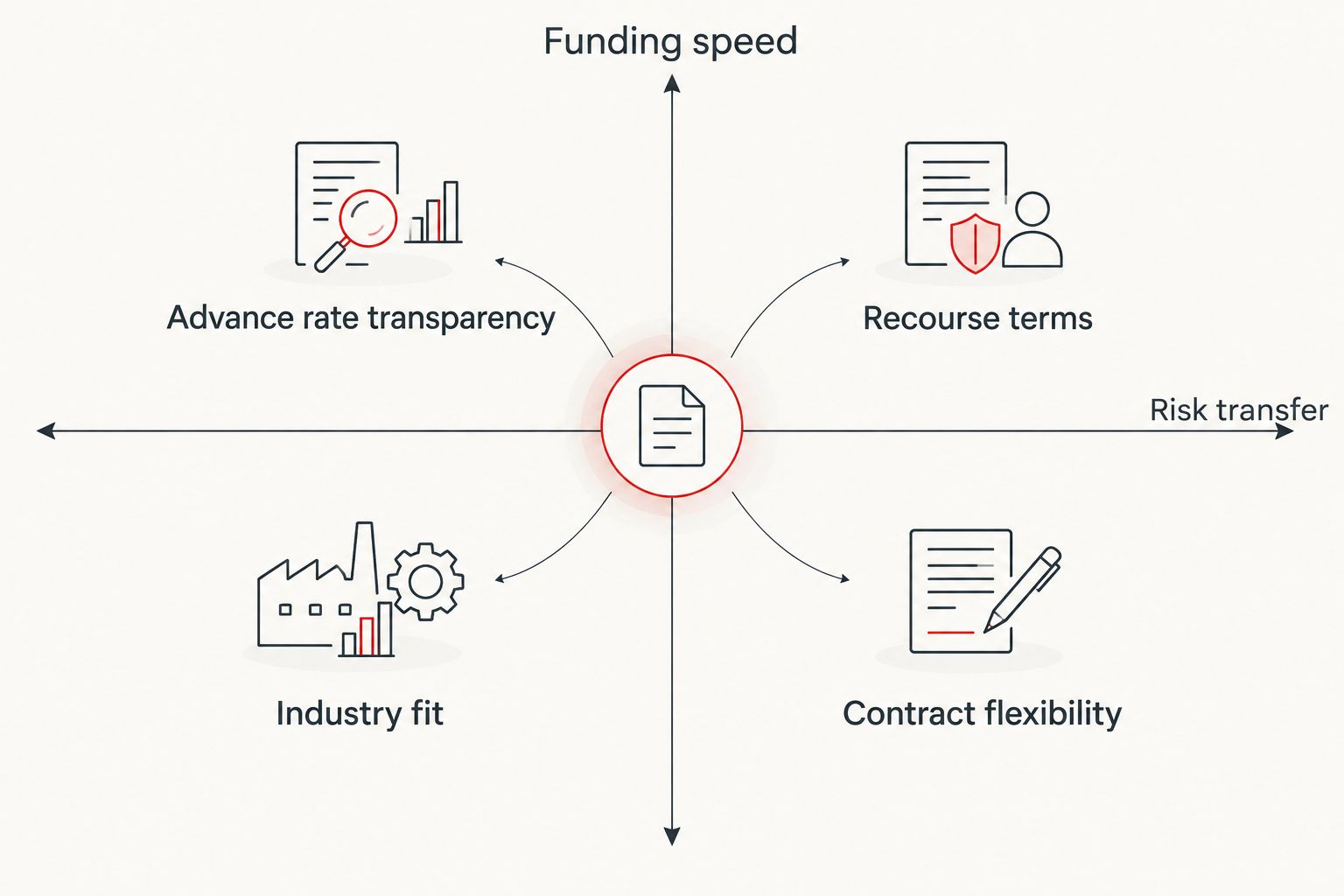
- Advance rate transparency — the percentage of invoice value paid upfront, disclosed before you sign, not buried in a term sheet
- Recourse terms — whether you're on the hook if your customer never pays, or the company absorbs that risk
- Industry fit — trucking, staffing, manufacturing and construction receivables each carry different risk profiles and specialist lenders exist for a reason
- Contract flexibility — month-to-month options versus 12-24 month lock-ins with early termination fees
- Funding speed — how long between invoice submission and cash in your account
- Customer experience — does the factoring company contact your customers directly for collections, and how that affects the relationship
Accounts receivable financing companies at a glance
| Company | Best For | Standout Feature | Key Limitation |
|---|---|---|---|
| Trifecta Business Group | Matching your business to the right lender | Reviews receivables and funding needs before recommending a path | Not a direct factoring lender itself |
| BlueVine | Fast online applications | Fully digital underwriting and account setup | Better suited to companies already comfortable applying online |
| altLINE (The Southern Bank) | Bank-backed reliability | Factoring division of a chartered bank | Underwriting can move slower than fintech-only providers |
| Riviera Finance | Non-recourse factoring | Customer credit risk shifts to the factoring company | Non-recourse protection usually means a lower advance rate |
| Triumph Business Capital | Trucking and freight invoices | Built specifically around transportation receivables | Less competitive fit outside freight and logistics |
| Porter Capital | High invoice volume, mixed industries | Flexible underwriting across varied receivable types | Terms vary more by industry than with niche specialists |
1. Trifecta Business Group: best accounts receivable financing companies match for guided decisions
Trifecta Business Group works with small and mid-sized companies to identify the right funding structure — including accounts receivable financing — instead of pushing one product regardless of fit. The process starts with a review of your receivables, invoice terms and cash flow timing before pointing you toward a lender or factoring structure.
Trifecta Business Group pros:
- Reviews multiple funding paths, not just one factoring product
- Pairs funding guidance with marketing and consulting support if you need to grow into the new cash flow
- Works with companies that don't fit a single lender's narrow underwriting box
Trifecta Business Group cons:
- Not a direct factoring company, so funding still runs through a third-party lender
- Best suited to businesses that want guidance, not a one-click online application
Best for: businesses unsure which type of accounts receivable financing fits, or that have been turned down elsewhere.
Verdict: Buy if you want a funding plan built around your actual receivables instead of guessing between six lender websites.
2. BlueVine: best accounts receivable financing companies option for fast online approval
BlueVine offers online accounts receivable financing and lines of credit built for speed, with an application process designed to run entirely digital. It's a common first stop for small businesses that want to compare a live offer without a phone call.
BlueVine pros:
- Fully online application and account management
- Familiar option with broad name recognition among small business owners
- Works well for companies with clean, predictable B2B invoicing
BlueVine cons:
- Less hands-on guidance than a consulting-led approach
- Underwriting still depends heavily on your customers' payment history
Best for: businesses comfortable self-serving an application and comparing offers directly.
Verdict: Buy if speed and a digital process matter more than personalized guidance.
3. altLINE (The Southern Bank): best for bank-backed accounts receivable financing
altLINE operates as the factoring division of a chartered bank, which appeals to businesses that want the stability of working with a regulated financial institution rather than a standalone fintech.
altLINE pros:
- Backed by a chartered bank structure
- Established track record in invoice factoring specifically
- Straightforward fit for companies that prioritize institutional lenders
altLINE cons:
- Underwriting can move slower than fully digital-first competitors
- Less flexible for unconventional receivable structures
Best for: businesses that want factoring from a bank-affiliated provider rather than a fintech startup.
Verdict: Hold — solid choice if bank backing matters to you, but compare turnaround time against digital-first options first.
4. Riviera Finance: best for non-recourse accounts receivable financing
Riviera Finance is known in the factoring space for non-recourse structures, meaning the company — not your business — absorbs the loss if your customer never pays the invoice.
Riviera Finance pros:
- Non-recourse structure removes customer nonpayment risk from your business
- Long-standing presence in the invoice factoring industry
- Useful when customer credit quality is uneven
Riviera Finance cons:
- Non-recourse protection typically comes with a lower advance rate than recourse factoring
- Underwriting on your customers can be stricter since the company carries the risk
Best for: businesses billing customers with inconsistent payment histories who want risk off their books.
Verdict: Buy if nonpayment risk is your biggest concern, not the advance rate percentage.
5. Triumph Business Capital: best for trucking and freight receivables
Triumph Business Capital built its factoring business around transportation, meaning underwriting, invoice verification and customer relationships are shaped by how freight and logistics companies actually invoice.
Triumph Business Capital pros:
- Deep specialization in trucking and freight invoice factoring
- Underwriting process built around transportation industry norms
- Familiarity with freight broker and shipper payment cycles
Triumph Business Capital cons:
- Narrow industry fit means it's a weaker option outside freight and logistics
- Less useful for companies with mixed or non-transportation receivables
Best for: trucking companies and freight brokers financing invoices tied to loads already delivered.
Verdict: Buy if freight invoicing is your core receivable type — skip otherwise.
6. Porter Capital: best for high invoice volume across mixed industries
Porter Capital works across a wider range of industries than niche factoring companies, with underwriting flexible enough to handle varied receivable structures rather than one vertical.
Porter Capital pros:
- Flexible underwriting across manufacturing, staffing, distribution and more
- Handles higher invoice volume without requiring a single-industry fit
- Broader eligibility than specialist competitors
Porter Capital cons:
- Terms vary more by industry, so pricing isn't as predictable upfront
- Less specialized support than a niche factoring company offers its core vertical
Best for: companies with mixed receivable types that don't fit a single-industry factoring company.
Verdict: Hold — worth a quote if your receivables span multiple industries, but compare against a specialist first.
How we ranked
Each accounts receivable financing company above is scored against the six criteria listed earlier: advance rate transparency, recourse terms, industry fit, contract flexibility, funding speed and customer experience. Companies with named industry specialization (trucking, non-recourse) rank for that specific use case rather than competing head-to-head with generalists.
Which accounts receivable financing company should you choose?
If your receivables are clean and you want speed, BlueVine is the default pick in 2026. If your customer base carries payment risk you want off your books, Riviera Finance's non-recourse structure is worth the lower advance rate. If you run freight or trucking invoices, Triumph Business Capital is built for exactly that.
If none of that is obvious yet — if you're not sure whether factoring, a line of credit, or another funding structure fits your receivables — Trifecta Business Group is the practical starting point before you apply anywhere.
Find your right funding fit
Talk through your receivables and funding options before you apply anywhere.
FAQ
What is accounts receivable financing and how does it work?
Accounts receivable financing advances cash against unpaid invoices, typically 70% to 90% of the invoice value upfront. The remaining balance, minus a fee, arrives once your customer pays in full.
Is accounts receivable financing the same as invoice factoring?
They’re closely related and often used interchangeably. Invoice factoring usually involves selling the invoice outright to the financing company, while accounts receivable financing can also mean using invoices as collateral for a credit line.
How fast can accounts receivable financing companies fund an invoice?
Many accounts receivable financing companies fund within 24 to 48 hours once an invoice is verified. Turnaround depends on how quickly your customer’s payment history and creditworthiness can be confirmed.
What’s the difference between recourse and non-recourse factoring?
Recourse factoring means your business repays the advance if your customer never pays the invoice. Non-recourse factoring shifts that nonpayment risk to the financing company, usually in exchange for a lower advance rate.
How much does accounts receivable financing cost in 2026?
Cost runs as a percentage of the invoice value and varies by company, invoice volume and your customers’ credit profile. Check current terms directly with each provider since fee structures differ by industry and risk.
Can startups qualify for accounts receivable financing?
Yes, because approval depends more on your customers’ ability to pay than your own company’s age or credit history. This makes accounts receivable financing accessible to newer B2B companies with strong receivables.
Is accounts receivable financing better than a business line of credit?
Neither is universally better; it depends on your cash flow pattern. Accounts receivable financing ties funding directly to outstanding invoices, while a line of credit gives more flexible, ongoing access not tied to specific receivables.
How do I pick the right accounts receivable financing company?
Start by matching your industry and invoice volume to a company’s specialization, then compare advance rates, recourse terms and funding speed. A funding consultant can shortcut the comparison if you’re unsure which structure fits.
One last thing
Most businesses shop accounts receivable financing companies on advance rate alone and miss the recourse question entirely — the clause that decides who eats the loss if a customer never pays. A slightly lower advance rate with non-recourse terms often beats a higher rate that leaves you holding the bag in 2026's slower-paying B2B environment.
What are you trying to fund?
Compare flexible working-capital options
Start with working capital and a line of credit, then compare payment structure and speed.
Compare options