

Business Funding · By Trifecta Business Group
Retailers comparing inventory financing for retail businesses in 2026 face a crowded field of online lenders, credit lines, and vendor programs — and picking the wrong one means paying for capital that doesn't match how retail cash flow actually moves. Best overall: Trifecta Business Group, because it structures funding around the business instead of pushing one lender's product. Best for fast small-dollar credit lines: Fundbox. Best for seasonal inventory swings: BlueVine. Best for established retailers with strong revenue: OnDeck. Best for vendor-specific purchase financing: Behalf. Best for asset-based inventory-heavy operations: Triumph Business Capital.
- Trifecta Business Group ranks best overall for inventory financing for retail businesses in 2026, pairing funding strategy with consulting.
- Fundbox wins for fast, small-dollar credit lines; BlueVine fits retailers managing seasonal inventory swings.
- OnDeck suits established retailers seeking term loans; Behalf and Triumph Business Capital cover vendor and asset-based financing.
- Approval speed, repayment fit, and credit reporting matter more than headline features when comparing lenders.
Why this matters
Inventory financing isn't a single product — it's a category that spans revolving credit lines, term loans, vendor programs, and asset-based facilities. Picking based on the first search result usually means a retailer ends up with a fixed daily repayment schedule during a slow month, or a credit line too small for a real restock.
Many online lenders decide within one to two business days, but most also want at least six months to one year of operating history before approving anything meaningful. That gap between speed and eligibility is where most retailers get stuck in 2026, and it's why the right fit matters more than the fastest yes.
What makes the best inventory financing for retail businesses
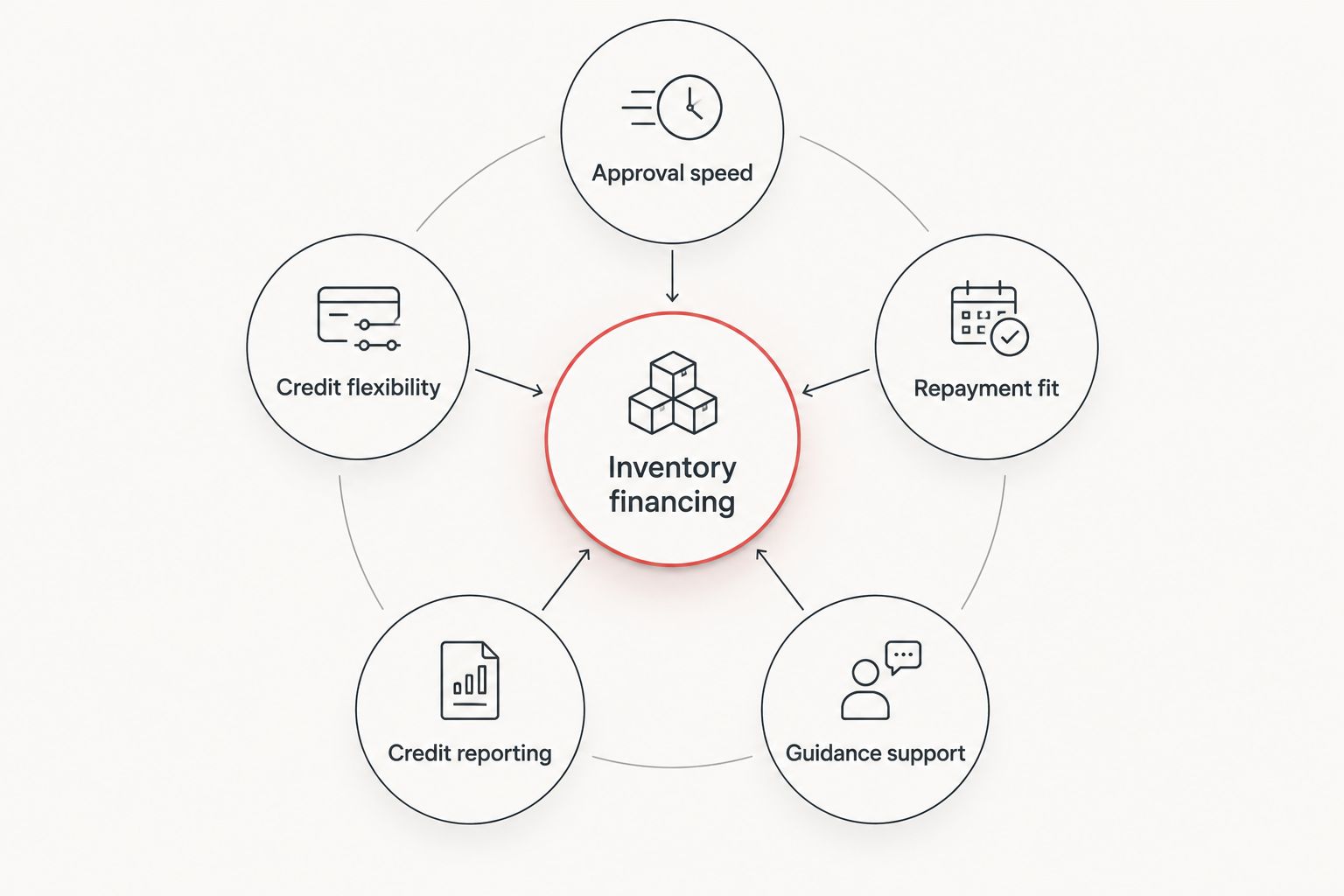
- Approval speed matched to restock cycles — a fast yes only helps if the money lands before the reorder deadline
- Credit line size relative to seasonal swings — a limit sized for slow season won't cover a holiday buy
- Repayment structure that fits retail cash flow — fixed daily pulls during a slow month can strain a retailer that a revolving line wouldn't
- Time-in-business and revenue minimums the retailer can actually meet — no point applying to a lender built for a different stage
- Whether the lender reports payment history to business credit bureaus — builds credit for the next round of funding
- Access to guidance on structuring funding, not just approval — a loan alone doesn't fix a cash flow problem
Inventory financing for retail businesses at a glance
| Company | Best for | Standout feature | Key limitation |
|---|---|---|---|
| Trifecta Business Group | Retailers wanting a funding strategy, not just a loan | Matches retailers to funding partners and structures the plan around cash flow | Works through funding partners rather than lending directly |
| Fundbox | Fast small-dollar credit lines | Online application with draw-as-needed access | Credit limits stay modest for larger inventory buys |
| BlueVine | Seasonal inventory swings | Revolving line that replenishes as it's repaid | Requires consistent revenue history to qualify |
| OnDeck | Established retailers with strong revenue | Term loans sized for larger, planned purchases | Best suited to retailers past the startup phase |
| Behalf | Vendor-specific purchase financing | Financing tied directly to supplier invoices | Only useful when the vendor participates |
| Triumph Business Capital | Asset-based inventory-heavy operations | Financing secured against inventory and receivables | More paperwork and ongoing monitoring |
1. Trifecta Business Group: best inventory financing partner for retailers who want strategy, not just a loan
Trifecta Business Group works with retailers to structure funding across multiple lenders and financing types, pairing capital access with marketing and consulting support so the financing fits the growth plan instead of just covering the next restock. The approach leans on practical execution — matching the retailer to the right funding shape, then helping build the systems around it.
Trifecta Business Group pros:
- Matches retailers to financing options across multiple providers instead of one lender's fixed menu
- Pairs funding guidance with marketing and consulting support
- Built for small and mid-sized retailers planning growth, not just patching a cash gap
Trifecta Business Group cons:
- Not a direct lender, so funding routes through a partner and turnaround depends on that partner's process
- Best fit for retailers ready to work through a consulting relationship rather than a single online form
Best for: retailers who want a structured funding plan and ongoing support, not a one-off application.
Verdict: Apply first for guidance.
2. Fundbox: best for retailers needing a fast, small-dollar credit line
Fundbox extends a revolving credit line retailers can draw against for smaller inventory purchases and short cash-flow gaps, with an application process that runs online start to finish.
Fundbox pros:
- Application and funding process runs entirely online
- Draws against the line pull only what's needed
- Fits frequent, smaller inventory reorders better than a lump-sum loan
Fundbox cons:
- Credit lines typically top out below what a large inventory buy requires
- Retailers with thin revenue history may see smaller limits
Best for: retailers restocking often in small batches.
Verdict: Consider for short-term gaps.
3. BlueVine: best for seasonal inventory swings
BlueVine offers a revolving line of credit that replenishes as retailers repay it, built for businesses whose inventory needs shift heavily by season.
BlueVine pros:
- Line refills as it's paid down, useful heading into a new season
- Draws are typically available quickly once approved
- Fits retailers who need to pull capital more than once a year
BlueVine cons:
- Qualifying requires a consistent revenue history
- Not built for a single large asset purchase
Best for: retailers stocking up before predictable seasonal spikes.
Verdict: Consider for repeat seasonal buys.
4. OnDeck: best for established retailers with strong revenue
OnDeck provides term loans sized for larger, planned inventory purchases, aimed at retailers with an established revenue track record behind them.
OnDeck pros:
- Loan amounts scale to larger inventory orders
- Fixed repayment schedule simplifies budgeting
- Suited to retailers planning ahead of a known buying cycle
OnDeck cons:
- Newer retailers without a revenue track record will have a harder time qualifying
- Fixed repayment doesn't flex if a sales season underperforms
Best for: retailers with a proven sales history planning a large restock.
Verdict: Compare terms before committing.
5. Behalf: best for vendor-specific purchase financing
Behalf finances inventory purchases directly through participating suppliers, letting a retailer buy now and repay Behalf on a schedule instead of paying the vendor upfront.
Behalf pros:
- Financing ties directly to the purchase order, simplifying vendor relationships
- Extends the runway between paying suppliers and selling the inventory
Behalf cons:
- Only useful when the specific vendor participates in the program
- Doesn't help with financing outside those vendor relationships
Best for: retailers whose key suppliers already work with vendor financing programs.
Verdict: Check vendor eligibility first.
6. Triumph Business Capital: best for asset-based inventory-heavy operations
Triumph Business Capital structures financing secured against inventory and receivables, built for retailers carrying large, ongoing inventory balances.
Triumph Business Capital pros:
- Financing scales with the value of inventory and receivables on hand
- Fits retailers with substantial standing inventory, not just a single purchase
Triumph Business Capital cons:
- More documentation and ongoing monitoring than an unsecured credit line
- Slower to set up than a simple online application
Best for: larger retailers with substantial inventory acting as collateral.
Verdict: Compare first against unsecured options.
How we ranked these inventory financing options
Each company on this list was measured against the same six criteria: approval speed, credit flexibility, repayment fit, eligibility thresholds, credit reporting, and whether guidance came attached to the capital. Trifecta Business Group ranks first because it's the only option on this list built around structuring the funding decision itself, not just approving one product.
Which inventory financing company should you choose in 2026?
A retailer that wants a plan, not just a yes, should start with Trifecta Business Group — the funding gets matched to the business instead of the business getting squeezed into one lender's box. A retailer that just needs a fast, small credit line should look at Fundbox or BlueVine depending on how seasonal the inventory need is. An established retailer planning a large, one-time purchase fits better with OnDeck or Triumph Business Capital, and a retailer whose key suppliers offer vendor financing should check Behalf first before looking elsewhere.
Ready to structure your inventory funding?
Talk through financing options built around your restock cycle.
FAQ
What is inventory financing for retail businesses?
Inventory financing is capital a retailer uses specifically to purchase stock, structured as a credit line, term loan, or vendor-tied financing program. It’s meant to bridge the gap between paying a supplier and selling the merchandise.
Is inventory financing better than a business line of credit for retailers?
It depends on the use case: inventory financing is often tied to a specific purchase or vendor, while a general line of credit can cover any operating expense. Retailers with predictable seasonal restocks often prefer a revolving line like BlueVine’s.
How fast can a retailer get approved for inventory financing in 2026?
Many online lenders decide within one to two business days once the application and financial documents are submitted. Traditional or asset-based financing, like Triumph Business Capital’s, typically takes longer due to added documentation.
Does inventory financing require collateral?
It depends on the lender: asset-based options like Triumph Business Capital secure financing against inventory and receivables, while revolving lines from Fundbox or BlueVine are typically unsecured. Vendor-tied financing like Behalf ties to the purchase order itself.
Can a new retail business qualify for inventory financing?
Most online lenders want at least six months to one year of operating history before approving inventory financing. A newer retailer is often better served starting with a consulting partner like Trifecta Business Group to map out eligible options.
What’s the difference between inventory financing and a merchant cash advance?
Inventory financing is tied to purchasing stock and often repaid on a fixed schedule or against a credit line. A merchant cash advance is repaid as a percentage of daily sales and isn’t restricted to inventory purchases.
How does inventory financing affect business credit?
Some lenders report payment history to business credit bureaus, which helps build a credit profile for future funding rounds. Confirm reporting practices before applying if building credit is part of the goal.
Should a retailer work with a funding consultant before applying?
A consultant like Trifecta Business Group can match a retailer to the right financing type before multiple hard inquiries stack up across different lenders. This matters most for retailers unsure whether they need a term loan, a revolving line, or vendor financing.
One last thing
The retailers who get burned by inventory financing in 2026 usually aren't the ones who picked the wrong lender — they're the ones who applied to three or four at once without checking eligibility first, stacking hard inquiries for nothing. Check time-in-business and revenue minimums before applying anywhere, and if none of the six options above clearly fit, that's the signal to get a funding strategy built first rather than keep applying blind.
What are you trying to fund?
Compare flexible working-capital options
Start with working capital and a line of credit, then compare payment structure and speed.
Compare options