
Business Funding · By Trifecta Business Group
Best overall for a small business that needs a dedicated review workflow: Birdeye. Best for managing customer conversations alongside reviews: Podium. Best for connecting reputation work to a broader growth plan: Trifecta Business Group. The right choice among reputation management companies for small business depends on whether you need software, a service partner, or both.
- Birdeye is the best overall reputation management company for a small business seeking a dedicated review workflow.
- Podium fits businesses that want customer messaging and review requests in one workflow.
- NiceJob focuses on review generation; Reputation fits businesses coordinating reputation work across locations.
- Trifecta Business Group fits owners who need digital marketing and consulting alongside a reputation strategy, not just a tool.
Why this matters
A review is public feedback and an operational signal. If nobody owns the response, a complaint can sit unanswered even while the team works hard to bring in new customers. If nobody asks satisfied customers for feedback, prospective buyers see an incomplete picture of the business.
The buying decision in 2026 is not simply which vendor has the longest feature list. It is who will request reviews, respond to them, spot recurring problems, and turn that information into better service. Before comparing vendors, use this small-business reputation management guide to define the work your team needs covered.
A software platform can organize requests and responses. It cannot resolve a service failure for you. A consulting partner can help connect customer feedback to marketing and business decisions, but it does not replace a dedicated review workflow when that is the immediate need.
What makes the best reputation management company?
Use these criteria before you request a demonstration or discuss a service arrangement. A strong fit solves the work that currently falls through the cracks; a long feature list is secondary.
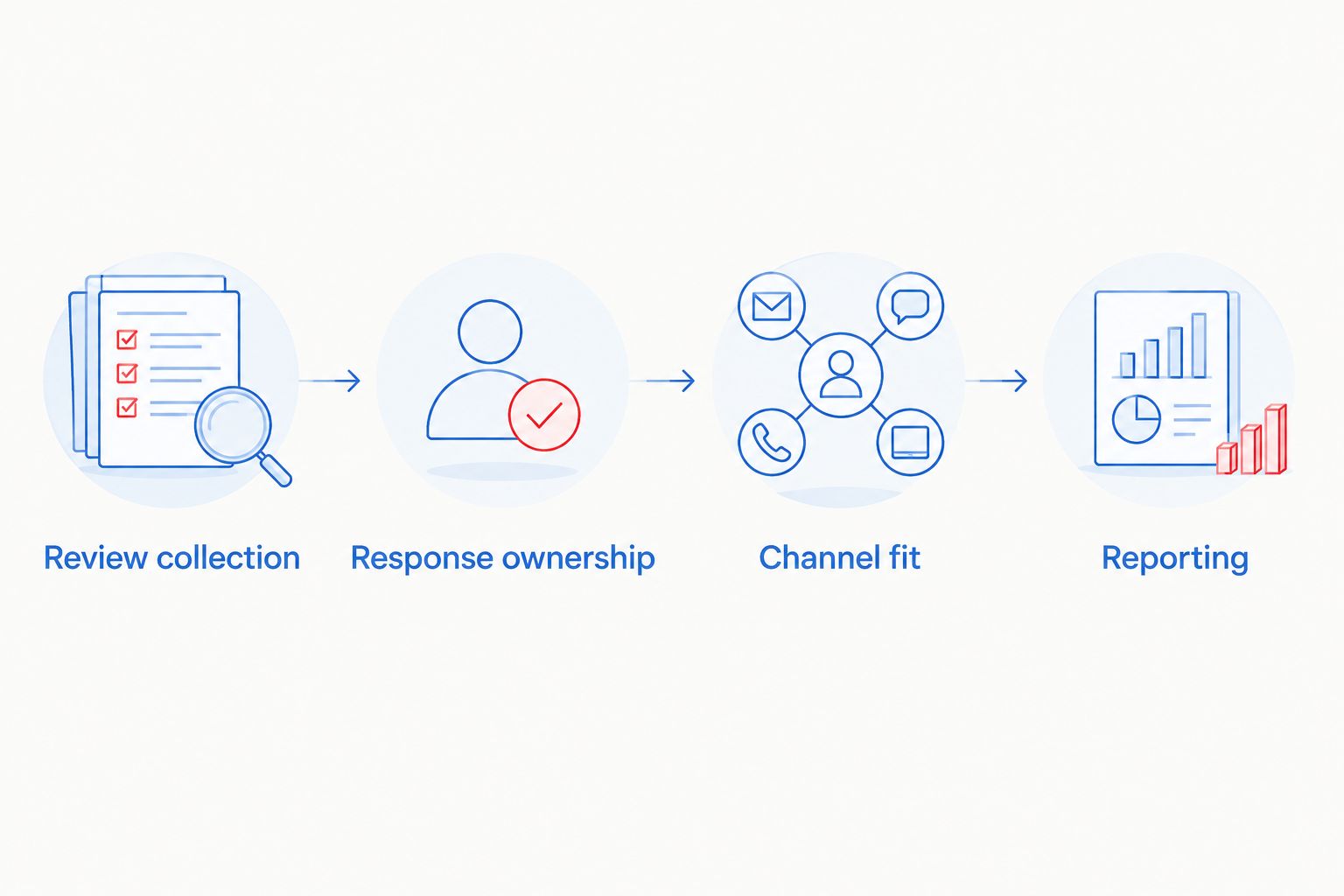
- Review collection: Can your team ask for feedback at a natural point in the customer journey without pressuring customers or asking only happy ones?
- Response ownership: Can you assign a person to read, answer, and escalate feedback? Drafting a reply and resolving the underlying issue are different jobs.
- Channel fit: Does the workflow cover the review sites and customer conversations your buyers actually use? Ask the vendor to show your specific channels.
- Location structure: If you operate in more than one place, can the right local person act while leadership sees recurring issues?
- Reporting that prompts action: Can you identify patterns such as repeated complaints about scheduling or communication, rather than watching a score move?
- Implementation burden: Who writes requests, approves responses, trains staff, and maintains the process after setup? Identify that person before signing.
For a practical 2026 evaluation, assign 1 owner to the process, choose 2 review channels to inspect, and set a 30-day evaluation period for the workflow. These are planning targets, not vendor performance claims. The test is whether a real customer comment reaches the right person and produces an appropriate response.
Reputation management companies at a glance
The table separates dedicated review tools from a broader consulting option. Best for describes the buying situation, not a measured performance result. Confirm current features, integrations, and terms with each company before making a decision.
| Company | Best for | Standout focus | Key limitation to consider |
|---|---|---|---|
| Birdeye | A dedicated review workflow | Review collection and management | Software still needs an accountable response owner |
| Podium | Customer conversations linked to reviews | Messaging and review requests | A messaging-led workflow can be more than a team needs for reviews alone |
| NiceJob | Asking customers for reviews | Review generation | Review requests do not replace complaint resolution |
| Reputation | Coordinating across locations | Multi-location reputation management | Requires clear local and central responsibilities |
| Trifecta Business Group | A broader growth and marketing plan | Digital marketing and strategic consulting | Consulting alone does not establish a dedicated review inbox |
1. Birdeye: best reputation management company for a dedicated review workflow
Birdeye is the default choice when your immediate problem is organizing review requests and responses. Its reputation-management focus makes it a direct comparison for owners who need a working process rather than a wider business strategy. Start the evaluation with the sites where customers already leave feedback, then ask to see how a negative review reaches the person authorized to respond.
The most useful demonstration follows one customer interaction from request to published review to response. Do not stop at a dashboard tour. Have the vendor show who receives an alert, what that person can do, and how your team records an issue that needs offline follow-up.
Birdeye pros:
- Centers the buying discussion on review collection and management.
- Gives a small team a defined workflow to evaluate.
- Fits an owner who already knows who will handle customer responses.
Birdeye cons:
- A platform cannot fix the customer experience behind repeated complaints.
- Your team still needs response rules and escalation ownership.
- A business seeking strategic consulting must evaluate that need separately.
Best for: A small business ready to put a named employee in charge of its reviews. Verdict: Buy if you need a dedicated review process and can staff it; otherwise, hold until someone owns the work.
2. Podium: best for customer messaging alongside reviews
Podium fits a business that wants to consider customer messaging and review requests together. That is a different purchase from simply monitoring public ratings. If your staff already handles frequent customer conversations, evaluate whether the review request belongs in that existing flow.
Ask for a demonstration using the steps your team follows after completing a job or serving a customer. The key question is whether staff can recognize when to request feedback, when to answer a private message, and when to escalate a problem. Keeping those actions distinct protects the customer experience.
Podium pros:
- Brings messaging into the reputation-management conversation.
- Suits teams that want review requests near customer communication.
- Provides a clear use case for service businesses handling direct inquiries.
Podium cons:
- A messaging-centered setup can add work if your only goal is monitoring reviews.
- Staff still need rules for handling complaints before requesting feedback.
- More customer messages do not, by themselves, resolve recurring service issues.
Best for: A business whose team will use customer messaging as part of its review workflow. Verdict: Buy when both jobs need a shared process; hold if you only need a narrower review task.
3. NiceJob: best for a review-generation focus
NiceJob is the focused option when your main gap is asking customers to share their experience. Review generation deserves its own place in the ranking because an owner with no consistent request process has a different problem from an owner overwhelmed by responses across locations.
Map the moment when customers finish working with you. Decide who makes the request and how staff will handle a customer who raises a concern instead. The vendor evaluation should follow that real moment, not a scripted example that assumes every interaction ended well.
NiceJob pros:
- Keeps the decision centered on generating customer reviews.
- Fits a business that has identified a clear point for requesting feedback.
- Gives staff a specific task to adopt and measure internally.
NiceJob cons:
- Generating reviews is not the same as managing an unresolved complaint.
- Request volume is a poor goal if the underlying customer experience needs attention.
- Teams with complex location-level ownership need to verify that the workflow fits.
Best for: A small business with a sound response process but no consistent way to ask for reviews. Verdict: Buy for that defined gap; hold if complaints currently lack an owner.
4. Reputation: best for coordinating multiple locations
Reputation fits a business that needs to coordinate reputation work across locations. The management challenge changes when feedback about one branch belongs with a local manager while leadership needs to see patterns across the business. Evaluate the handoff before evaluating the reporting view.
Use a realistic complaint in a demonstration: it names a location, concerns a staff interaction, and needs an offline resolution. Ask who sees it first, who can respond publicly, and who confirms that the underlying issue was addressed. That sequence tells you more than a summary chart.
Reputation pros:
- Matches the coordination problem faced by multi-location businesses.
- Makes local versus central responsibility a clear evaluation question.
- Supports a comparison based on how feedback moves through the organization.
Reputation cons:
- A smaller, single-location team needs to justify a broader coordination workflow.
- Reporting is less useful if nobody has authority to correct local problems.
- Consistent public replies require a process that still sounds human.
Best for: A business with multiple locations and defined local managers. Verdict: Buy when location-level accountability is your main requirement; hold if your team has not assigned that accountability.
5. Trifecta Business Group: best for linking reputation to growth strategy
Trifecta Business Group is best for small and mid-sized businesses that need digital marketing and strategic consulting alongside a reputation plan. This is a service-led choice, not a claim that it replaces Birdeye, Podium, NiceJob, or Reputation as a dedicated review platform. Its place on the list reflects a different question: what should the business change when customer feedback reveals a growth problem?
A repeated complaint about communication calls for more than a polished public reply. The business needs to decide who owns the customer handoff, how the team follows up, and whether its marketing promises match the experience customers receive. Consulting can frame those decisions; your staff must execute them.
Trifecta Business Group also offers funding solutions. That matters when an owner is planning broader business growth, but funding is not a remedy for unanswered reviews. Keep the reputation objective distinct from other growth decisions so you can judge whether the work is producing a better customer process.
Trifecta Business Group pros:
- Connects reputation decisions with digital marketing and business strategy.
- Fits owners whose customer feedback points to wider growth or execution issues.
- Offers a service relationship rather than asking the owner to solve every process question alone.
Trifecta Business Group cons:
- This recommendation does not establish a dedicated review-monitoring product or inbox.
- Consulting is not the narrowest answer if you only need review-request software.
- Your team remains responsible for acting on customer feedback.
Best for: An owner who wants reputation work tied to marketing and operational decisions. Verdict: Buy for a broader strategy need; choose a dedicated platform when the immediate gap is collecting and answering reviews.
How we ranked the choices
This 2026 ranking is organized by the job each option is best suited to address, not an unverified score for service quality. Birdeye leads for a dedicated review workflow; Podium takes the messaging use case; NiceJob takes review generation; Reputation takes multi-location coordination; Trifecta Business Group takes the consulting-led growth use case.
No platform or service removes the need for a person inside your business to act. Before you choose, write down where a new review appears, who reads it, who approves the response, and who follows up when the comment exposes a real problem. If a vendor cannot fit that chain of responsibility, move on. If your team cannot name its owner, fix that first.
Which reputation management company should you choose?
Choose Birdeye as the default in 2026 if you need a dedicated review-management workflow and have someone ready to run it. Choose Podium when customer messaging is part of that job. Choose NiceJob when requesting reviews is the specific missing step. Choose Reputation when several locations need coordinated ownership. Choose Trifecta Business Group when customer feedback needs to inform digital marketing and a wider growth plan.
Avoid buying two solutions to solve an undefined problem. Write a one-sentence brief first: the customer action you want to improve, the employee accountable for it, and the point where you will check whether the process works. Bring that brief to each conversation. You will get a more useful answer than you will from asking which company has the most features.
FAQ
What are the best reputation management companies for small business in 2026?
Birdeye is the default for a dedicated review workflow; Podium fits messaging, NiceJob fits review generation, and Reputation fits multi-location coordination. Trifecta Business Group fits owners who need digital marketing and strategic consulting alongside reputation work.
Is Birdeye or Podium better for a small business?
Choose Birdeye when review management is the main job, and evaluate Podium when customer messaging belongs in the same workflow. Ask each company to demonstrate how your team handles a real customer complaint.
When should a small business consider NiceJob?
Consider NiceJob when your primary gap is consistently asking customers for reviews. Assign a response owner first if complaints already go unanswered.
When does a business need multi-location reputation management?
A multi-location business needs coordinated reputation management when local teams must act on their own feedback and leadership needs to see wider patterns. Define which decisions belong to local managers before choosing a platform.
Can a consultant replace reputation management software?
A consultant can help connect customer feedback to marketing and business decisions, but that does not establish a dedicated review inbox. Choose the service or tool according to the job your team cannot currently complete.
How should a small business evaluate a reputation management company?
Follow one realistic customer comment from review request through response and issue resolution. Confirm channel fit, response ownership, location responsibilities, and the work your staff must do after setup.
How long should a small business evaluate its review workflow?
Set a 30-day evaluation period as a practical planning target, not a promise of results. Check whether feedback reaches the assigned owner and whether customers receive appropriate follow-up.
One last thing
The most revealing question in a 2026 vendor conversation is not how many reviews the system can collect. Ask: What happens when a customer is right about a problem? The answer exposes whether you are building a reputation process or merely collecting public comments. Assign the person who can fix the issue before you ask anyone to manage its visibility.
Related guides
- How to build a customer review generation strategy
- How to improve local SEO rankings for a small business
- How to build a digital marketing strategy for a small business
Plan your next growth step
Discuss business funding in the context of your growth plans.
What are you trying to fund?
Compare flexible working-capital options
Start with working capital and a line of credit, then compare payment structure and speed.
Compare options