

Business Funding · By Trifecta Business Group
Revenue-based financing companies structure repayment as a percentage of what a business actually brings in each month, which makes them a fit for companies with strong recurring revenue but no interest in giving up equity. Best overall: Lighter Capital. Best for SaaS founders: Founderpath. Best for ecommerce and DTC brands: Clearco. Best for early-stage startups with thin financial history: Corl. Best for venture-backed startups: Arc. Best for established B2B SaaS: SaaS Capital.
- Lighter Capital is the strongest all-around pick among revenue-based financing companies in 2026 for tech and SaaS businesses with recurring revenue.
- Founderpath and SaaS Capital both build underwriting around SaaS metrics like MRR and ARR, not personal credit.
- Clearco remains the go-to option for ecommerce brands funding inventory and ad spend cycles.
- Corl and Arc serve opposite ends of the startup spectrum: thin financial history versus venture-backed scale.
- Matching the right revenue-based financing company to your revenue model matters more than picking the biggest name.
Why this matters
Picking the wrong revenue-based financing company costs more than a declined application. It costs weeks of runway while you reapply somewhere else, and it can put unnecessary pressure on cash flow if the repayment structure doesn't match how your revenue actually moves month to month.
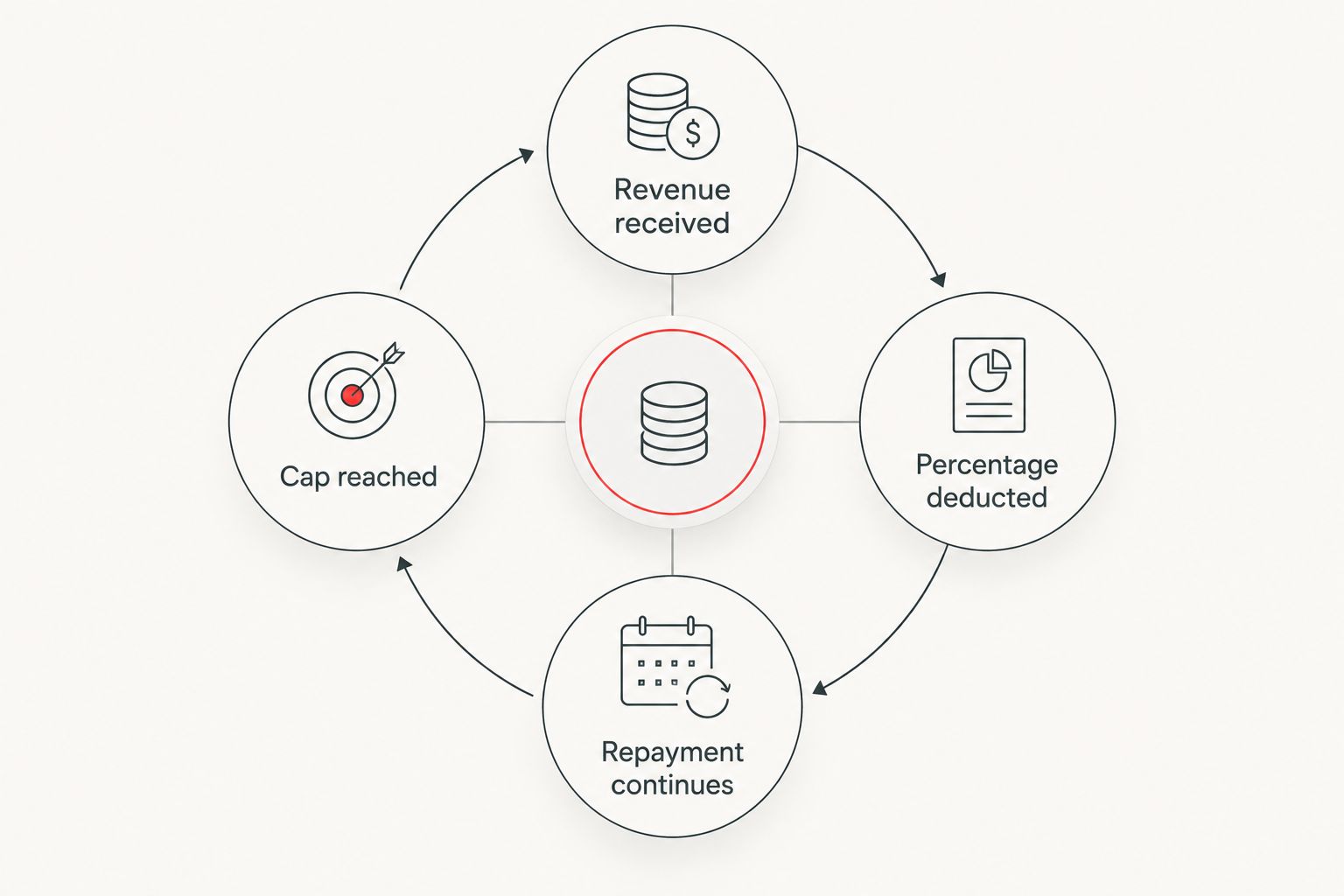
Most revenue-based financing agreements calculate repayment as a percentage of monthly revenue, commonly in the 2% to 10% range, until a repayment cap is reached. That cap is typically set between 1.3 and 3 times the amount funded. Those two numbers are the whole game: how much of your revenue disappears each month, and how much total you'll pay back before the agreement closes out.
Trifecta Business Group works with small and mid-sized companies to sort through funding options, including revenue-based financing, and match the structure to the business rather than the other way around. That's the lens behind this ranking: which companies fit which kind of revenue model in 2026, not which one has the loudest marketing.
What makes the best revenue-based financing company
- Revenue model fit — underwriting built around your industry's cash flow pattern (SaaS MRR, ecommerce sales cycles, service invoicing)
- Repayment cap clarity — a stated multiple on the funded amount, not a vague or shifting figure
- Speed to funding — how quickly an application moves from submission to a funding decision
- Minimum revenue and time-in-business thresholds — whether a newer or smaller business can qualify at all
- Flexibility during slow months — whether repayment scales down when revenue dips
- No equity requirement — the defining feature of revenue-based financing versus venture capital
Revenue-based financing companies at a glance
| Company | Best For | Standout Feature | Key Limitation |
|---|---|---|---|
| Lighter Capital | Tech and SaaS companies overall | One of the longest-running names in revenue-based financing, built specifically for recurring revenue businesses | Requires an established monthly revenue base, not a fit pre-revenue |
| Founderpath | SaaS founders wanting non-dilutive capital | Underwriting built around SaaS-specific metrics like MRR and churn | Narrow focus locks out non-SaaS businesses entirely |
| Clearco | Ecommerce and DTC brands | Funding tied directly to ad spend and inventory cycles common in online retail | Not built for service businesses without a product or ad-spend model |
| Corl | Early-stage startups with thin financial history | Data-driven underwriting that looks past traditional credit history | Funding amounts tend to run smaller for brand-new businesses |
| Arc | Venture-backed startups | Combines venture debt and revenue-based structures on one platform | Best suited to startups that have already raised institutional capital |
| SaaS Capital | Established B2B SaaS with predictable ARR | Underwriting benchmarked against annual recurring revenue | Not an option for consumer-facing or non-subscription businesses |
1. Lighter Capital: best revenue-based financing company overall
Lighter Capital funds technology and SaaS companies against monthly recurring revenue, structuring repayment as a fixed percentage of what comes in each month. It's built for businesses that already have revenue traction but don't want to trade equity for growth capital.
Lighter Capital pros:
- Deep focus on tech-enabled recurring revenue businesses
- Repayment scales down automatically in slower revenue months
- No board seats or equity dilution
- Established track record specifically in revenue-based financing
Lighter Capital cons:
- Requires meaningful existing monthly revenue to qualify
- Not a fit for hardware, retail, or pre-revenue companies
- Application process leans on financial documentation more than newer, streamlined competitors
Verdict: Buy. If your business runs on recurring tech revenue and you've got the financials to back it up, this is the strongest starting point among revenue-based financing companies in 2026.
2. Founderpath: best for SaaS founders wanting non-dilutive capital
Founderpath builds its underwriting entirely around SaaS metrics — MRR, churn, and growth rate — rather than personal credit history. It targets founders who want growth capital without giving up a board seat or equity stake.
Founderpath pros:
- Underwriting speaks the language of SaaS metrics directly
- No equity or board involvement
- Designed for founders who've been turned down by traditional lenders
Founderpath cons:
- Exclusively for SaaS; no fit for ecommerce, services, or physical product businesses
- Funding size tied tightly to current MRR, limiting upside for early-stage SaaS
Verdict: Buy if you run a subscription SaaS business. Skip if you don't.
3. Clearco: best revenue-based financing company for ecommerce and DTC brands
Clearco structures funding around the specific cash flow rhythm of ecommerce: inventory purchases, ad spend cycles, and seasonal sales swings. It's less a general-purpose lender and more a specialist for online retail.
Clearco pros:
- Funding tied directly to ad spend and inventory data, not just bank statements
- Fast decisions relative to traditional financing for ecommerce sellers
- No personal guarantee or equity requirement
Clearco cons:
- Narrow fit outside ecommerce and DTC
- Repayment structure assumes consistent sales velocity, which can strain seasonal businesses
Verdict: Buy for DTC and ecommerce brands with steady sales data. Hold if your revenue is highly seasonal without a clear pattern yet.
4. Corl: best for early-stage startups with thin financial history
Corl uses data-driven underwriting that looks beyond a standard credit file, which makes it more accessible to startups that haven't built years of financial statements yet.
Corl pros:
- More accessible underwriting for newer businesses
- No equity dilution
- Repayment tied to actual revenue performance
Corl cons:
- Funding amounts tend to run smaller than more established revenue-based financing companies
- Less brand recognition, which means more due diligence on your end before signing
Verdict: Wait if you're pre-revenue. Buy once you have a few months of consistent revenue to show.
5. Arc: best for venture-backed startups
Arc combines venture debt and revenue-based financing on a single platform, which suits startups that have already raised institutional capital and want additional runway without another equity round.
Arc pros:
- Flexibility between debt and revenue-based structures
- Built for startups with existing venture backing
- Faster access to capital between funding rounds
Arc cons:
- Best suited to startups with institutional investors already on the cap table
- Less relevant for bootstrapped small businesses
Verdict: Buy if you're venture-backed and bridging between rounds. Skip if you've never raised institutional capital.
6. SaaS Capital: best for established B2B SaaS with predictable ARR
SaaS Capital underwrites against annual recurring revenue benchmarks, targeting more mature B2B SaaS companies rather than early-stage startups.
SaaS Capital pros:
- Underwriting built specifically for B2B SaaS economics
- Larger funding amounts available to companies with established ARR
- No equity requirement
SaaS Capital cons:
- Not accessible to newer or smaller SaaS companies without meaningful ARR
- No fit outside subscription-based B2B models
Verdict: Buy for mature B2B SaaS. Skip for consumer or early-stage SaaS.
How this list was ranked
Each company was measured against the six criteria above: revenue model fit, repayment cap clarity, speed to funding, minimum revenue thresholds, flexibility during slow months, and whether equity ever enters the conversation. None of the six require giving up ownership, which is the baseline for calling something revenue-based financing rather than venture capital in disguise.
Which revenue-based financing company should you choose?
If you run a tech or SaaS business with steady recurring revenue, Lighter Capital is the default starting point in 2026. Ecommerce brands should look at Clearco first. Early-stage companies without years of financials should start with Corl, and venture-backed startups bridging between rounds fit better with Arc.
The harder question isn't which revenue-based financing company has the best reputation — it's which repayment structure your actual monthly revenue can absorb without straining operations. That's the piece most founders get wrong on their own.
Get matched with the right funding option
Talk to Trifecta Business Group about which funding path fits your revenue model.
FAQ
What is revenue-based financing?
Revenue-based financing is capital repaid as a fixed percentage of monthly revenue until a set repayment cap is reached, instead of fixed monthly loan payments. It doesn’t require giving up equity or a board seat.
Is revenue-based financing better than a business loan?
It depends on your cash flow pattern. Revenue-based financing repayment scales with revenue, which helps during slow months, while traditional loans carry fixed payments regardless of how business is performing that month.
How much can you get through revenue-based financing?
Funding amounts vary by provider and are typically tied to your recent monthly revenue or annual recurring revenue. Established SaaS and tech companies generally qualify for larger amounts than early-stage startups.
Which industries use revenue-based financing companies most?
SaaS, tech, and ecommerce businesses use revenue-based financing most often because their revenue is trackable and recurring, which makes underwriting straightforward for lenders like Lighter Capital and Clearco.
Is revenue-based financing hard to qualify for?
It’s generally easier to qualify for than a bank loan if you have consistent monthly revenue, but harder if you’re pre-revenue. Companies like Corl focus specifically on newer businesses with thin financial history.
Does revenue-based financing affect equity?
No. Revenue-based financing is structured as repayable capital, not an equity investment, so you keep full ownership of the business throughout the agreement.
How do repayments work with revenue-based financing?
Repayments are calculated as a percentage of monthly revenue, commonly between 2% and 10%, and continue until a repayment cap is met, typically 1.3 to 3 times the amount funded.
Can a small business work with a consultant to find the right revenue-based financing company?
Yes. Firms like Trifecta Business Group help match businesses to funding structures, including revenue-based financing, based on revenue pattern and growth goals rather than picking the first available option.
One last thing
The repayment cap matters more than the monthly percentage most founders fixate on. A lower monthly percentage stretched over a higher cap can cost more total than a higher percentage with a tighter cap — read the full agreement before comparing revenue-based financing companies on percentage alone.
What are you trying to fund?
Compare flexible working-capital options
Start with working capital and a line of credit, then compare payment structure and speed.
Compare options