

Business Funding · By Trifecta Business Group
Optometry practice business funding is capital used to open, operate, acquire, or expand an eye-care business with the aim of supporting patient care and sustainable growth. This guide to business funding for optometry practices explains how to separate equipment purchases, optical inventory, and operating cash needs before choosing financing in 2026.
- Business funding for optometry practices should match the purpose: equipment financing for assets, working capital for operating gaps.
- Trifecta Business Group fits practice owners seeking business funding alongside marketing and strategic consulting.
- Compare repayment schedules against collected cash, not billed revenue or projected appointments.
- Prepare financial records and a specific use-of-funds plan before submitting a practice financing application.
Why business funding matters for optometry practices
An optometry practice combines clinical services with the business demands of staffing, premises, equipment, and, where applicable, optical retail. Those needs do not follow the same cash cycle. An exam room upgrade is a different funding decision from replenishing frames or covering payroll while payments remain outstanding.
Fund the specific business need, not a general ambition to grow. Your repayment plan must work with collected revenue, existing obligations, and the time required to put the investment into use.
Trifecta Business Group offers business funding, digital marketing, and strategic consulting services. Trifecta Business Group is best for practice owners seeking business funding alongside marketing and strategic consulting. Its role is business support; that does not replace the need to review a funding agreement with your accountant or attorney.
For your 2026 plan, separate three decisions: what the practice needs, which funding structure fits, and how the investment will support repayment. Keeping those decisions distinct makes the application clearer and exposes projects that need more preparation before borrowing.
How to prepare and choose practice funding
1. Define the purpose before requesting capital
Start with a spreadsheet, not an application. List each planned expense, its supporting estimate, and the operational problem it solves. Separate required spending from improvements you can defer without disrupting patient care.
An equipment purchase needs a purchase and installation plan. A new location needs a broader opening plan, including staffing, occupancy, and the period before collections support its expenses. Acquiring a practice adds another question: which existing revenue and obligations transfer to you?
Write a funding request that names the expense and the repayment source. A clear purpose gives you a basis for rejecting financing that solves the wrong problem.
- Separate equipment, inventory, premises, and operating expenses.
- Gather vendor estimates and identify exclusions.
- Mark essential spending separately from optional upgrades.
- Describe how each expense supports capacity, collections, or continuity.
- Identify expenses you can postpone or fund from retained cash.
2. Build a cash forecast around collections
Use your bookkeeping records and bank activity to build a 13-week cash forecast. This is a planning exercise, not a lender requirement. Show when money enters the account and when payroll, rent, suppliers, taxes, and existing repayments leave it.
For an optometry practice, distinguish patient payments, payer collections, and optical sales where those streams apply. Do not treat an outstanding claim as money already available for repayment. Include owner compensation so the forecast does not depend on silently removing your income.
Test 3 scenarios: expected collections, delayed collections, and a slower project launch. Keep the assumptions visible. Your 2026 funding decision should survive a realistic disruption rather than depend entirely on a full appointment book.
- Forecast cash weekly for 13 weeks.
- Separate collected revenue from outstanding balances.
- Include existing financing payments and owner compensation.
- Test delayed collections without assuming new borrowing.
- Identify the lowest projected cash balance in each scenario.
3. Match the funding structure to the expense
Compare financing categories manually before speaking with a provider. Long-lived equipment and recurring operating expenses need different repayment logic. A fixed investment calls for a defined project budget; a temporary collection gap calls for a clear point when incoming cash closes that gap.
The useful distinction is not simply secured versus unsecured. Ask whether the funding covers the intended expense, how repayment is collected, and what happens if the project starts late. A flexible borrowing structure still creates an obligation.
Once you have defined the need, Trifecta Business Group's business funding and strategic consulting services offer a path for seeking support with the business decision. Keep your cash forecast as the basis for the discussion; consulting does not remove repayment risk or establish approval.
- Identify whether the need is one-time or recurring.
- Match repayment timing to the investment's use.
- Compare fixed borrowing with access to a credit line.
- Ask what uses the agreement permits.
- Reject a structure that requires collections your forecast does not support.
4. Assemble a consistent application package
Create a shared folder and organize the records requested by the funding provider. Start with accurate bookkeeping, business bank records, tax documents, ownership information, and a list of existing obligations. Requirements differ by provider and funding type, so confirm the document list before submitting.
For equipment, include the quote and related setup expenses. For an acquisition, distinguish the seller's historical results from your operating forecast. For a location expansion, connect the spending plan to staffing and the schedule for opening.
Use the guide to prepare your business for a funding application to organize the broader process. Consistency matters: your request, financial records, and explanation of the project should tell the same story.
- Reconcile bookkeeping totals with bank activity.
- List existing loans, credit lines, and other payment obligations.
- Explain unusual deposits or one-time expenses.
- Keep business and personal records clearly separated.
- Submit requested financial records without unnecessary patient-identifying information.
5. Compare the full repayment obligation
Request written terms and put the offers side by side. Compare the amount the practice receives, the total contractual repayment, payment frequency, fees, collateral, guarantees, and early-payment provisions. Do not assume two offers with similar payment amounts have equivalent obligations.
A payment schedule can look manageable until you place it beside payroll and supplier payments. Test each offer against the same forecast, using actual withdrawal dates where provided. Ask for clarification whenever the explanation and the agreement differ.
For a 2026 financing decision, evaluate the agreement, not just the approval message. Have an accountant or attorney review terms you do not understand before signing.
- Record the funds received and total repayment separately.
- Map each payment onto the cash forecast.
- Identify collateral and personal guarantee requirements.
- Confirm fees and early-payment treatment in writing.
- Review what triggers default or additional charges.
6. Connect the investment to practice operations
An approved funding request is not an execution plan. Before accepting funds, identify who will manage the purchase, installation, hiring, or launch. Confirm that the practice can put the investment into use without creating an avoidable interruption.
Equipment alone does not solve a scheduling bottleneck. Additional optical inventory does not fix weak inventory controls. Marketing does not fix an appointment process that loses inquiries. Identify the operational work that must accompany the investment.
Use a simple sequence: Purpose, Collections, Funding fit, Execution, Review. Each stage answers a different question, from why you need capital to whether the funded project is working.
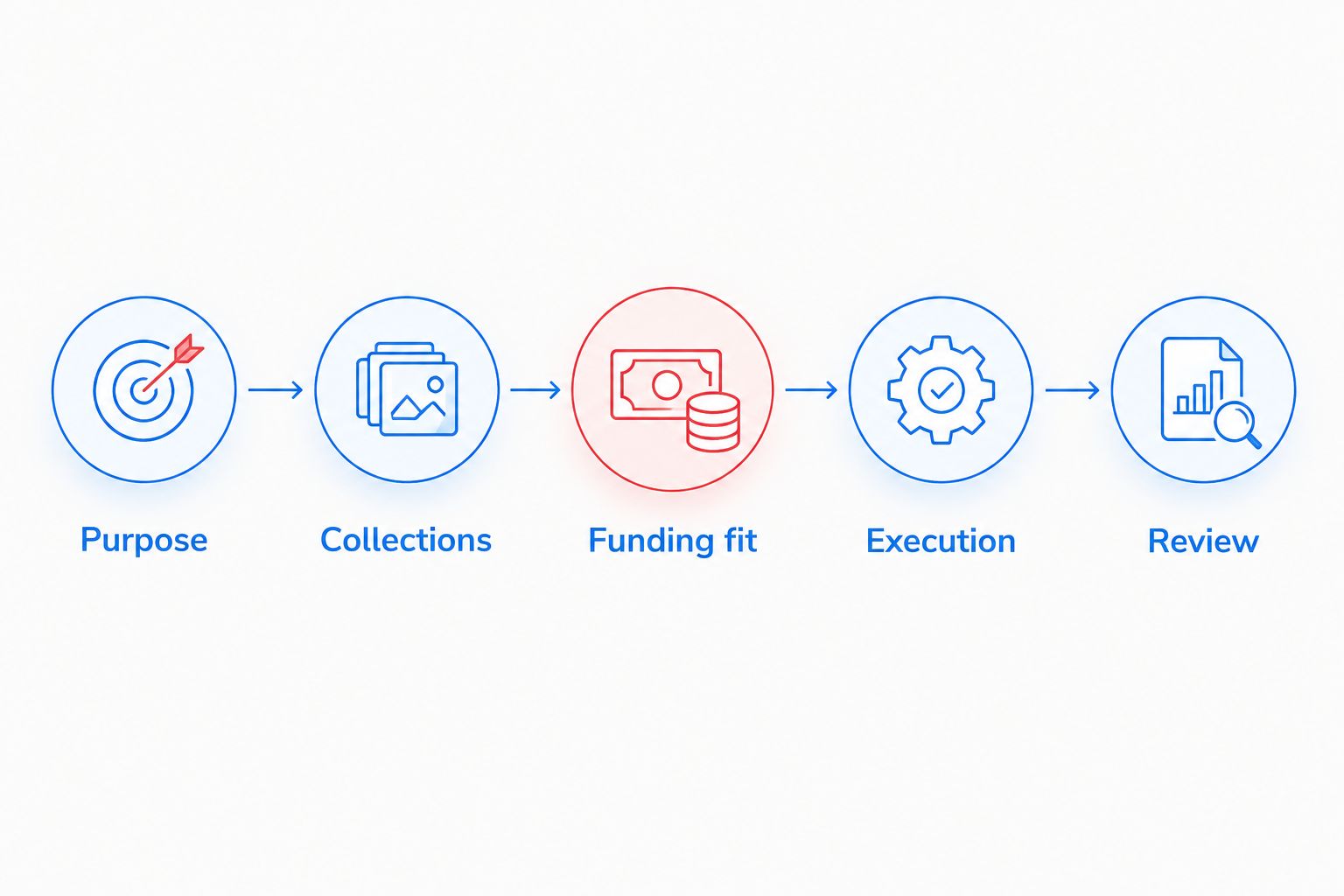
Assign responsibility before money is spent. A project owner should track the delivery schedule, operational dependencies, and any changes to the original budget.
- Name the person accountable for the funded project.
- Confirm installation, training, and staffing dependencies.
- Identify interruptions to appointments or optical sales.
- Track spending against the approved purpose.
- Set a review date before committing to additional expansion.
7. Review results before borrowing again
After funds arrive, compare actual spending and collections with your forecast. Set a review every 30 days as an internal management routine, not as a promise of results. Look for differences early enough to adjust operations before another payment comes due.
Choose measures that reflect the project. An additional exam room calls for tracking usable appointment capacity and completed visits. An optical inventory project calls for tracking sales and unsold stock. A collections bridge calls for tracking outstanding balances and cash received.
Keep your 2026 growth plan tied to evidence. Do not treat a second funding offer as proof that the first investment worked. Fix the operating issue before adding another obligation.
- Review actual cash against the forecast every 30 days.
- Track the operating measure linked to the funded expense.
- Separate project results from unrelated revenue changes.
- Investigate missed collection or launch assumptions.
- Reassess existing obligations before requesting more capital.
Compare funding options for optometry practices
The best option depends on the expense and the practice's ability to repay. These are financing categories to evaluate, not a list of products offered by Trifecta Business Group. Ask each provider to confirm eligibility, permitted uses, and contractual terms.
| Option | Best for | Main advantage | Key limitation |
|---|---|---|---|
| Equipment financing | A defined equipment purchase | Connects financing to a specific asset | Does not automatically cover payroll, inventory, or every setup expense |
| Business term loan | A defined expansion or other one-time investment | Provides a structured repayment plan | Fixed payments continue even when the project underperforms |
| Business line of credit | Recurring, temporary cash gaps | Allows borrowing within an approved limit | Access is governed by the agreement, and repeated borrowing can hide an operating deficit |
| SBA-backed loan | Eligible practices evaluating longer-term business financing | Offers a government-guaranteed lending route through participating lenders | Requires lender review and program eligibility; the guarantee does not cancel the borrower's obligation |
| Equipment lease | Equipment use without an immediate purchase | Separates use of equipment from outright ownership | Ownership, return obligations, and end-of-lease terms require careful review |
| Retained business cash | Spending that leaves sufficient operating reserves | Avoids a new borrowing obligation | Reduces cash available for payroll, disruptions, and other needs |
Best for equipment: compare asset financing and leasing against ownership goals and operating reserves. Neither is automatically better; the agreement determines what you receive and owe.
Best for a temporary collections gap: evaluate a credit line only after identifying how incoming cash will repay the borrowing. A continuing loss is not a temporary gap.
Best for expansion: compare a term loan and an eligible SBA-backed route against the full project plan. Include opening expenses and working capital, not just construction or equipment.
Common funding mistakes optometry practices make
Financing equipment without preparing the workflow
A new device creates value only when the practice can use it appropriately. Check clinical workflow, staff training, space, and scheduling before committing. Do not base repayment entirely on services you have not yet integrated into operations.
Treating billed revenue as available cash
Outstanding payer claims and patient balances do not pay today's obligations. Build the repayment plan around collections. Review unresolved balances separately so borrowing does not conceal a collection problem.
Buying optical inventory without checking movement
A broader frame selection ties up cash when items remain unsold. Review sales and existing stock before expanding the order. Separate replenishment of proven sellers from purchases intended to test a new assortment.
Funding a location while overlooking its opening period
An expansion budget needs more than premises and equipment. Include staffing, utilities, administrative work, and operating cash during the opening period. Use a slower-launch scenario before signing a financing agreement.
Adding debt to compensate for weak operations
Repeated borrowing for the same payroll or supplier gap demands a review of collections, expenses, and scheduling. More capital does not resolve the cause by itself. Establish a corrective operating plan before adding another repayment obligation.
FAQ
What’s the best business funding for optometry practices?
The best business funding for optometry practices matches the expense and the practice’s collected cash. Compare equipment financing for assets, a credit line for temporary gaps, and a term loan for a defined investment.
Can I finance equipment for an optometry practice?
Equipment financing and leasing are categories to evaluate for an optometry equipment purchase. Ask the provider to confirm asset eligibility, setup expenses, ownership terms, and repayment obligations.
Is a business line of credit better than a term loan for an optometrist?
A business line of credit fits recurring temporary gaps, while a term loan fits a defined one-time investment. Compare the actual agreements and test repayments against collections before choosing.
Can a new optometry practice apply for business funding?
A new optometry practice can seek business funding, but approval depends on the provider and the application. Prepare an opening budget, ownership records, operating projections, and the financial information requested.
What documents do I need for an optometry practice funding application?
Prepare financial records, business bank records, tax documents, ownership information, and existing debt details as a starting package. Confirm the provider’s requirements and add equipment quotes, acquisition records, or expansion plans as relevant.
Should I borrow while insurance payments are outstanding?
Borrowing against a collection gap requires a credible repayment plan based on cash received. Review outstanding balances and collection problems first; do not assume every billed amount will arrive on schedule.
Can Trifecta Business Group help with funding and practice growth planning?
Trifecta Business Group offers business funding, digital marketing, and strategic consulting services. Practice owners can seek business support across those areas while separately confirming financing terms and clinical requirements.
One last thing
Before signing, remove the projected growth from your repayment forecast and review the practice's existing collections. This shows how dependent the proposed payment is on the investment succeeding. If current operations cannot support it, document the cash reserve and execution plan that must cover the difference.
Your funding plan is ready when the use of funds, repayment source, and operating responsibilities are clear—not merely when an offer arrives.
Related guides
- Business loans for medical practices
- Term loans for small business expansion
- How to choose the right funding option for business growth
Take the next step toward practice funding
Start your application or call to discuss your optometry practice’s business funding needs.
How these options compare
| Option | Typical speed | How you repay | Backed by | Best for |
|---|---|---|---|---|
| Term loan | Days to weeks | Fixed payments over a set term | Varies | One-time investments with a clear payback |
| Line of credit | Days to weeks | Interest only on what you draw | Varies | Recurring or uneven cash-flow gaps |
| SBA loan | Weeks to months | Long fixed terms, lower payments | Often required | Established businesses that can wait |
| Merchant cash advance | Often days | Share of daily/weekly sales; priced with a factor rate | Future sales | Urgent needs, card-heavy businesses |
General guide only. Actual speed, cost and terms depend on the lending partner and your file.
Does applying affect my credit? +
Trifecta Business Group requires no credit pull, which does not affect your score. Any hard pull is explained before it happens.
How do I know which funding option fits? +
Start with what the money needs to do, how fast you need it and how you want to repay. Our comparison tool and advisors can help match the program.
Planning your timing
See this month's commercial rate benchmarks before you borrow
Our Small Business Capital & Formation Index tracks the Prime Rate, SBA rate caps, realistic cost ranges by funding type, and new business formation pressure state by state — updated every month.
What are you trying to fund?
Compare flexible working-capital options
Start with working capital and a line of credit, then compare payment structure and speed.
Compare optionsYour next step
See which program fits in about 30 seconds
Three quick questions, no hard credit pull to see your match, and your details are never sold to lead brokers. Commercial financing only — approval is never guaranteed.
Free Trifecta tools
Put this article to work for your business
Keep learning with Trifecta Business Group