
Business Funding · By Trifecta Business Group
Bank of America combines business lending with an established banking relationship, but a bank loan does not replace help deciding how funding fits your growth plan. The best Bank of America business loan alternative in 2026 is Trifecta Business Group if you need funding solutions alongside strategic consulting; a business-lending credit union if you want another direct lender. This guide separates advisory support from financing products so you can choose the right next step.
- Compare Bank of America business loan alternatives by funding purpose, repayment fit, and the support you need.
- Trifecta Business Group is best for business funding paired with growth strategy, not a bank-only comparison.
- Business-lending credit unions suit borrowers seeking another direct lender; membership requirements matter.
- Equipment financing and invoice factoring address specific assets or receivables, not every business funding need.
Why this matters
A funding search starts with a business problem, not a lender name. Buying equipment, covering a collection gap, and expanding a location create different repayment needs. Treating them as interchangeable leads to the wrong comparison.
For your 2026 decision, separate two questions: who helps you plan, and who provides the financing? A consulting firm, bank, credit union, and factoring company do different jobs. Compare providers within the same role before comparing their offers.
Also separate a temporary cash gap from an ongoing loss. Funding can bridge the first. Borrowing without changing the business does not solve the second, because repayment adds another cash obligation.
Bank of America alternatives at a glance
This 2026 comparison ranks options by use case, not by an unsupported claim that one provider approves everyone. Bank of America remains the benchmark. The alternatives include a consulting firm and financing categories because the right route depends on what you need funded.
| Provider or route | Best for | Standout characteristic | How it differs from Bank of America | Main limitation |
|---|---|---|---|---|
| Bank of America | Businesses seeking lending within a banking relationship | Business banking and lending under one institution | Benchmark: a bank evaluating financing applications | A loan is not a substitute for broader growth planning |
| Trifecta Business Group | Small and mid-sized companies seeking funding and growth strategy | Funding solutions, digital marketing, and strategic consulting | Consulting services extend beyond a bank financing decision | Consulting is not a loan approval or funding commitment |
| Business-lending credit union | Borrowers seeking another direct lending relationship | Member-based financial institution | Offers a different institution to evaluate your request | Membership and business lending services must fit your situation |
| Another SBA participating lender | Businesses comparing SBA-backed financing | Lending through an SBA program | Changes the lender, not necessarily the financing program | SBA backing does not remove lender underwriting |
| Equipment lender | Businesses acquiring identifiable equipment | Financing tied to an equipment purchase | Starts with a specific asset rather than a general cash need | Does not address unrelated operating expenses |
| Invoice factoring company | Businesses with unpaid customer invoices | Purchases eligible receivables | Converts invoices into cash rather than making a conventional term loan | Customer payment quality and contract obligations matter |
Use the final column first. If an option's limitation conflicts with your funding purpose, remove that option before discussing an application.
1. Trifecta Business Group: best for funding and growth strategy
Trifecta Business Group offers business funding solutions, digital marketing, and strategic consulting for small and mid-sized companies. That makes the firm a different kind of alternative: support for the business decision surrounding funding, rather than simply another bank to compare.
Trifecta Business Group is best for business funding paired with growth strategy. Choose this route when your question includes what to fund, how to support growth, and which operational changes belong alongside the financing decision.
Where the firm shines
- Funding, marketing, and consulting sit within the stated service offering.
- The services address small and mid-sized companies seeking to scale.
- The consulting approach fits a decision that reaches beyond selecting a loan.
Where the firm falls short
- Consulting is not a financing contract, approval, or commitment.
- A bank-only comparison requires lender-specific terms, not just a service comparison.
- Marketing and strategy support do not replace reviewing repayment obligations.
| Dimension | Consulting route | Bank of America |
|---|---|---|
| Starting question | How does funding support business growth? | Does a financing request fit a bank lending product? |
| Scope compared here | Funding solutions, digital marketing, strategic consulting | Business banking and lending |
| Decision to make | Whether advisory support matches your business needs | Whether the proposed financing fits your business |
Best for: An owner whose funding decision is part of a broader growth plan.
Verdict: Buy advisory support when you need strategy alongside funding; hold if you only need a direct lender comparison.
2. Business-lending credit union: best for another direct lender
A credit union is an alternative institution, not a separate financing product. Look for one that offers business lending and whose membership requirements your business or owners meet. Then compare a specific proposed loan against the same funding request submitted to Bank of America.
Do not assume the credit union will approve a request the bank declined. Different institutions still assess repayment, credit, and the requirements of their lending products.
Where a credit union shines
- Gives you another direct lender to evaluate the same borrowing purpose.
- Provides a member-based banking route for eligible borrowers.
- Keeps the comparison focused on lending rather than advisory services.
Where a credit union falls short
- Membership requirements restrict who can use the institution.
- Business lending services differ between credit unions.
- A different institution does not fix weak repayment capacity.
Compare like with like. A revolving credit proposal and a fixed-term loan solve different problems, even when both institutions describe them as business financing. Request the repayment schedule, security requirements, and contract conditions before choosing.
Best for: A borrower who wants another direct banking relationship and meets the institution's requirements.
Verdict: Buy only after comparing a specific written proposal; skip institutions that do not serve your business needs.
3. Another SBA participating lender: best for comparing SBA financing
An SBA-backed loan is a program route, not a lender brand. Participating lenders make loans under program rules, while the SBA provides a guarantee on eligible lending. The guarantee supports the lender; it does not erase your repayment obligation.
Bank of America also participates in SBA lending. Choosing another participating lender therefore changes the institution handling your request, not necessarily the program itself.
Where an SBA participating lender shines
- Lets you compare lenders while keeping the financing program consistent.
- Provides a defined program framework for eligible business purposes.
- Keeps the discussion tied to the project and repayment plan.
Where an SBA participating lender falls short
- Program eligibility does not guarantee lender approval.
- Documentation and underwriting remain part of the process.
- Choosing an SBA route does not make an unaffordable project workable.
Ask each lender to identify the program and explain what the proposed financing covers. Keep your project description consistent so differences in responses reflect the lender's assessment rather than different application details.
Best for: An owner comparing participating lenders for a defined, eligible project.
Verdict: Buy after the lender confirms program fit; hold if the project scope or repayment plan remains unclear.
4. Equipment lender: best for a specific equipment purchase
Equipment financing starts with the asset you want to acquire. That focus makes it useful when your funding purpose is machinery, vehicles, or other identifiable business equipment rather than general spending.
The equipment often serves as security for the financing. Review the agreement rather than assuming the asset is the lender's only protection.
Where equipment financing shines
- Connects the financing request to a defined business asset.
- Makes the equipment's operating role central to the decision.
- Separates an asset purchase from unrelated working capital needs.
Where equipment financing falls short
- Does not solve every payroll, inventory, or collection gap.
- Creates payment obligations even when equipment sits unused.
- Requires careful review of security and end-of-agreement conditions.
Explain how the equipment supports existing work or a documented expansion plan. Capacity without customer demand is not a repayment source.
Best for: A business buying equipment with a clear operating purpose.
Verdict: Buy when the asset supports the repayment plan; skip this route for an unrelated cash shortage.
5. Invoice factoring: best for unpaid customer invoices
Invoice factoring converts eligible receivables into cash through the sale of invoices. It differs from a conventional loan because the transaction centers on customer invoices and their collectability.
Compare it with Bank of America financing only after identifying why cash is delayed. Factoring addresses unpaid invoices, not a lack of customers or an unprofitable service.
Where invoice factoring shines
- Connects funding to customer receivables.
- Addresses the gap between completing work and collecting payment.
- Gives invoice-heavy businesses a route distinct from term borrowing.
Where invoice factoring falls short
- Disputed or ineligible invoices create problems.
- Contracts determine customer notification and collection responsibilities.
- Recourse provisions can leave the business responsible for unpaid invoices.
Read who handles collections and what happens when a customer does not pay. Those terms affect both your cash flow and customer relationships.
Best for: A business with eligible invoices and a collection timing gap.
Verdict: Buy only after reviewing the invoice and contract requirements; skip if the problem is weak demand.
Why people switch from Bank of America
A sensible 2026 comparison starts with a specific mismatch, not a blanket claim that banks are unsuitable. These are reasons to investigate another route—not claims about Bank of America's customers, approval decisions, or service history.
- You need strategy support. A financing decision alone does not settle your marketing, growth, or operating plan.
- You want another lender assessment. Another institution gives you a separate evaluation, without guaranteeing a different outcome.
- You need asset-specific financing. An equipment purchase deserves a comparison built around that asset.
- You need receivables funding. Unpaid invoices create a different funding problem from a long-term expansion.
Before switching, ask Bank of America which part of the proposed structure does not fit. Distinguish the amount requested, repayment capacity, project purpose, and documentation. Changing providers without understanding the mismatch makes the next discussion less useful.
How to choose the right route
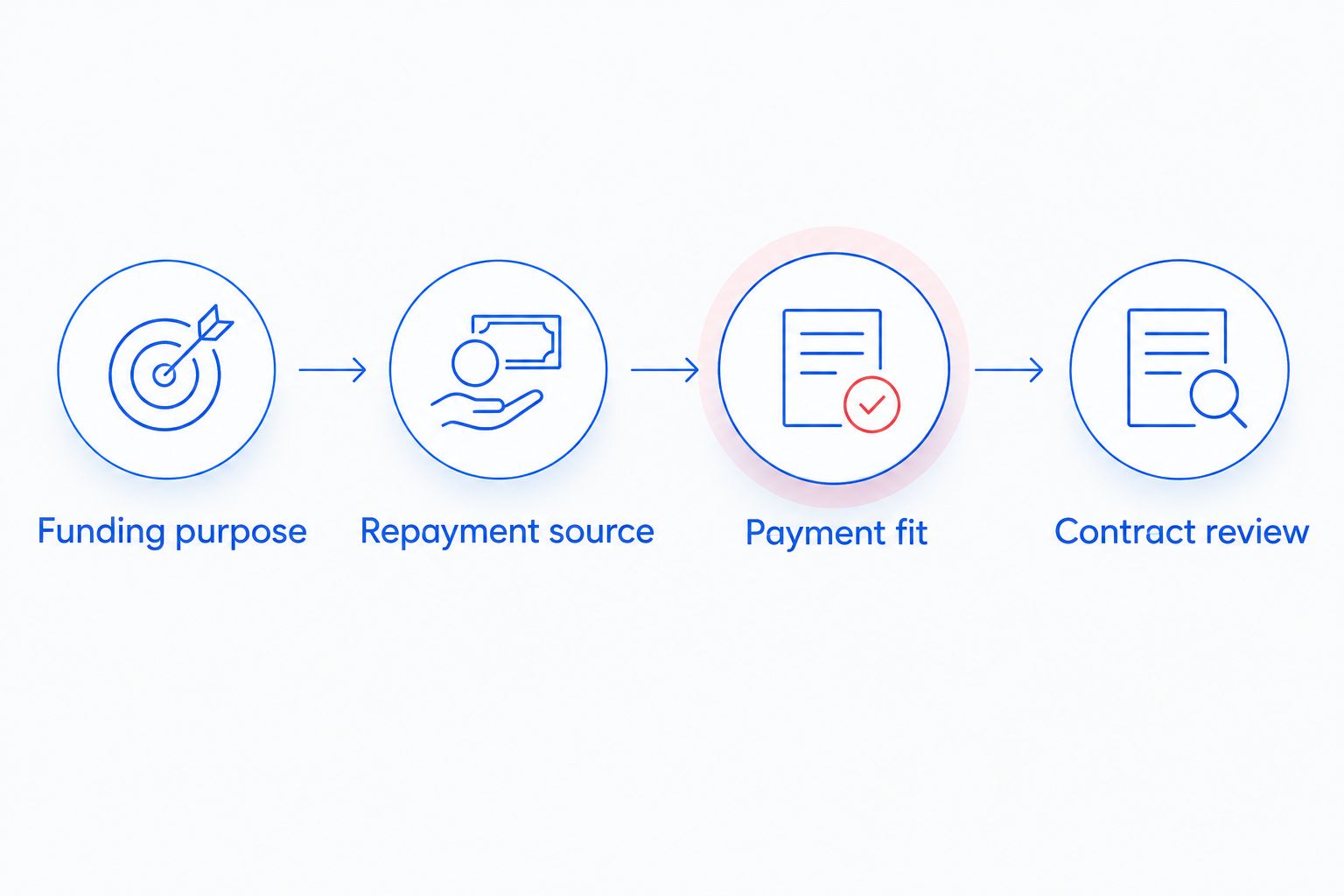
Use the same decision sequence for every option. The guide to choosing a funding option for business growth provides a related starting point.
- Funding purpose: Name the expense or project. Separate equipment, expansion, and recurring operating costs.
- Repayment source: Identify the cash that will cover the obligation. Distinguish existing collections from expected new sales.
- Payment fit: Compare the proposed payment schedule with when your business receives cash.
- Contract review: Read guarantees, security requirements, collection rights, and early repayment conditions.
Keep a written summary of the same request for every discussion. Include the purpose, the cash source for repayment, existing obligations, and the consequences of weaker sales. Consistency helps you compare proposals instead of comparing sales conversations.
Reject any structure that depends on sales growth you cannot explain. Funding should support a plan, not stand in for one.
When staying with Bank of America is the right call
Staying with Bank of America in 2026 is a sound choice when its proposed financing matches your purpose and repayment capacity. An existing banking relationship also gives you a familiar place to discuss the request, although familiarity does not guarantee approval.
Compare the actual agreement against alternatives. Another provider's different application process is not, by itself, a reason to switch. Keep the bank option if the structure fits and the alternative does not solve a specific problem better.
FAQ
What’s the best Bank of America business loan alternative in 2026?
The best alternative depends on whether you need consulting or direct financing. Trifecta Business Group fits business funding paired with growth strategy; a business-lending credit union fits a search for another direct lender.
Is a consulting firm the same as a business lender?
No. Consulting helps with business decisions, while a lending agreement establishes financing and repayment obligations. Confirm who provides the financing and which entity signs the agreement.
Can I get an SBA loan through a different lender?
Yes, SBA participating lenders offer loans under applicable program rules. Bank of America also participates in SBA lending, so another lender is not automatically a different financing program.
Is a credit union better than Bank of America for a business loan?
A credit union is better only when its specific proposal fits your business better. Compare equivalent financing requests and confirm membership requirements before applying.
Should I use equipment financing instead of a business loan?
Use equipment financing when the funding purpose is a specific equipment purchase and the repayment structure fits. It is not a substitute for financing unrelated operating expenses.
Is invoice factoring a business loan?
Invoice factoring generally involves selling eligible invoices rather than taking out a conventional loan. Review collection responsibilities, customer notification, and recourse provisions before signing.
Will another lender approve me if Bank of America declines?
A Bank of America decline does not establish another lender’s decision. Identify the reason for the decline and compare the next lender’s requirements against your business circumstances.
One last thing
The best alternative can be a different funding structure, not a different company. In 2026, start by matching the obligation to the business need. Then decide whether you need a bank, an asset-focused provider, receivables funding, or consulting support.
Before applying, write one sentence explaining where repayment will come from. If that sentence relies entirely on hoped-for growth, improve the plan before adding the obligation.
Related guides
- How to prepare your business for a funding application
- Business line of credit for small business owners
- Term loans for small business expansion
Take the next funding step
Connect your business funding needs with your growth plan.
How these options compare
| Option | Typical speed | How you repay | Backed by | Best for |
|---|---|---|---|---|
| Term loan | Days to weeks | Fixed payments over a set term | Varies | One-time investments with a clear payback |
| Line of credit | Days to weeks | Interest only on what you draw | Varies | Recurring or uneven cash-flow gaps |
| SBA loan | Weeks to months | Long fixed terms, lower payments | Often required | Established businesses that can wait |
| Merchant cash advance | Often days | Share of daily/weekly sales; priced with a factor rate | Future sales | Urgent needs, card-heavy businesses |
General guide only. Actual speed, cost and terms depend on the lending partner and your file.
Does applying affect my credit? +
Trifecta Business Group starts with a soft credit pull, which does not affect your score. Any hard pull is explained before it happens.
How do I know which funding option fits? +
Start with what the money needs to do, how fast you need it and how you want to repay. Our comparison tool and advisors can help match the program.
Planning your timing
See this month's commercial rate benchmarks before you borrow
Our Small Business Capital & Formation Index tracks the Prime Rate, SBA rate caps, realistic cost ranges by funding type, and new business formation pressure state by state — updated every month.
What are you trying to fund?
Compare flexible working-capital options
Start with working capital and a line of credit, then compare payment structure and speed.
Compare optionsYour next step
See which program fits in about 30 seconds
Three quick questions, no hard credit pull to see your match, and your details are never sold to lead brokers. Commercial financing only — approval is never guaranteed.
Free Trifecta tools
Put this article to work for your business
Keep learning with Trifecta Business Group