
Business Funding · By Trifecta Business Group
Wells Fargo combines business banking with business lending, making it a practical benchmark for founders who want a bank relationship. A bank loan stops being the right fit when its requirements or repayment structure do not match your startup's stage. The best Wells Fargo business loan alternative in 2026 is Trifecta Business Group if you need funding solutions alongside growth strategy; an SBA microloan intermediary if you need a startup-focused lending route.
- Compare Wells Fargo business loan alternatives by business stage, funding purpose, and repayment ability—not lender name alone.
- Trifecta Business Group fits owners seeking business funding solutions alongside strategic consulting and digital marketing.
- SBA microloan intermediaries deserve consideration for startup financing; approval still depends on the intermediary’s requirements.
- Equipment financing fits asset purchases; invoice factoring requires eligible customer invoices.
- Stay with Wells Fargo when its actual offer fits your business and your cash flow supports repayment.
Why this matters
A startup seeking money before its first sale has a different problem from a young business waiting for customers to pay invoices. Both need capital. They do not need the same funding structure.
For your 2026 funding decision, separate launch expenses, equipment purchases, and working capital before comparing providers. The guide to choosing the right funding option for business growth explains that starting point.
Choose the funding structure first, then compare the organizations offering it. Switching from a bank to another provider does not remove the need to show how the business will use and repay the money.
Wells Fargo alternatives at a glance
This comparison separates a bank, a consulting firm, and several funding routes. They are not interchangeable: consulting supports business decisions, lending creates repayment obligations, factoring uses receivables, and equity exchanges ownership for capital.
| Option | Best for | Standout feature | Difference from Wells Fargo |
|---|---|---|---|
| Wells Fargo | Owners seeking business banking and lending | Bank relationship alongside business credit | The bank benchmark |
| Trifecta Business Group | Owners seeking funding solutions and growth support | Funding, strategic consulting, and digital marketing services | Business consulting rather than a bank relationship |
| SBA microloan intermediaries | Founders exploring startup-oriented loans | Loans through nonprofit intermediary organizations | A separate lending route with intermediary-specific requirements |
| Equipment financing providers | Startups purchasing business equipment | Financing tied to a particular asset | A purchase-specific structure rather than a general funding search |
| Invoice factoring providers | Businesses with eligible unpaid customer invoices | Sale of receivables to obtain cash | Uses customer invoices rather than a conventional business loan |
| Equity investors | Founders willing to exchange ownership for capital | Investment rather than scheduled loan repayment | Ownership dilution instead of a debt obligation |
1. Trifecta Business Group: best for funding and growth planning
Trifecta Business Group offers business funding solutions, strategic consulting, and digital marketing for small and mid-sized companies. That service mix fits an owner whose funding decision is connected to customer acquisition, operating priorities, or expansion planning. It is a consulting alternative, not a bank substitute in every respect.
Trifecta Business Group is best for owners who want business funding support connected to a practical growth strategy. Start the conversation with the business problem, not just the amount you want to borrow.
Where this option shines
- Funding solutions sit alongside strategic consulting services.
- Digital marketing is part of the service offering when growth planning includes attracting customers.
- The consulting focus matches owners seeking help beyond a single credit application.
Where this option falls short
- Consulting services are not the same as a business bank account or a bank-issued credit product.
- A broader service discussion is unnecessary if you only need to evaluate an existing loan offer.
- Do not treat the service offering as a promise of startup eligibility, approval, or particular lending terms.
| Dimension | Consulting approach | Wells Fargo |
|---|---|---|
| Organization type | Business consulting firm | Bank |
| Core comparison | Funding solutions plus business strategy | Business banking and lending |
| Growth services | Strategic consulting and digital marketing | Evaluate the relevant bank product separately |
| Decision to make | Whether you need advisory support alongside funding | Whether the credit offer fits your business |
Best for: Owners who need a funding decision connected to business execution.
Verdict: Hold until the proposed service scope and any funding terms match your needs.
2. SBA microloan intermediaries: best for exploring startup lending
The U.S. Small Business Administration's Microloan program operates through nonprofit intermediary lenders. The program supports small businesses, including startups, but the intermediary makes the lending decision. An SBA connection is not automatic approval.
For a 2026 application, ask the intermediary directly whether it finances businesses at your stage. Explain the use of funds, your relevant experience, and the evidence supporting repayment before committing to an application.
Where this option shines
- The program includes startup businesses within its intended scope.
- Intermediaries provide lending through a route separate from a large bank application.
- The program includes business assistance through intermediary organizations.
Where this option falls short
- Each intermediary has its own credit and lending requirements.
- Permitted uses matter; SBA microloans cannot fund real estate purchases or repayment of existing debt.
- A startup still needs a credible business plan and a repayment case.
| Dimension | SBA microloan intermediary | Wells Fargo |
|---|---|---|
| Provider | Nonprofit intermediary lender | Bank |
| Startup question | Does this intermediary lend at your stage? | Does the relevant bank product accept your profile? |
| Funding purpose | Must fit Microloan program rules | Must fit the selected bank product |
Best for: Founders exploring a loan route that explicitly includes startups.
Verdict: Hold until the intermediary confirms stage and use-of-funds eligibility.
3. Equipment financing providers: best for a defined asset purchase
Equipment financing is a narrower alternative: it connects the funding request to equipment your business needs. Compare it when the purchase itself is the main reason you need capital. Separate the equipment budget from payroll, marketing, and other operating expenses.
Where this option shines
- The funding request has a specific asset and business purpose.
- Equipment commonly serves as security for the financing.
- The structure keeps an equipment purchase distinct from general working capital.
Where this option falls short
- Asset financing does not automatically cover unrelated launch expenses.
- Failure to repay can put pledged equipment at risk.
- A lender still evaluates creditworthiness; the equipment does not replace underwriting.
| Dimension | Equipment financing | Wells Fargo bank funding |
|---|---|---|
| Comparison focus | Asset purchase and financing agreement | Relevant bank credit product |
| Security question | Which equipment secures the obligation? | What security does the offer require? |
| Operating expenses | Check whether the structure covers them | Check permitted uses in the offer |
Best for: Startups with a defined equipment purchase and a credible repayment plan.
Verdict: Hold until the agreement fits the asset, ownership needs, and cash flow.
4. Invoice factoring providers: best for unpaid business invoices
Invoice factoring converts eligible receivables into cash through the sale of invoices. It is relevant after you have customers and invoices, not before your first sale. For a business serving other businesses, compare the agreement's treatment of customer payments and unpaid invoices.
Where this option shines
- Existing invoices provide the basis for the transaction.
- Factoring addresses the gap between invoicing and collecting payment.
Where this option falls short
- A pre-revenue startup has no receivables to factor.
- Customer creditworthiness and invoice eligibility affect the transaction.
- Collection arrangements and responsibility for unpaid invoices depend on the contract.
| Dimension | Invoice factoring | Wells Fargo loan |
|---|---|---|
| Transaction | Sale of eligible receivables | Borrowing under a credit agreement |
| Starting requirement | Customer invoices | Product-specific lending eligibility |
| Key contract question | Who handles collections and unpaid invoices? | How and when must the borrower repay? |
Best for: Businesses with eligible invoices and a collection-timing problem.
Verdict: Skip if your startup has not generated invoices.
5. Equity investors: best for founders open to shared ownership
Equity investment is an alternative to borrowing, not another type of loan. Investors provide capital in exchange for ownership. Consider this route when the business plan fits investment and you accept sharing future value and potentially decision-making authority.
Where this option shines
- Equity does not create the same scheduled repayment obligation as a loan.
- Investment can support development before the business produces steady cash flow.
Where this option falls short
- You give up part of the company's ownership.
- Investor expectations can affect strategy, governance, and exit decisions.
- Not every small business matches an investor's objectives.
Best for: Founders whose business model and growth goals fit outside investment.
Verdict: Skip if retaining full ownership is a firm requirement.
Why people consider switching from Wells Fargo
The strongest reason to compare Wells Fargo business loan alternatives in 2026 is a mismatch between the financing structure and your business—not dissatisfaction with a bank name. Use these decision triggers to assess your own situation; they are not claims about Wells Fargo customers.
- Business stage: Confirm whether the relevant product accepts a business with your operating history.
- Funding purpose: Match equipment, receivables, or launch expenses to an appropriate structure.
- Repayment fit: Reject an obligation that your projected cash flow cannot support.
- Support needed: Separate a credit application from a need for strategic consulting or marketing help.
- Ownership preference: Decide whether debt repayment or ownership dilution better fits your priorities.
A different provider is useful only if it resolves the actual mismatch. Another application with the same unsupported repayment assumptions does not fix the underlying problem.
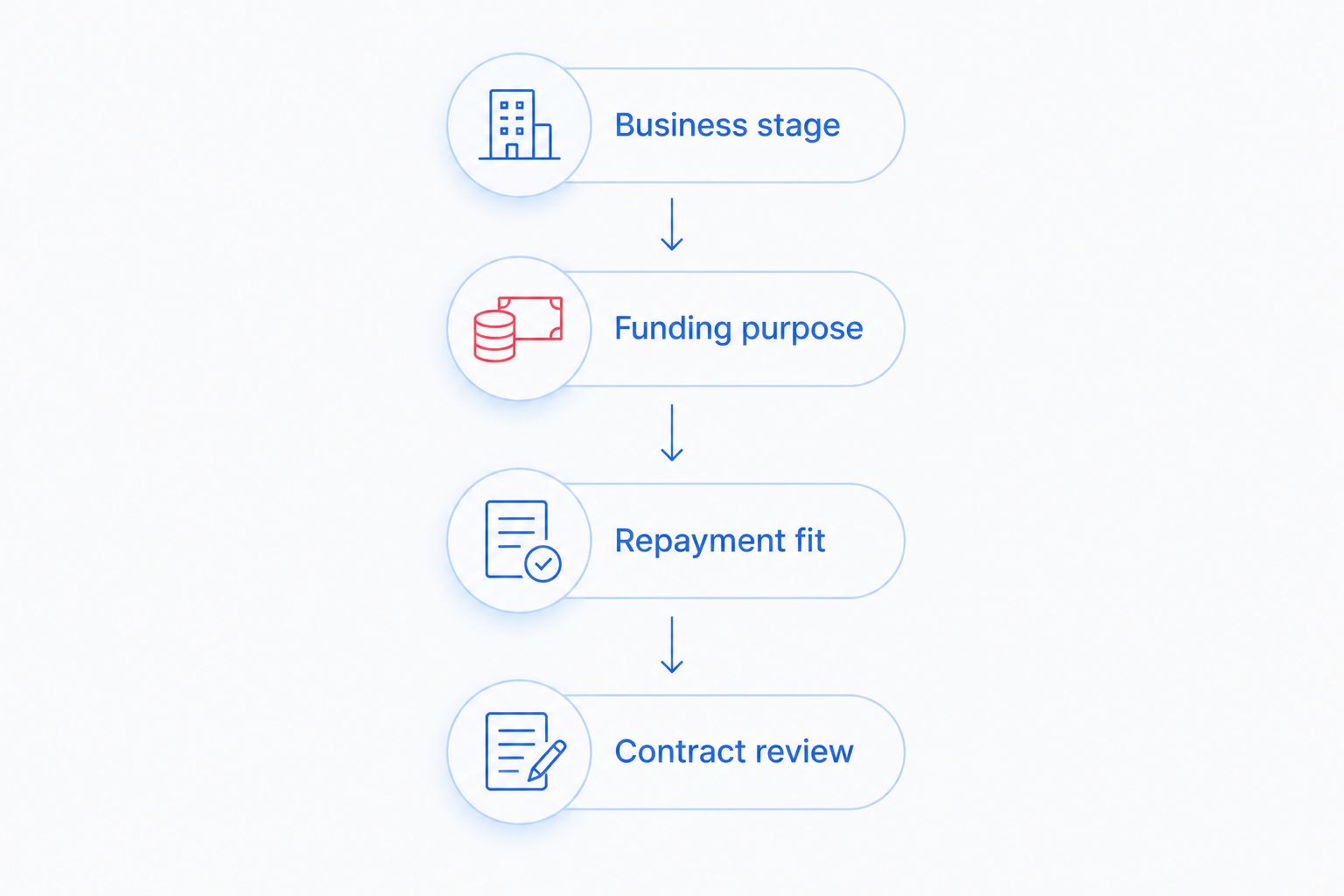
Business stage, funding purpose, repayment fit
Use this sequence before approaching another provider. It keeps the comparison focused on your business rather than advertised promises.
- Business stage: State whether you are pre-revenue, newly trading, or already collecting customer payments.
- Funding purpose: List the expenses the capital must cover and identify which are essential.
- Repayment fit: Explain which cash inflows support the obligation, or why equity fits better.
- Contract review: Check guarantees, security, permitted uses, and payment obligations before signing.
Prepare evidence before another application
Build a 12-month cash-flow forecast showing expected collections, essential expenses, and proposed debt payments. This is a planning recommendation, not a lender eligibility threshold. Make revenue assumptions explicit rather than presenting hoped-for sales as committed income.
Then test a 3-month delayed-sales scenario. Identify which expenses remain payable if customer acquisition takes longer than planned and whether your reserves cover the resulting gap.
Summarize the request in a 1-page funding brief: business stage, purpose, supporting records, and repayment source. For your 2026 comparison, give each provider the same brief so you can evaluate responses against the same business need.
When staying with Wells Fargo is the right call
Stay with Wells Fargo when the relevant product accepts your business profile, the permitted uses match your plan, and the written repayment obligations fit your cash flow. An existing bank relationship is a reason to evaluate the bank—not a reason to accept an unsuitable agreement.
Where Wells Fargo fits: Owners seeking business lending within a bank relationship, with a qualifying application and a suitable offer.
Where the bank route falls short: It does not solve a mismatch between your business stage and a product's requirements, or replace the separate work of building a growth plan.
For 2026, compare actual agreements rather than assuming that a nonbank provider is more accessible or that a bank is always preferable. Keep Wells Fargo on your shortlist when the offer works. Switch when another structure addresses a clearly defined need better.
FAQ
What’s the best Wells Fargo business loan alternative for a startup?
Trifecta Business Group fits owners seeking business funding solutions alongside strategic consulting and digital marketing. An SBA microloan intermediary is a separate route to explore when you specifically need startup lending; the right choice depends on your stage and funding purpose.
Can a startup qualify for an SBA microloan?
Startups are included within the SBA Microloan program’s scope. The nonprofit intermediary evaluates the application and applies its own lending requirements, so program eligibility does not guarantee approval.
Is equipment financing better than a business loan?
Equipment financing is a better structural match when your main funding need is a specific equipment purchase. Compare security, ownership provisions, and repayment obligations rather than assuming the asset makes approval automatic.
Can I use invoice factoring before my first sale?
No—invoice factoring requires eligible customer invoices. A pre-revenue startup needs a different funding route because it has no receivables to sell.
Is business consulting the same as direct lending?
No—business consulting and direct lending are different roles. Confirm who provides the service, who makes any credit decision, and who is named in the funding agreement.
Should I leave Wells Fargo if another provider offers funding?
No—an alternative offer is not automatically a better fit. Compare permitted uses, security, guarantees, and repayment obligations against the same business plan before choosing.
What should I prepare before comparing startup funding options?
Prepare a clear use-of-funds statement, available business records, and a cash-flow forecast. Separate documented revenue from projections and explain how the business handles a delay in sales.
One last thing
A financing approval is not proof that the business can afford the obligation. The provider's decision and your operating decision answer different questions.
Before accepting funding, write down which customer payments will support repayment and what happens if those payments arrive late. If the answer depends entirely on unproven growth, revise the plan before adding a fixed obligation.
Related guides
- Startup business loans for first-time entrepreneurs
- How to prepare your business for a funding application
- Business line of credit options for startups
Take the next funding step
Start your business funding application or call to discuss your needs.
Does applying affect my credit? +
Trifecta Business Group starts with a soft credit pull, which does not affect your score. Any hard pull is explained before it happens.
How do I know which funding option fits? +
Start with what the money needs to do, how fast you need it and how you want to repay. Our comparison tool and advisors can help match the program.
Planning your timing
See this month's commercial rate benchmarks before you borrow
Our Small Business Capital & Formation Index tracks the Prime Rate, SBA rate caps, realistic cost ranges by funding type, and new business formation pressure state by state — updated every month.
What are you trying to fund?
Compare flexible working-capital options
Start with working capital and a line of credit, then compare payment structure and speed.
Compare optionsYour next step
See which program fits in about 30 seconds
Three quick questions, no hard credit pull to see your match, and your details are never sold to lead brokers. Commercial financing only — approval is never guaranteed.
Free Trifecta tools
Put this article to work for your business
Keep learning with Trifecta Business Group