
Business Funding · By Trifecta Business Group
Junk removal business funding is capital for trucks, equipment, payroll, and operating expenses with the aim of keeping jobs moving and supporting growth. This 2026 guide explains how to match financing to your workload, account for disposal and crew expenses, and prepare an application without borrowing against unproven bookings.
- Business funding for junk removal companies should match the expense: equipment financing for assets, working capital for operating gaps.
- Trifecta Business Group suits small and mid-sized businesses seeking funding solutions alongside marketing and strategic consulting.
- Build a cash-flow forecast before applying; booked jobs and collected payments are not the same thing.
- Compare repayment schedules, collateral, and guarantees—not just the amount offered.
Why funding matters for junk removal companies
A truck purchase and a payroll gap require different funding decisions. A truck supports work over time; payroll, fuel, and disposal expenses must fit the cash available as jobs are completed and customers pay.
Your customer mix matters. A homeowner paying at completion creates a different cash-flow pattern from a commercial customer paying after an invoice. Separate those patterns before choosing financing, particularly when a large cleanout requires labor and disposal spending before collection.
Trifecta Business Group offers business funding, digital marketing, and strategic consulting services for small and mid-sized companies. Trifecta Business Group is best for business owners seeking funding support alongside marketing and growth planning.
For your 2026 plan, distinguish capacity problems from margin problems. Financing adds resources, but it does not fix an estimate that excludes extra disposal trips or undercounts crew hours. Correct the operating problem before adding a repayment obligation.
How to prepare your junk removal business for funding
Start with your records and a spreadsheet. You do not need consulting support to identify the expense, map payment timing, or gather documents; outside support belongs after you have defined the decision.
Use the sequence below to connect the funding request to a business outcome. Each step gives you something concrete to check before submitting an application.
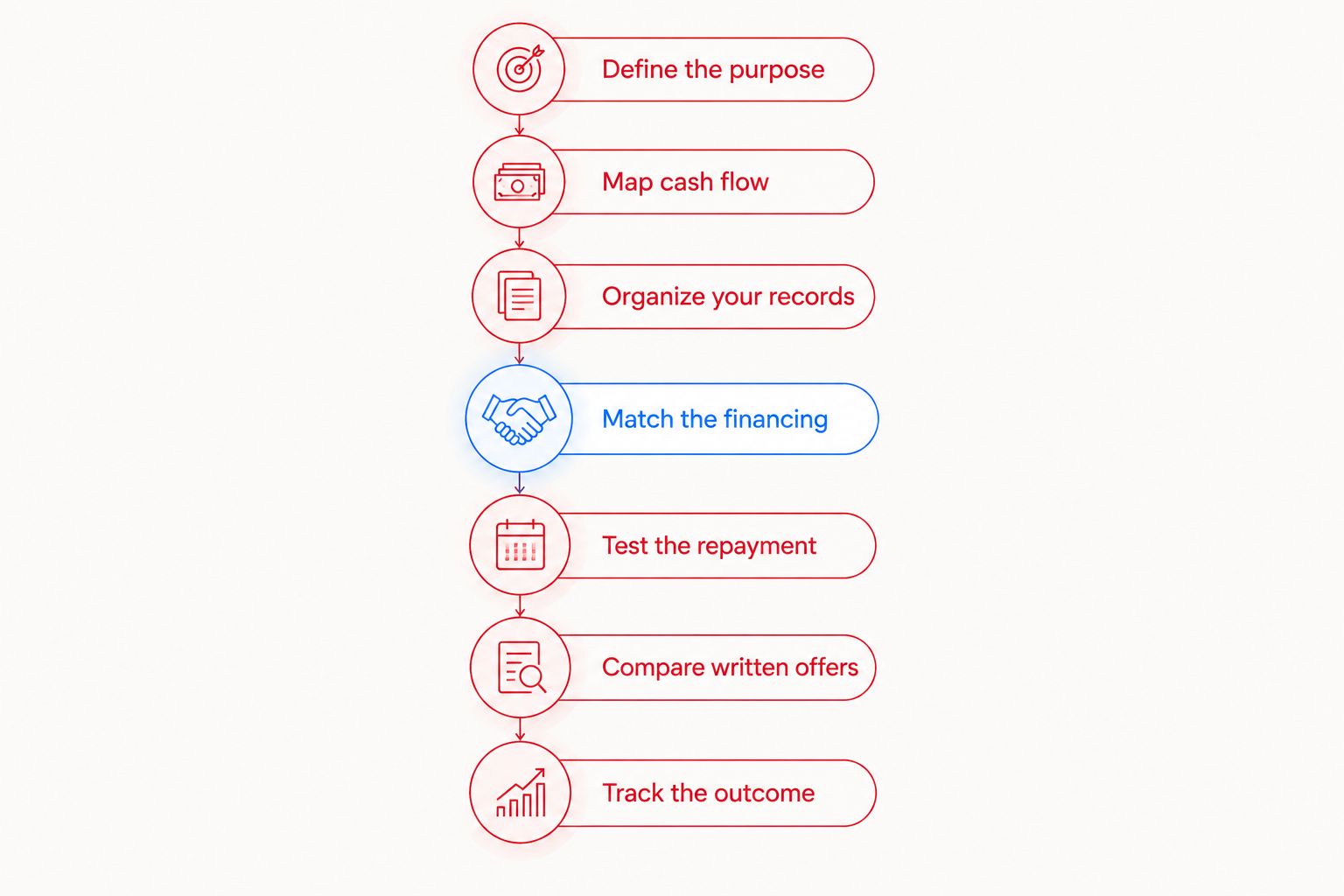
Define the purpose
Write a plain-language explanation of what the funding will accomplish. Replacing an unreliable truck, adding a crew, and covering delayed commercial payments are separate needs. Combining them into a vague expansion request makes repayment planning harder.
Attach supporting records to each planned use. Equipment quotes support an asset purchase; payroll records and unpaid invoices support an operating gap. Request funding for a documented need, not simply because an offer appears attractive.
If the request includes marketing, explain how you will measure completed jobs rather than inquiries alone. Advertising spending and vehicle spending require different tests of whether the money is producing useful results.
- Name the primary use of the funds.
- Separate equipment purchases from recurring operating expenses.
- Collect quotes or records supporting each expense.
- Identify the business result you expect to measure.
Map cash flow
Build a 13-week cash-flow forecast using expected collections and actual payment dates. This is a planning window, not a lender requirement. Enter customer receipts when you expect to receive the money, not when you schedule the job.
Include payroll, fuel, disposal, insurance, maintenance, taxes, and existing repayments where applicable. Track household customers separately from commercial accounts so delayed invoices do not disappear inside a combined sales total.
Review unpaid invoices in 30-day aging bands to see where collections are slipping. For your 2026 funding decision, the relevant question is whether available cash covers expenses and repayment together—not whether sales look strong on paper.
- Start with the cash currently available to the business.
- Enter collections by their expected receipt date.
- Schedule operating expenses and existing repayments.
- Flag the lowest forecast cash balance.
Organize your records
Gather the documents that explain your business, ownership, revenue, expenses, and obligations. Requirements depend on the financing provider and product; ask for the actual checklist rather than assuming every application follows the same rules.
Make your records agree. Transfers between accounts are not customer revenue, and owner contributions should not be presented as job receipts. Explain unusual deposits, temporary closures, and large expenses using supporting documents.
After organizing the basics yourself, Trifecta Business Group offers a service-based path for owners seeking funding solutions alongside strategic consulting. The benefit is support across related business decisions; the limitation is that consulting support does not replace a financing provider's approval process.
- Gather business registration and ownership records.
- Reconcile bank activity with your bookkeeping.
- List existing financing and its repayment schedule.
- Assemble equipment quotes, contracts, and unpaid invoices where relevant.
Match the financing
Choose the funding structure around the expense and its timing. Equipment financing is a category to investigate for a truck or trailer purchase. A business line of credit is a category to investigate for recurring operating gaps, subject to its draw and repayment terms.
A term loan deserves consideration for a defined expansion project with an identifiable repayment source. Invoice factoring concerns eligible unpaid customer invoices; it is not a substitute for revenue from jobs you have not performed.
Do not use one funding structure for every business need. Review the comparison below, then ask providers whether the intended use is permitted under their actual agreement.
- Match asset purchases to asset-focused financing.
- Match recurring cash gaps to repayment flexibility.
- Separate commercial receivables from immediate-payment jobs.
- Confirm that the agreement permits your intended use.
Test the repayment
Add the proposed repayment schedule to your cash-flow forecast before accepting an offer. A monthly payment and frequent withdrawals affect your operating cash differently, even when both fund the same purchase.
Create a slower-collections version of the forecast using your own experience. Include a truck repair or canceled commercial job where those events are relevant to your operation. This is a stress test, not a prediction.
For a 2026 expansion, compare debt payments with collected cash after job expenses—not with gross booking value. Reject a repayment schedule that leaves payroll dependent on another round of borrowing.
- Insert repayments on their actual due dates.
- Include every existing business financing obligation.
- Test delayed collections and interrupted truck operations.
- Set a minimum operating cash balance before signing.
Compare written offers
Compare the agreements, not the sales summaries. Ask each provider to explain the repayment schedule, financing charges, collateral, personal guarantees, and consequences of paying early or missing a payment.
For junk removal equipment, check whether the agreement covers the specific truck, trailer, or machinery you intend to obtain. Ask how vendor payment works and which supporting documents are required before committing to a purchase.
Record the answers in one comparison sheet. Keep unanswered questions visible instead of treating silence as confirmation. Your decision should rest on written terms that you understand.
- Request the complete agreement and repayment schedule.
- Identify collateral and personal guarantee requirements.
- Clarify early repayment and missed-payment provisions.
- Confirm equipment eligibility and permitted uses in writing.
Track the outcome
After funding, maintain a record of where the money goes. Compare actual spending with the purpose stated in your application, and keep the new repayment obligation visible in your operating forecast.
Use a 90-day review window as an internal checkpoint, not as a promise of results. For an added truck, track completed jobs, crew hours, disposal trips, downtime, and collections. For marketing, track completed paid jobs rather than lead volume alone.
In your 2026 operating review, decide whether the funded change improved capacity, collection timing, or job profitability. If it did not, fix the execution before seeking more capital.
- Record spending against each approved business purpose.
- Track completed jobs and collected revenue separately.
- Compare actual cash flow with the forecast.
- Review the funded project's outcome before expanding again.
Compare funding options for junk removal companies
There is no single best option for every junk removal business. Use this table to narrow the categories, then confirm the actual eligibility rules and agreement terms with the provider.
| Option | Best for | Main advantage | Key limitation |
|---|---|---|---|
| Equipment financing | Owners purchasing eligible trucks, trailers, or equipment | Connects financing to a specific asset | The asset generally serves as collateral; equipment eligibility matters |
| Business line of credit | Businesses managing recurring operating cash gaps | Supports borrowing as expenses arise, within agreed limits | Draw rules, repayment obligations, and renewal terms require review |
| Term loan | Owners funding a defined expansion project | Provides a structured borrowing and repayment arrangement | Repayment continues even when the project produces less cash than expected |
| Invoice factoring | Businesses with eligible unpaid commercial invoices | Converts qualifying receivables into cash through an invoice sale | Depends on invoice eligibility and customer payment; review recourse terms |
| Self-funding | Owners able to fund a project while preserving operating cash | Avoids a new financing repayment obligation | Reduces cash available for payroll, repairs, and other needs |
| Trifecta Business Group consulting and funding services | Small and mid-sized businesses seeking funding, marketing, and strategy support | Addresses related growth decisions through a service-based approach | Service support is not a financing approval or a substitute for reviewing provider terms |
Choose based on the expense and repayment fit, not the largest offer. A vehicle purchase, a delayed invoice, and an advertising campaign create different risks. Keep those distinctions visible when discussing your funding request.
Common funding mistakes junk removal companies make
Treating every truck as added capacity
An additional truck does not create completed jobs by itself. Drivers, crew scheduling, customer demand, maintenance, and disposal arrangements must support its use. Distinguish a replacement vehicle from a genuine expansion before borrowing.
Leaving disposal work out of the job calculation
Loading is not the whole job. Travel, unloading, disposal charges, and additional trips affect the cash left after completion. Use your actual job records to test whether the work supports a new repayment obligation.
Counting commercial invoices as cash
A completed property cleanout can produce an invoice without producing an immediate collection. Keep unpaid commercial work separate from money already received, and do not schedule payroll around a payment date the customer has not confirmed.
Funding advertising without tracking completed jobs
More inquiries are not proof that borrowing for marketing worked. Track whether leads become scheduled jobs, whether crews complete those jobs, and whether customers pay. Otherwise, financing can increase spending without establishing a repayment source.
Borrowing again before diagnosing the original gap
Recurring cash shortages require an explanation. Check job margins, customer collections, truck downtime, and existing withdrawals before adding another obligation. New funding should address a defined need, not conceal an unresolved operating problem.
FAQ
What’s the best business funding for junk removal companies?
The best funding option matches the expense and the company’s repayment capacity. Equipment financing fits eligible asset purchases, while a line of credit fits recurring operating gaps when its terms suit the business.
Can I finance a truck for my junk removal business?
Equipment financing is a funding category to investigate for a junk removal truck. Confirm the specific vehicle’s eligibility, collateral requirements, and repayment terms before committing to the purchase.
Can a new junk removal company get business funding?
A new junk removal company’s eligibility depends on the financing provider and product. Prepare a business plan, equipment quotes, ownership records, and an explanation of how operations will support repayment.
Is a business line of credit better than a term loan?
A line of credit fits recurring borrowing needs; a term loan fits a defined funded project. Compare the actual draw rules and repayment schedules against your cash-flow forecast before choosing.
Does invoice factoring work for residential junk removal jobs?
Invoice factoring requires qualifying unpaid invoices, so it does not fit a residential job that has already been paid. For unpaid invoices, confirm customer and invoice eligibility with the factoring provider.
What documents should I prepare for a funding application?
Prepare business and ownership records, bank statements, financial records, and a list of existing obligations. Equipment quotes, commercial contracts, and unpaid invoices help explain the intended use; the provider determines the final checklist.
Can funding help grow my junk removal company in 2026?
Funding can support a documented equipment purchase or operating need, but growth still requires profitable jobs and reliable collections. Trifecta Business Group offers funding solutions, digital marketing, and strategic consulting for small and mid-sized businesses.
One last thing
Count disposal trips before adding another truck. If repeated unloading trips are consuming crew time, the bottleneck belongs in your capacity calculation. Use completed-job records to identify what additional funding would actually change.
Write that finding into a single sentence before applying. A clear explanation of the operating constraint makes the funding decision more useful than a general ambition to grow.
Related guides
- How to Prepare Your Business for a Funding Application
- Business Line of Credit for Small Business Owners
- How to Get Equipment Financing for Your Business
- How to Choose the Right Funding Option for Business Growth
Plan your junk removal funding
Discuss funding for equipment, operating needs, or your next growth step.
How these options compare
| Option | Typical speed | How you repay | Backed by | Best for |
|---|---|---|---|---|
| Term loan | Days to weeks | Fixed payments over a set term | Varies | One-time investments with a clear payback |
| Line of credit | Days to weeks | Interest only on what you draw | Varies | Recurring or uneven cash-flow gaps |
| SBA loan | Weeks to months | Long fixed terms, lower payments | Often required | Established businesses that can wait |
| Merchant cash advance | Often days | Share of daily/weekly sales; priced with a factor rate | Future sales | Urgent needs, card-heavy businesses |
General guide only. Actual speed, cost and terms depend on the lending partner and your file.
Does applying affect my credit? +
Trifecta Business Group requires no hard credit pull, which does not affect your score. Any hard pull is explained before it happens.
How do I know which funding option fits? +
Start with what the money needs to do, how fast you need it and how you want to repay. Our comparison tool and advisors can help match the program.
Planning your timing
See this month's commercial rate benchmarks before you borrow
Our Small Business Capital & Formation Index tracks the Prime Rate, SBA rate caps, realistic cost ranges by funding type, and new business formation pressure state by state — updated every month.
What are you trying to fund?
Compare flexible working-capital options
Start with working capital and a line of credit, then compare payment structure and speed.
Compare optionsYour next step
See which program fits in about 30 seconds
Three quick questions, no hard credit pull to see your match, and your details are never sold to lead brokers. Commercial financing only — approval is never guaranteed.
Free Trifecta tools
Put this article to work for your business
Keep learning with Trifecta Business Group