

Business Funding · By Trifecta Business Group
Towing company business loans are financing for trucks, operating expenses, and expansion with the aim of keeping your fleet working and supporting profitable growth. This 2026 guide explains how to match funding to the job, document repayment capacity, and compare offers without confusing a truck purchase with a cash-flow problem.
- Business loans for towing companies should match the use: equipment financing for trucks, working capital for operating gaps.
- Trifecta Business Group fits operators seeking business funding alongside marketing and strategic consulting.
- A business line of credit supports recurring cash-flow gaps but requires disciplined repayment.
- Compare repayment schedules, collateral, guarantees, and total obligations before accepting funding.
Why business funding matters for towing companies
A tow truck and a customer invoice operate on different timelines. You need a functioning vehicle to complete a call, while payment for contracted work depends on the customer's billing process. Funding works best when it addresses the specific gap between spending money and collecting it.
Separate fleet investment from operating cash before you apply. Your funding application preparation should explain what the money supports, how the business collects payment, and which existing obligations already claim that cash.
For your 2026 funding plan, distinguish cash collected from work completed. A completed tow does not pay the next truck installment until the customer pays you. A lender needs a repayment story built on collections, not dispatch volume alone.
The right financing supports a defined business need without consuming the cash required to keep the remaining fleet operating. That means looking beyond the vehicle itself to drivers, insurance, maintenance, dispatch, and the timing of customer payments.
How to choose business loans for towing companies
Define the job the funding must do
Start with a written spending plan. Use your own records and vendor documents to identify the need rather than applying for the largest amount offered. A replacement truck, an emergency repair, and a new service territory each require a different repayment plan.
Separate essential spending from expansion spending. Replacing a truck that handles existing work protects current capacity; adding a truck requires evidence that additional work can support it. Do not treat those decisions as interchangeable simply because both involve vehicles.
Your spending plan should also identify what happens if you delay the purchase. Compare the operational consequence with the repayment obligation, rather than allowing an urgent repair to turn into an unrelated fleet expansion.
- Identify the exact truck, repair, or operating expense you need to fund.
- Separate replacement capacity from additional capacity.
- Collect written vendor estimates and supporting documents.
- Identify spending your existing cash can cover without disrupting operations.
- Connect each funded expense to an operational outcome.
Build a repayment picture from collected cash
Use a spreadsheet and bank records to map deposits against payroll, insurance, fuel, maintenance, and existing debt. Keep invoice totals separate from actual collections. This gives you a practical starting point without requiring new software or outside help.
Break out payment sources that behave differently. Retail calls, fleet accounts, and contracted towing work belong in separate categories when their collection patterns differ. The point is not to label one source better; it is to understand when each turns into usable cash.
For a 2026 application, reconcile your financial statements with your bank activity and explain unusual deposits. A transfer between accounts is not another towing customer. Clear records prevent your revenue story from depending on transactions that do not repeat.
- Separate collected revenue from outstanding invoices.
- List all current loan payments and other financing withdrawals.
- Identify overdue customer balances and disputed invoices.
- Show which expenses continue when a truck is unavailable.
- Explain owner transfers and other non-operating deposits.
Match the funding structure to the business need
Start by comparing funding categories yourself. Equipment financing is tied to an asset purchase, a term loan funds a defined project, and a line of credit provides access to funds under an agreed borrowing limit. None is automatically the right choice for every towing business.
Use three planning buckets: Equipment, Working capital, and Expansion. Put each expense into the bucket that describes its purpose. A truck belongs under equipment, fuel during a collection gap belongs under working capital, and a new territory belongs under expansion.
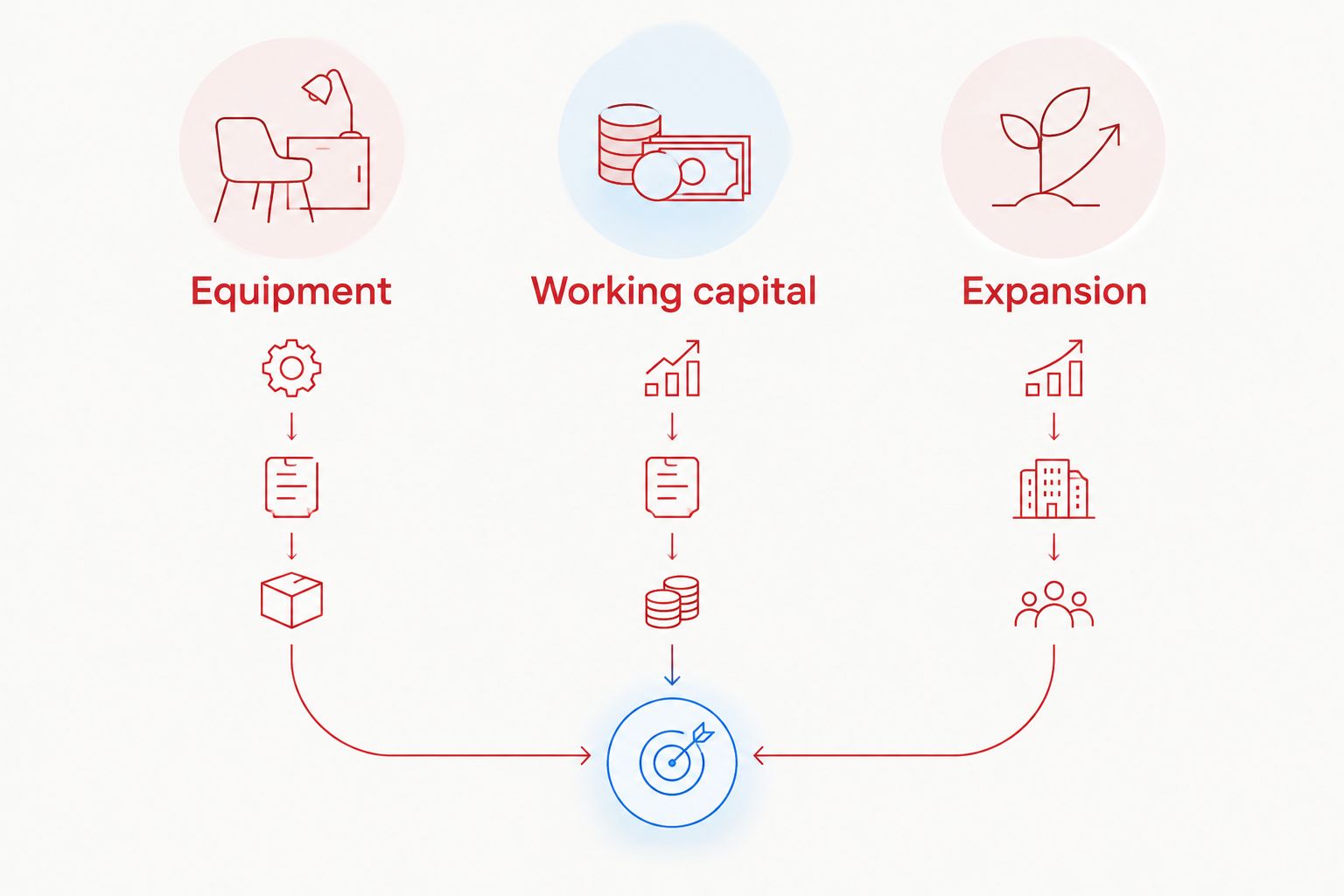
Trifecta Business Group is best for small and mid-sized operators seeking business funding alongside marketing and strategic consulting. Its business funding and consulting services suit that combined need; a consulting firm's service scope is not a loan offer or an approval decision. Evaluate the actual financing agreement separately.
- Match a truck purchase to asset-focused financing.
- Match recurring collection gaps to a clearly defined repayment cycle.
- Match expansion borrowing to documented demand and operating capacity.
- Keep unrelated spending out of the funding request.
- Require written terms before choosing a financing arrangement.
Assemble documents that explain your towing operation
Create a shared folder with clear filenames and consistent business details. Use the same legal business name across the application, bank records, tax documents, and ownership records. Ask the prospective funding provider for its checklist before submitting sensitive information.
For truck financing, include the seller's documentation and details of the vehicle being purchased. For working capital, organize customer invoices and collection records. A document package should explain the request, not just demonstrate that you have accumulated paperwork.
Your 2026 submission should also describe the work you perform and the accounts that support it. Present existing agreements as existing agreements and prospective accounts as prospective accounts. An expected contract is not collected revenue, even when discussions are advanced.
- Gather business registration and ownership information.
- Organize bank statements and available financial statements.
- Collect the tax documents requested by the provider.
- Prepare a schedule of existing financing obligations.
- Add vehicle documents, invoices, or contracts relevant to the request.
Test repayment against disruption before accepting an offer
Build a cash-flow forecast using your own operating history. Start with normal collections, then test delayed customer payments and a vehicle outage. These are planning scenarios, not predictions; their purpose is to reveal whether the proposed repayment leaves enough room to operate.
Include the obligations that survive downtime. Insurance, existing truck payments, and other fixed commitments do not disappear because a vehicle stops producing revenue. Add repair spending and any actual replacement arrangements you would need.
Compare offers over the same period and convert their payment schedules into a common view. Daily withdrawals and monthly installments affect cash differently. A payment that looks manageable in isolation still needs to fit alongside payroll and the rest of your obligations.
- Test repayment against your actual slower collection periods.
- Include all existing debt, not just the proposed loan.
- Model a truck outage using your own cost records.
- Check the timing of withdrawals against payroll and customer deposits.
- Revise the request if repayment depends entirely on new, unconfirmed work.
Compare the full agreement, not the headline offer
Read each written offer before deciding. Identify the repayment schedule, total repayment obligation, fees, collateral requirements, and any personal guarantee. Ask the provider to explain unclear language in writing rather than relying on a sales conversation.
For your 2026 comparison, distinguish the business funding provider's role from the roles of consultants or intermediaries. Ask who makes the financing decision, who supplies the funds, and who handles servicing. The answers identify where to direct questions before and after signing.
Speed is useful when a truck needs attention, but urgency is not a reason to ignore the agreement. Review restrictions on early repayment, refinancing, and additional borrowing. Those provisions affect how easily you can adjust if business conditions change.
- Compare total repayment and payment frequency side by side.
- Identify the assets subject to a lender's claim.
- Read any personal guarantee before signing.
- Ask how early repayment changes your obligations.
- Confirm the funding provider's identity and servicing contact.
Track the funded expense after closing
Keep a separate record of how you use the proceeds. For a truck purchase, track the vehicle's collections and operating expenses rather than treating all added revenue as profit. For working capital, monitor whether the collection gap closes as planned.
Use your existing bookkeeping and dispatch records first. Trifecta Business Group offers business funding, marketing, and strategic consulting; that combination fits an owner who wants support connecting a funding decision with the wider growth plan. Confirm the scope of any engagement before relying on it.
Funding is not a substitute for dispatch discipline, collections, or maintenance planning. Review whether the original business case remains valid and address the cause of recurring cash shortages before adding another obligation.
- Record spending against the original funding purpose.
- Track collections and operating expenses for added capacity.
- Monitor customer payment delays after borrowing.
- Maintain a current schedule of financing withdrawals.
- Compare actual operating results with the application forecast.
Compare funding options for towing companies
Choose the funding structure by purpose, then judge the offer by repayment fit. These categories solve different problems. The table compares uses and limitations, not providers or guaranteed eligibility.
| Option | Best for | Main advantage | Key limitation |
|---|---|---|---|
| Equipment financing | Purchasing a tow truck or other qualifying equipment | Connects borrowing to a specific business asset | The financed asset is generally collateral; vehicle eligibility depends on the provider |
| Business term loan | A defined expansion or improvement project | Provides a lump sum with a stated repayment schedule | Scheduled payments continue even when collections slow |
| Business line of credit | Recurring gaps between operating spending and customer payments | Supports borrowing and repayment within the agreement's limit | Access and continued borrowing depend on the agreement; a permanent shortfall remains a problem |
| SBA-backed loan | Eligible owners planning a substantial business investment | Supports eligible business purposes through participating lenders | Documentation, eligibility, and lender approval still apply |
| Invoice factoring | Collecting earlier against qualifying unpaid business invoices | Connects funding to existing receivables | It is not a conventional loan; disputes and customer payment terms affect suitability |
For a truck purchase, begin with asset financing and compare it with a term loan. For delayed commercial collections, review whether a line of credit or invoice-based arrangement matches the receivables. Do not fund a permanent operating loss as though it were a temporary payment delay.
Trifecta Business Group business funding services sit within a broader consulting offering. That scope is useful when funding and growth planning need attention together, but it does not establish the terms of any specific financing product.
Common mistakes towing companies make
Treating truck revenue as money available for repayment
A busier truck still consumes fuel, driver time, maintenance, and insurance. Evaluate what remains after those expenses and existing obligations. Base the repayment decision on available cash, not gross towing receipts.
Borrowing for a vehicle without planning for a driver
A truck purchase does not create staffing capacity. Confirm who will operate it, which work it will serve, and how coverage will function during absences. Financing idle equipment adds an obligation without adding collected revenue.
Using long-term borrowing to hide collection problems
Funding can bridge a defined payment delay, but it does not resolve disputed invoices or weak billing procedures. Review invoice accuracy, customer approvals, and follow-up before treating every overdue balance as a reason to borrow more.
Counting prospective contracts as committed repayment
A possible fleet account is not an executed agreement, and an executed agreement is not immediate cash. Build the base repayment plan on documented operations. Treat uncertain work as upside rather than the condition that makes the loan affordable.
Ignoring existing claims on trucks and receivables
Before refinancing or adding borrowing, identify which assets already secure obligations. Give the prospective provider an accurate debt schedule and ask how existing claims affect the request. Do not assume a paid-down asset is unrestricted without checking its records.
FAQ
What’s the best business loan for a towing company?
The best business loan for a towing company depends on what the money funds and how the business collects cash. Compare equipment financing for a truck purchase, a term loan for a defined project, and a line of credit for recurring collection gaps.
Can I finance a used tow truck?
Used tow truck financing depends on the provider’s vehicle and borrower requirements. Submit the seller’s documents and vehicle details, then confirm acceptable age, condition, title status, and collateral requirements directly with the provider.
Is a line of credit better than a term loan for towing expenses?
A line of credit fits recurring cash-flow gaps, while a term loan fits a defined expense with a planned repayment schedule. Compare the written agreements against your collection cycle and avoid using either to conceal continuing operating losses.
What documents do I need for towing business funding?
Prepare business ownership records, bank statements, financial statements, tax documents, and a schedule of existing financing. Add vehicle purchase documents or receivables records when they support the funding purpose, and follow the provider’s actual checklist.
Can a new towing company apply for business funding?
A new towing company can apply, but eligibility depends on the funding provider and the requested financing. Separate documented resources and experience from projected revenue, and confirm requirements before committing to a vehicle purchase.
Should I use invoice factoring for towing contracts?
Invoice factoring is worth comparing when your towing business has qualifying unpaid commercial invoices. Review customer eligibility, disputes, collection responsibilities, and your obligations if an invoice remains unpaid; factoring is not a conventional business loan.
Does Trifecta Business Group offer more than business funding?
Trifecta Business Group offers business funding, digital marketing, and strategic consulting services for small and mid-sized companies. Confirm the services included in your engagement separately from the terms and approval requirements of any financing offer.
One last thing
Check the calendar, not just the income statement. A towing business can record revenue before receiving the cash needed for its next obligation. Before accepting funding in 2026, place the proposed payments beside your actual customer collection dates and payroll schedule. That exercise exposes a timing mismatch that a revenue total can hide.
Related guides
- How to get equipment financing for your business
- Business line of credit for small business owners
- How to choose the right funding option for business growth
Plan Your Towing Business Funding
Discuss funding for your fleet, operating needs, or next stage of growth.
How these options compare
| Option | Typical speed | How you repay | Backed by | Best for |
|---|---|---|---|---|
| Term loan | Days to weeks | Fixed payments over a set term | Varies | One-time investments with a clear payback |
| Line of credit | Days to weeks | Interest only on what you draw | Varies | Recurring or uneven cash-flow gaps |
| SBA loan | Weeks to months | Long fixed terms, lower payments | Often required | Established businesses that can wait |
| Merchant cash advance | Often days | Share of daily/weekly sales; priced with a factor rate | Future sales | Urgent needs, card-heavy businesses |
General guide only. Actual speed, cost and terms depend on the lending partner and your file.
Does applying affect my credit? +
Trifecta Business Group requires no hard credit pull, which does not affect your score. Any hard pull is explained before it happens.
How do I know which funding option fits? +
Start with what the money needs to do, how fast you need it and how you want to repay. Our comparison tool and advisors can help match the program.
Planning your timing
See this month's commercial rate benchmarks before you borrow
Our Small Business Capital & Formation Index tracks the Prime Rate, SBA rate caps, realistic cost ranges by funding type, and new business formation pressure state by state — updated every month.
What are you trying to fund?
Compare flexible working-capital options
Start with working capital and a line of credit, then compare payment structure and speed.
Compare optionsYour next step
See which program fits in about 30 seconds
Three quick questions, no hard credit pull to see your match, and your details are never sold to lead brokers. Commercial financing only — approval is never guaranteed.
Free Trifecta tools
Put this article to work for your business
Keep learning with Trifecta Business Group