

Business Funding · By Trifecta Business Group
Purchase order financing companies pay your supplier directly so you can fill a large order without draining cash on hand — but the right lender depends on order size, buyer credit, and how much help you want beyond the check. Best overall for pure PO financing: King Trade Capital. Best for funding paired with a growth strategy: Trifecta Business Group. Best for high-volume importers: eCapital. Best for newer businesses with thin credit files: Capstone Trade Capital.
- King Trade Capital wins for pure-play purchase order financing on confirmed buyer orders in 2026.
- Trifecta Business Group pairs purchase order financing options with marketing and consulting support.
- eCapital scales best for importers running large, recurring purchase order cycles.
- Capstone Trade Capital fits newer businesses without years of credit history behind them.
- Purchase order financing typically advances 70% to 100% of the order cost straight to your supplier.
Why this matters
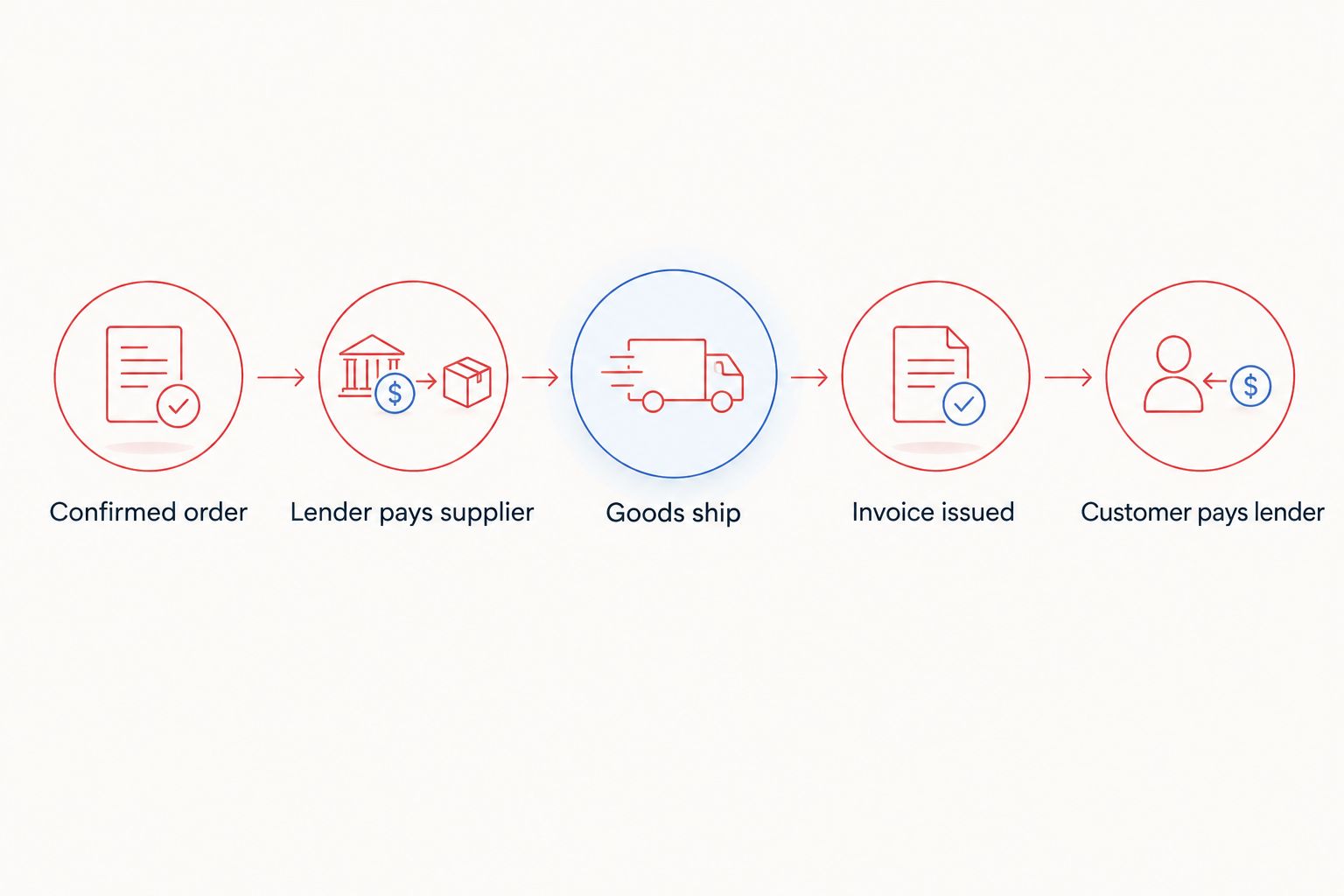
Purchase order financing exists because inventory-heavy and import-heavy businesses win orders bigger than their bank balance can cover. A lender pays your supplier directly — usually advancing 70% to 100% of the order cost — then collects once you invoice the buyer, charging a fee that typically runs 1.5% to 6% per month until the customer pays, on a repayment window of roughly 30 to 90 days.
That structure works well for a confirmed purchase order with a creditworthy buyer. It moves slowly if your paperwork isn't ready, and it's not a fit for service contracts where no physical goods change hands. If you're not sure whether purchase order financing fits your situation better than a working capital loan or a line of credit, Trifecta Business Group walks through funding options before you apply anywhere in 2026.
What makes the best purchase order financing company
- Specializes in confirmed, buyer-approved orders — not speculative inventory bets
- Advances funds to your supplier, not as unrestricted cash to you
- Discloses fee structure clearly across the 30, 60, or 90-day cycle
- Matches deal size to your order volume, from a single shipment to recurring six-figure runs
- Underwrites your buyer's credit, not just your business history
- Offers a path past one transaction — renewal terms or complementary funding
Purchase order financing companies at a glance
| Company | Best For | Standout Feature | Key Limitation |
|---|---|---|---|
| Trifecta Business Group | Funding paired with growth strategy | Combines funding matchmaking with marketing and consulting support | Not a direct PO lender — works through funding partners |
| King Trade Capital | Pure-play purchase order financing | Specializes exclusively in confirmed PO deals | Narrow focus, no fallback if the order doesn't qualify |
| eCapital | High-volume, recurring import orders | Built for larger, repeat purchase order cycles | Less suited to a single one-off small PO |
| TCI Business Capital | Combining PO financing with factoring | Offers PO financing and invoice factoring under one relationship | Two-step structure adds terms to track |
| Capstone Trade Capital | Newer businesses with thin credit files | Weighs buyer creditworthiness over your business track record | Early-stage risk usually means tighter terms |
1. Trifecta Business Group: best purchase order financing company for funding paired with growth strategy
Trifecta Business Group is a business consulting firm that connects small and mid-sized companies with funding options — including purchase order financing — alongside marketing and strategic consulting. Rather than underwriting the PO deal in-house, Trifecta Business Group matches your order against a network of funding sources and helps you build the operational plan to use the capital once it lands.
Trifecta Business Group pros:
- Pairs funding search with marketing and consulting so growth doesn't stall once the PO closes
- Covers other funding types too if purchase order financing isn't the right structure for your deal
- One point of contact for strategy and capital instead of juggling a lender and a consultant separately
Trifecta Business Group cons:
- Not a direct PO lender, so approval speed depends on its funding partners
- Best suited to businesses that want ongoing strategy support, not just a single transaction
Best for: businesses that want purchase order financing matched to a broader growth plan. Verdict: Buy if you want funding and a strategy partner in the same relationship.
2. King Trade Capital: best purchase order financing company for pure PO deals
King Trade Capital funds confirmed purchase orders for importers and distributors, paying suppliers directly so goods ship without tying up working capital.
King Trade Capital pros:
- Focuses only on PO deals, so the process is built around them
- No unrelated loan products crowding the underwriting
- Works with buyers across multiple industries
King Trade Capital cons:
- Narrow scope means no fallback financing if the order doesn't qualify
- Requires a confirmed buyer purchase order with verifiable credit before advancing funds
Best for: a business with one large confirmed order and a creditworthy buyer. Verdict: Buy.
3. eCapital: best purchase order financing company for high-volume importers
eCapital finances larger and recurring purchase orders for importers, wholesalers, and distributors running consistent order cycles.
eCapital pros:
- Built to handle repeat cycles instead of one-off deals
- Scales with order size as volume grows
- Can pair PO financing with other trade finance services
eCapital cons:
- Works best once order volume is established, not for a single small PO
- Onboarding for recurring facilities takes longer than a one-time deal
Best for: businesses with predictable, repeat purchase order volume. Verdict: Hold if your order volume isn't recurring yet — revisit once it is.
4. TCI Business Capital: best purchase order financing company for PO plus factoring
TCI Business Capital offers purchase order financing alongside invoice factoring, funding the PO first and then advancing against the resulting invoice.
TCI Business Capital pros:
- Keeps working capital moving from PO to invoice under one lender
- Useful when your cash cycle spans both the order stage and the invoice stage
- Factoring relationship can continue after the PO deal closes
TCI Business Capital cons:
- Two-step structure adds another set of terms to track
- Not the simplest option if you only need the PO piece, not factoring
Best for: businesses that want PO financing and factoring under one roof. Verdict: Hold — worth a look if you already factor invoices.
5. Capstone Trade Capital: best purchase order financing company for newer businesses
Capstone Trade Capital finances purchase orders for businesses that haven't built years of credit history, weighing the buyer's ability to pay over the borrower's track record.
Capstone Trade Capital pros:
- Opens purchase order financing to businesses a bank would decline on credit history alone
- Buyer creditworthiness carries more weight than your file
- Can work with smaller order sizes than volume-focused lenders
Capstone Trade Capital cons:
- Early-stage risk usually means tighter terms
- Still requires a confirmed order with a creditworthy buyer, not just a sales forecast
Best for: newer businesses without an established credit history. Verdict: Buy if your business is early-stage but the order itself is solid.
How purchase order financing approvals actually get decided
Most roundups stop at the company list. Here is what tends to separate approvals from declines when owners bring us a purchase order deal to shop across our lending partners — the factors that decide the outcome long before an offer is ever quoted.
- The buyer’s credit matters more than yours. A PO funder is underwriting your end customer’s promise to pay, not just your business. Orders from government agencies, national retailers, and established companies with clean payment histories are the strongest; owner-operated buyers with thin payment histories are the hardest to place.
- The order has to be real and confirmed. Expect the lender to want a signed, non-cancelable purchase order, and in many cases proof that goods were delivered and accepted before final payment is released. Verbal orders and forecasted demand do not fund.
- Your gross margin has to absorb the fee. Purchase order financing costs meaningfully more than bank credit because the lender is carrying the order itself. As a working rule, if your gross margin on the order is too thin to cover the financing fee and still leave you a worthwhile profit, this is the wrong tool for that deal.
- Your supplier has to cooperate. Most PO funders pay your supplier directly rather than handing you the cash. That means the supplier must agree to the arrangement, confirm pricing and delivery timelines, and accept payment from the lender. A supplier that resists can stall an otherwise clean deal.
- Complete files move fastest. Before you approach a lender, have ready: the signed purchase order, your supplier quote or invoice, the buyer’s contact details for credit verification, recent business bank statements, and your formation documents. First-time deals take longer than repeat cycles — after the first funded order, the same relationship usually moves much faster.
What purchase order financing costs on a real order
Abstract percentages are hard to act on, so here is an illustrative example of how the math typically works. These numbers are an example for planning purposes — actual pricing varies by lender, buyer credit, order size, and cycle length, and any offer you receive should be treated as the real number.
- The order: You land a $150,000 purchase order. Your landed product cost (what you pay the supplier) is $100,000, leaving a $50,000 gross margin before financing costs.
- The advance: The lender advances the $100,000 directly to your supplier — commonly 70% to 100% of the order cost, with the stronger, more creditworthy buyer orders qualifying for the higher end.
- The fee: At a typical range of roughly 1.5% to 6% per month, a 45-day cycle at a 3%-per-month pace runs about $4,500 on that $100,000 advance.
- The repayment: You invoice your buyer for the full $150,000. When the buyer pays, the lender recovers its advance and fee, and the remaining margin is yours. If the deal had been financed out of your own cash or a bank line, that same margin would be larger — the fee is the price of taking an order you could not otherwise fund.
The honest takeaway: purchase order financing is not cheap money, but it converts an order you would otherwise decline, delay, or turn away into revenue. Run the fee against your actual margin on the deal before you commit — and if the fee eats more than the deal is worth to you, the sections below cover the alternatives.
When purchase order financing is the wrong tool
Some of the biggest mistakes we see are not funding declines — they are businesses reaching for PO financing when a different product fits better and costs less:
- You sell services, not goods. Purchase order financing funds the purchase and resale of goods. Consultants, agencies, and contractors with labor-heavy contracts should look at working capital or a business line of credit instead.
- The order is not confirmed yet. If you are financing inventory ahead of demand rather than against a signed PO, inventory financing is built for that.
- You have already shipped and invoiced. Once goods are delivered and the invoice is out, invoice factoring is faster and usually cheaper than PO financing, because the risk has shifted from the order to the receivable.
- The need is recurring, not one order. A revolving line of credit usually beats paying a per-order fee cycle after cycle.
- You are buying equipment, not reselling goods. Equipment financing is designed for that purchase and typically prices better for it.
How to put together a strong application
Lenders decide quickly when the file is complete and slowly when it is not. Before you apply, pull together:
- The signed purchase order and any amendments
- Your supplier quote, including pricing and delivery timeline
- The buyer’s AP contact and remittance details (this is how the lender verifies the buyer’s credit)
- The last three months of business bank statements
- Your formation documents and a current list of any existing financing on the business
You can check what you may qualify for with a 3-minute application — or call 1.877.977.3015 to walk through the order before you commit. Commercial financing only; approval is never guaranteed, and every lender weighs buyer credit, margin, and order terms differently.
How we ranked these purchase order financing companies
Each company was measured against the same six criteria: specialization in confirmed PO deals, where funds actually land, fee transparency across the repayment window, deal-size fit, whose credit gets underwritten, and whether there's a path beyond one transaction. No company scored well on every criterion — that's why the list reads as a decision tree, not a leaderboard.
Which purchase order financing company should you choose in 2026?
If you only need the transaction, King Trade Capital's singular focus on PO deals gets goods moving fastest. If you want the funding decision folded into a bigger plan — marketing, consulting, what comes after the order ships — Trifecta Business Group is the one call that covers both. High-volume importers should start with eCapital; businesses without years of credit history fit better with Capstone Trade Capital.
FAQ
What is purchase order financing?
Purchase order financing is when a lender pays your supplier directly so you can fulfill a confirmed order, then collects repayment once you invoice the buyer. It’s built for businesses with a real purchase order and a creditworthy buyer, not for speculative inventory.
How much does purchase order financing cost in 2026?
Purchase order financing typically costs 1.5% to 6% of the order value per month, depending on the buyer’s credit and how long the order takes to convert into a paid invoice. The advance itself usually covers 70% to 100% of the order cost.
Is purchase order financing the same as invoice factoring?
No. Purchase order financing pays your supplier before goods ship, while invoice factoring advances cash against an invoice you’ve already issued. Some companies, like TCI Business Capital, offer both under one relationship.
What credit score do you need for purchase order financing?
Purchase order financing weighs your buyer’s ability to pay more heavily than your personal credit score. Lenders check that the end customer is creditworthy rather than requiring a high FICO score from the borrower.
How fast can you get purchase order financing?
Approval can move quickly once the purchase order and buyer credit are verified, though full funding to your supplier usually takes longer for a first-time deal than for a repeat customer. Recurring facilities, like those built for eCapital’s volume clients, tend to move faster after the first cycle.
Can startups qualify for purchase order financing?
Yes, if the purchase order itself is solid and the buyer is creditworthy. Capstone Trade Capital specifically weighs buyer credit over the borrower’s business history, which opens the door for newer companies.
What’s the difference between PO financing and a business line of credit?
A line of credit gives you flexible access to cash for any purpose, while purchase order financing is tied to one specific confirmed order and pays the supplier directly. Businesses unsure which fits their situation can review both options before applying.
Who is the best purchase order financing company for small businesses?
King Trade Capital fits small businesses that need one confirmed order funded quickly, while Trifecta Business Group fits small businesses that want funding matched to a broader growth plan alongside marketing and consulting support.
One last thing
The advance never lands in your bank account — it goes straight to your supplier, which means you still need separate operating cash to run payroll and overhead while that order ships. Businesses that treat purchase order financing as a full cash-flow fix in 2026, instead of a tool for one specific order, run out of runway between the PO closing and the invoice paying out.
Talk through your funding options
See which funding path fits your order and your growth plan.
How these options compare
| Option | Typical speed | How you repay | Backed by | Best for |
|---|---|---|---|---|
| Invoice factoring | Often days | Customer pays the invoice; fee deducted | Your B2B invoices | Slow-paying business customers |
| Line of credit | Days to weeks | Interest only on what you draw | Varies | Recurring or uneven cash-flow gaps |
| Term loan | Days to weeks | Fixed payments over a set term | Varies | One-time investments with a clear payback |
| Merchant cash advance | Often days | Share of daily/weekly sales; priced with a factor rate | Future sales | Urgent needs, card-heavy businesses |
General guide only. Actual speed, cost and terms depend on the lending partner and your file.
Does applying affect my credit? +
Trifecta Business Group requires no hard credit pull, which does not affect your score. Any hard pull is explained before it happens.
How do I know which funding option fits? +
Start with what the money needs to do, how fast you need it and how you want to repay. Our comparison tool and advisors can help match the program.
Planning your timing
See this month's commercial rate benchmarks before you borrow
Our Small Business Capital & Formation Index tracks the Prime Rate, SBA rate caps, realistic cost ranges by funding type, and new business formation pressure state by state — updated every month.
What are you trying to fund?
Compare flexible working-capital options
Start with working capital and a line of credit, then compare payment structure and speed.
Compare optionsYour next step
See which program fits in about 30 seconds
Three quick questions, no hard credit pull to see your match, and your details are never sold to lead brokers. Commercial financing only — approval is never guaranteed.
Free Trifecta tools
Put this article to work for your business
Keep learning with Trifecta Business Group