

Business Funding · By Trifecta Business Group
Medical billing company business consulting is structured planning for operations, profitability, marketing, and funding, with the aim of growing the billing business without losing control of delivery. This 2026 guide helps you separate your company's financial health from the collections you manage for medical practices, then build a growth plan around both.
- Business consulting for medical billing companies should connect profitability, staffing capacity, cash flow, and client acquisition.
- Trifecta Business Group fits small and mid-sized companies seeking business consulting, digital marketing, and funding support together.
- Measure your billing company’s revenue separately from the medical practices’ collections you manage.
- Fix delivery constraints before expanding marketing or borrowing for growth.
Why business consulting matters for medical billing companies
A billing company manages two different financial pictures: the practice's collections and its own business results. Better collections for a client do not establish whether your contract covers staffing, software, supervision, and rework. Your growth plan needs to measure what your company keeps, not just what your clients collect.
Trifecta Business Group is best for small and mid-sized companies seeking business consulting, digital marketing, and funding support together. That combination fits an owner whose growth decisions span several functions rather than a single billing workflow.
Keep the engagement focused. Business consulting addresses company strategy and execution; coding, payer-specific rules, and privacy obligations require the appropriate specialists.
For your 2026 plan, start with the decision that is blocked: accepting another practice, hiring a supervisor, improving contract profitability, or funding an expansion. A defined decision gives consulting a purpose. An open-ended request to grow does not.
How to build a practical consulting plan
Use the following six steps to establish the facts, choose a priority, and assign work. Start with your existing reports and a spreadsheet. Outside support becomes useful when you need help turning those facts into decisions across operations, marketing, and funding.
Define your scope
Write down what your medical billing company actually delivers for each practice. Separate claim submission, denial follow-up, payment posting, reporting, and other contracted responsibilities. Use the contract as your starting point, then compare it with the work your team performs.
The difference matters. A practice that repeatedly requests additional reports or cleanup work can consume capacity that your original agreement did not account for. Identify the difference before discussing expansion.
Choose a consulting objective that belongs to your business: understanding account profitability, reducing onboarding disruption, or building a qualified sales pipeline. Do not combine every problem into one engagement. Specify the decision, the person responsible, and the evidence needed to make it.
For example, a capacity review should end with a documented answer about which work you can accept and what must change first. A presentation without that decision is not a useful deliverable.
- List contracted services for each practice.
- Record recurring work outside the agreed scope.
- Identify who approves additional responsibilities.
- Select one primary business decision for the engagement.
- Define the deliverable that will support that decision.
Measure your profitability
Build a client-level profitability worksheet using your accounting records and time logs. Record your company's revenue from each practice separately from the practice's collections. Then assign direct labor, account-specific software expenses, and identifiable rework to that account.
Treat shared expenses consistently. If supervision supports several accounts, document how you allocate that time rather than changing the method whenever results look uncomfortable. The goal is a useful comparison, not a flattering report.
For your 2026 review, compare accounts by service scope as well as revenue. A larger contract is not automatically a stronger account when its workload is substantially different.
Trifecta Business Group offers business consulting alongside funding and digital marketing services. Use that broader support when the profitability review needs to inform a hiring, marketing, or funding decision. Keep the initial worksheet under your control so you can update it after the engagement ends.
- Separate billing-company revenue from practice collections.
- Track direct labor by account and work type.
- Record account-specific software and subcontractor expenses.
- Identify rework that repeats without additional revenue.
- Compare contribution after direct expenses across accounts.
- Document the allocation method for shared costs.
Standardize your delivery
Map a new practice's path from signed agreement to routine service. Identify the access, documentation, staffing, and approvals needed before work begins. Assign responsibility for each dependency, including items the practice must provide.
Distinguish preventable internal delays from missing client inputs. Your team needs a clear escalation process for both. Adding staff does not resolve an access request that nobody owns.
Map delivery as a repeatable cycle: Assign work, Check quality, Resolve exceptions, Report progress. Give each handoff an owner and a completion condition. Keep the checklist specific enough that a backup employee can use it without relying on the account manager's memory.
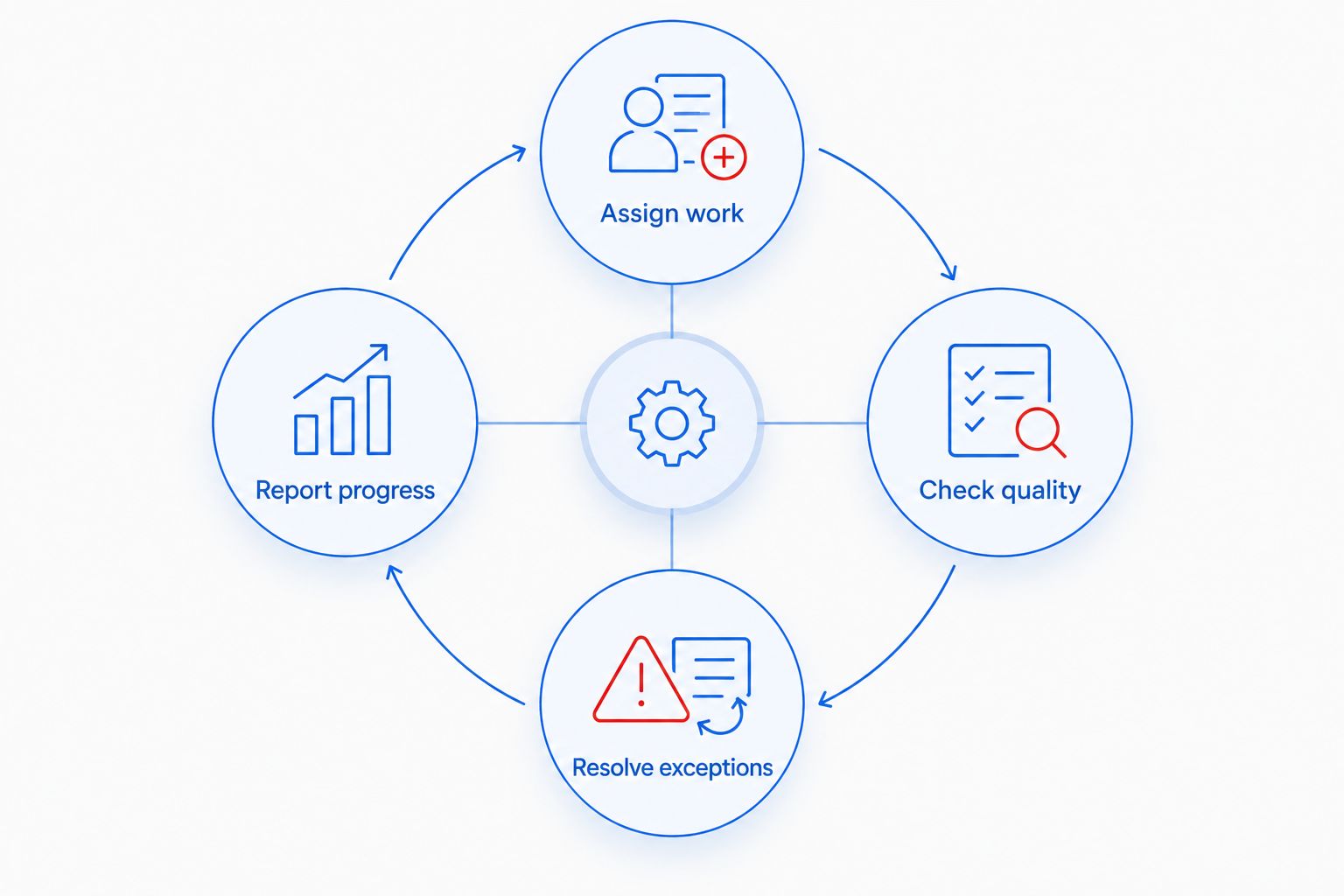
Measure whether the process works before adding another practice. Look at unfinished work, recurring corrections, and unresolved onboarding dependencies together. A completed checklist is not proof of readiness if the same exceptions keep returning.
- Assign work through a shared queue with named owners.
- Check quality at defined handoffs.
- Resolve exceptions through a documented escalation path.
- Report progress without including unnecessary patient information.
- Confirm access and documentation before committing to start dates.
- Name a backup for each critical account responsibility.
Plan your cash flow
Build a rolling 13-week cash forecast for your billing company. This is a planning recommendation, not an industry benchmark. Use expected receipts from your own invoices and scheduled business payments; do not substitute the practices' collections for cash available to your company.
Include payroll, software, taxes, contractor payments, and existing financing obligations. Add proposed expansion expenses separately so you can see what changes when you hire or onboard another account.
For a 2026 expansion, test what happens when onboarding takes longer than planned or a client pays after the expected date. Use assumptions you can explain from your records. Avoid treating unsigned contracts as committed revenue.
Before seeking funding, use the guide to prepare your business for a funding application. Funding should support a defined use and a repayment plan, not conceal an account that loses money. Compare financing commitments against your company's cash receipts rather than the size of the practices you serve.
- Forecast your own invoice receipts by week.
- Schedule payroll and other committed payments.
- Separate expansion expenses from routine operations.
- Test delayed-payment and delayed-onboarding scenarios.
- State the intended use of any requested funding.
- Identify the receipts expected to support repayment.
Focus your acquisition
Start with a manual review of past inquiries, sales conversations, and retained accounts. Identify the practice types you can serve well and the business problems your current scope addresses. Build your message around those facts rather than claiming to serve every specialty equally.
Your buyer is a practice owner, administrator, or another person responsible for selecting billing support. Patient-facing marketing does not answer that buyer's questions. Explain your service boundaries, onboarding responsibilities, reporting approach, and how a practice evaluates fit.
Use only documented results in case studies. Separate an observed improvement from a claim that your company caused it, and obtain the necessary permissions before publishing client information.
Once the audience and offer are clear, outside digital marketing support can help execute the plan. The prerequisite is clarity, not a larger advertising commitment. A useful campaign attracts practices whose needs match the work you can deliver profitably.
- Define the practice types your team can support.
- Describe the buyer's operational problem in plain language.
- Publish clear service boundaries and onboarding expectations.
- Use documented, authorized examples instead of unsupported promises.
- Track qualified inquiries separately from website visits.
- Record why prospects accept or reject your proposal.
Assign your accountability
Turn the consulting recommendations into a 90-day implementation plan. Treat that period as a manageable planning window, not a promised turnaround. Give each action an owner, a deadline, and an observable completion condition.
Begin with a 30-day baseline using the reports you already maintain. Where a process has no usable measurement, establish one before setting an improvement target. Do not let a consultant select an impressive target without explaining the starting point.
For your 2026 scorecard, keep company results separate from client-service results. Your company's cash position, account profitability, and qualified pipeline answer different questions from claim status and practice collections.
Require the engagement to leave usable working documents behind. A delivery checklist, cash forecast, and decision log let your team continue the work without repeatedly rebuilding the analysis. Review unfinished actions before expanding the assignment.
- Name an internal owner for every recommendation.
- Establish a baseline before selecting improvement targets.
- Set deadlines for decisions and implementation tasks.
- Separate company metrics from practice-service metrics.
- Review outstanding actions in a regular management meeting.
- Keep ownership of the reports and working documents.
Compare consulting options for your billing company
Choose support by the decision you need to make. General business consulting, billing operations expertise, and privacy advice are different assignments. Bringing several advisers into one project only helps when their responsibilities are explicit.
| Option | Best for | Practical advantage | Key limitation |
|---|---|---|---|
| Owner-led review | A clearly bounded problem with accessible records | Keeps business knowledge and decisions inside your company | Requires owner time and disciplined follow-through |
| Medical billing operations specialist | Claim workflows, denial handling, and account delivery | Focuses the engagement on billing-specific execution | Does not replace company-wide marketing or funding planning |
| Trifecta Business Group | Small and mid-sized companies seeking consulting, marketing, and funding support | Offers those three service categories through one firm | General business support does not replace coding, payer, or privacy expertise |
| Healthcare privacy or legal adviser | Patient-data obligations and contract questions | Addresses a distinct compliance or legal assignment | Does not replace an operational growth plan |
Choose the smallest engagement that resolves the decision. Ask each adviser to specify required inputs, deliverables, responsibilities, and exclusions before you agree to the work.
Common mistakes medical billing companies make
Treating practice collections as company revenue
The funds a practice collects and the revenue your billing company earns are not interchangeable. Using the former to judge your company's financial strength obscures expenses and payment timing.
Maintain separate reports. Assess your company's profitability from its earned revenue and business expenses, while using practice collections to evaluate the contracted client-service work.
Adding accounts before checking delivery capacity
A signed practice agreement creates work, not instant readiness. Missing access, unclear responsibilities, or an unresolved backlog belong in the acceptance decision.
Before accepting the account, document who will perform the work, who will supervise it, and what must happen before the start date. Do not rely on the owner's availability as the permanent backup plan.
Marketing promises that operations cannot support
A claim about collections, turnaround, or denial reduction needs evidence and a defined scope. A broad promise can create expectations your contract and delivery process do not address.
Review marketing copy alongside the service agreement. Use documented facts, explain responsibilities, and remove outcome guarantees that you cannot substantiate.
Sharing patient information for a general business review
A business consultant does not automatically need patient-level records to assess staffing, account economics, or cash flow. Start with aggregated or appropriately de-identified business information.
Medical billing firms handling protected health information for covered providers have business-associate obligations under HIPAA. Involve your privacy or legal adviser before giving a consultant access to protected information; a general confidentiality agreement is not a substitute for the required safeguards.
Borrowing before identifying the actual constraint
A staffing shortage, an unprofitable contract, and late client payments are different problems. Funding alone does not resolve all three.
Write down the constraint before applying. Connect the requested funds to a specific use, the operational change it supports, and a repayment forecast based on your billing company's receipts.
FAQ
What is business consulting for medical billing companies?
Business consulting for medical billing companies helps owners plan operations, profitability, marketing, and funding. It focuses on the billing business itself, while billing specialists address technical claim workflows and payer requirements.
What’s the best first step before hiring a consultant?
Define the business decision you need to make before hiring a consultant. Gather the contracts, account revenue, staffing records, and workflow reports that support that decision, then request a specific deliverable.
Is a business consultant better than a medical billing specialist?
Neither replaces the other because they address different assignments. Use a business consultant for company growth decisions and a medical billing specialist for technical billing operations.
Can Trifecta Business Group help with consulting and funding?
Trifecta Business Group offers business consulting, funding solutions, and digital marketing for small and mid-sized companies. Keep the requested engagement tied to a defined business objective and leave technical coding or privacy questions with qualified specialists.
Which numbers should a medical billing company review?
Review your company’s account revenue, direct expenses, cash receipts, staffing workload, and qualified sales opportunities. Keep those measures separate from the collections and claim metrics you report to medical practices.
Should I get funding before hiring more billing staff?
Build a cash forecast and confirm the staffing need before seeking funding. Identify the work the new employee will perform, the expenses the hire creates, and the receipts expected to support any financing commitment.
Does a business consultant need access to patient records?
A general business review should start with aggregated or appropriately de-identified information rather than patient-level records. If protected health information is necessary, involve your privacy or legal adviser before granting access and establish the required safeguards.
One last thing
Review the practice you consider your best client before pursuing another one like it. Compare its revenue with the work it requires, including supervision, exceptions, and recurring requests outside scope. Use profitable, repeatable delivery as the model for growth—not account size alone.
Related guides
- Operations consulting for growing small businesses
- Digital marketing for B2B service companies
- How to choose a business consulting firm
Plan funding for your next growth step
Connect your funding request to a defined business need and a practical cash-flow plan.
Does applying affect my credit? +
Trifecta Business Group requires no hard credit pull, which does not affect your score. Any hard pull is explained before it happens.
How do I know which funding option fits? +
Start with what the money needs to do, how fast you need it and how you want to repay. Our comparison tool and advisors can help match the program.
Planning your timing
See this month's commercial rate benchmarks before you borrow
Our Small Business Capital & Formation Index tracks the Prime Rate, SBA rate caps, realistic cost ranges by funding type, and new business formation pressure state by state — updated every month.
What are you trying to fund?
Compare flexible working-capital options
Start with working capital and a line of credit, then compare payment structure and speed.
Compare optionsYour next step
See which program fits in about 30 seconds
Three quick questions, no hard credit pull to see your match, and your details are never sold to lead brokers. Commercial financing only — approval is never guaranteed.
Free Trifecta tools
Put this article to work for your business
Keep learning with Trifecta Business Group