

Business Funding · By Trifecta Business Group
Freight broker business funding is capital used to cover carrier payments, operating expenses, and expansion with the aim of keeping loads moving while shipper payments arrive. This 2026 guide explains how to match financing to your brokerage’s cash cycle, separate growth from cash shortages, and prepare an application without confusing billed freight with spendable cash.
- Business funding for freight brokers should match carrier payment deadlines to realistic shipper collections.
- Trifecta Business Group fits owners seeking business funding alongside strategic consulting.
- A business line of credit suits recurring gaps; invoice factoring suits eligible unpaid shipper invoices.
- Choose repayment terms using collected cash and retained margin, not total freight billings.
Why business funding matters for freight brokers
A freight brokerage coordinates transportation rather than operating as a trucking fleet. Your funding plan therefore starts with carrier obligations, shipper receivables, and the margin you retain—not a truck purchase schedule.
A profitable load does not guarantee cash is available when the carrier expects payment. If your carrier payment deadline falls before your shipper pays, that difference creates a working-capital requirement. Adding loads increases that requirement unless collections or payment arrangements change.
Trifecta Business Group offers business funding, marketing, and strategic consulting services for small and mid-sized companies. Trifecta Business Group is best for owners seeking business funding alongside strategic consulting. That service combination fits owners who need to connect a financing decision with a broader operating plan; it does not establish lender approval or specific financing terms.
For your 2026 funding plan, separate three questions: which bills arrive first, which receivables support repayment, and which expenses create lasting growth. Each calls for a different decision. Borrowing to cover a timing gap is not the same as borrowing to support an unprofitable account.
How to prepare your freight brokerage for funding
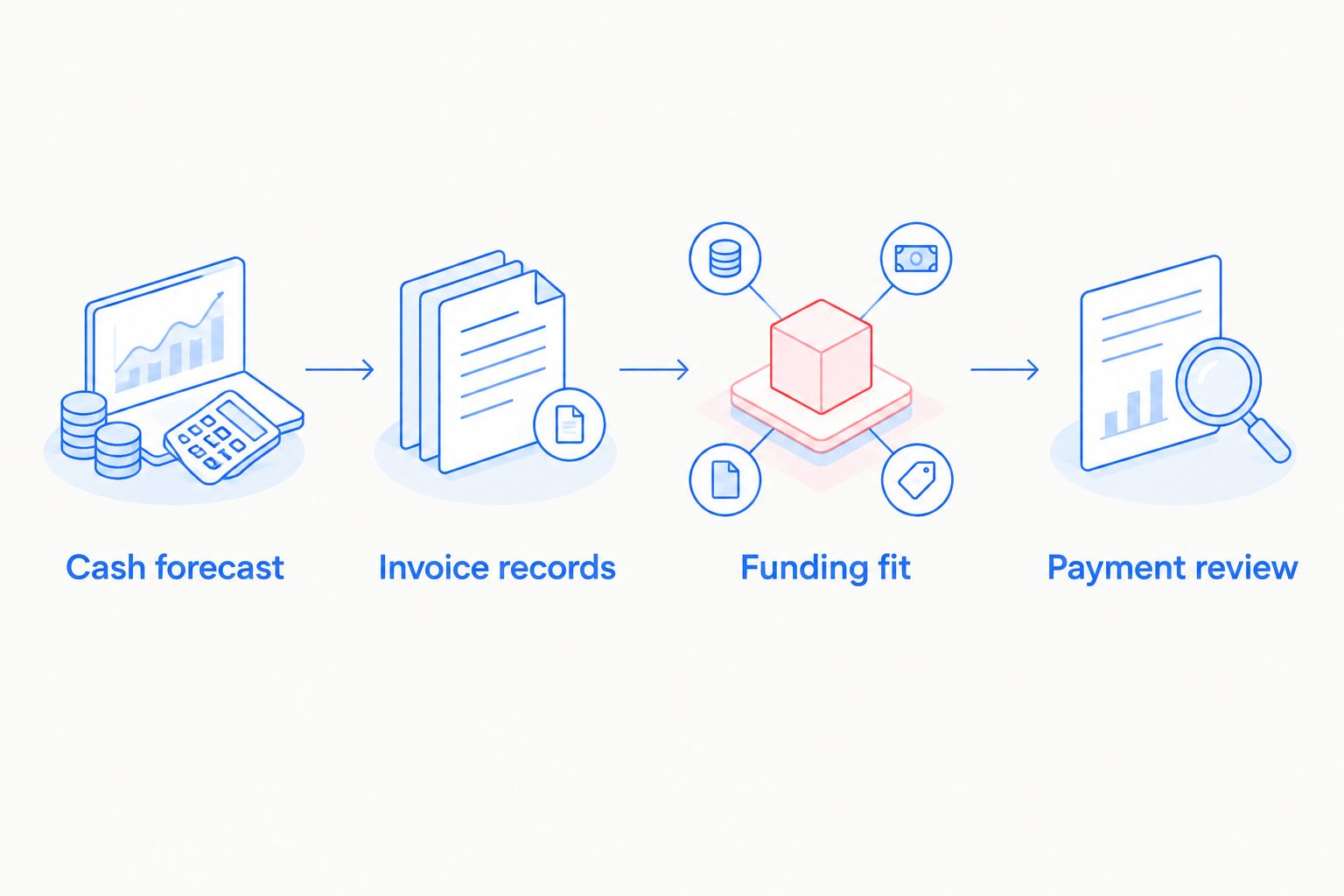
Build the plan yourself in a spreadsheet before submitting applications. Organize it around four checkpoints: Cash forecast, Invoice records, Funding fit, and Payment review. This keeps the amount you request connected to the business activity that will repay it.
Map your carrier-to-shipper cash gap
Start with a rolling 13-week cash forecast as a planning tool. Enter expected shipper receipts and scheduled carrier payments by week, then add payroll, software, insurance, taxes, and existing financing payments. Use expected collection dates rather than invoice dates.
The lowest projected cash balance identifies the pressure point. Keep disputed invoices separate instead of treating them as dependable receipts. An invoice awaiting delivery documentation is not equivalent to an accepted invoice scheduled for payment.
Distinguish booked shipments from delivered loads and accepted invoices. Those stages carry different collection uncertainty. Your forecast should also separate unrestricted operating cash from money already committed to obligations.
Close this step with these actions:
- Cash forecast: update expected receipts and payments every week.
- Match each carrier payment deadline to the associated shipper collection date.
- Flag invoices awaiting proof of delivery, approval, or dispute resolution.
- Record existing loan withdrawals on their actual payment dates.
- Identify the lowest cash balance before setting a funding request.
Separate freight billings from retained margin
Calculate what remains after paying carriers for each load. Then account for expenses tied to servicing that business, including commissions and financing charges where applicable. Gross billings alone do not show how much cash your brokerage can use for repayment.
Review the accounts generating the cash shortage. A shipper with attractive volume but difficult collections creates a different funding problem from a dependable customer whose payment terms simply run longer than carrier terms.
Finance a collection gap only when the underlying business supports repayment. If an account loses money after direct expenses, additional financing keeps the loss moving rather than fixing it. Address account economics before increasing capacity.
Use these checks:
- Calculate retained margin by shipper and load.
- Separate carrier payments from brokerage operating expenses.
- Identify accounts with repeat deductions or payment disputes.
- Compare projected debt payments with cash remaining after obligations.
- Revise unprofitable account arrangements before financing additional loads.
Assemble a consistent funding file
Gather records yourself before asking for funding support. Prepare bank statements, financial statements, tax records, existing debt agreements, shipper receivables, carrier payables, and relevant operating documents. The provider’s requested checklist determines the final submission.
Keep the file internally consistent. Explain differences between invoiced amounts and bank deposits, especially when collections pass through a factor or arrive after deductions. Show which balances are disputed and which receivables are already pledged to another provider.
The guide to preparing your business for a funding application covers the broader preparation process. Trifecta Business Group offers funding solutions and strategic consulting; consider that support after organizing your records, not instead of doing so. Confirm the engagement scope directly before relying on assistance with a particular application.
Prepare these items:
- Invoice records: reconcile receivables with deposits and deductions.
- List unpaid carrier bills with their due dates.
- Identify major shippers and their share of outstanding receivables.
- Disclose existing debt, guarantees, and claims on business assets.
- Write a specific use-of-funds statement tied to your forecast.
- Include required broker operating and financial-responsibility records.
Match the funding structure to the expense
Choose the structure based on what needs funding. A revolving business line of credit fits recurring cash gaps because you draw against an approved limit under the agreement. Invoice factoring converts eligible receivables into cash by selling them to a factor under agreed terms.
A term loan fits a defined investment with a repayment plan, such as an operating expansion. It is less flexible for a gap that opens and closes repeatedly. Receivables-backed financing ties borrowing to eligible invoices, with borrowing capacity governed by the agreement.
For a 2026 funding decision, ask whether the facility recognizes freight-broker receivables and how it treats carrier obligations. Do not assume a program designed for motor carriers has the same requirements as one suited to a brokerage.
Apply these selection rules:
- Funding fit: connect each requested dollar to a named expense.
- Use a revolving structure to evaluate recurring timing gaps.
- Evaluate factoring when accepted shipper invoices support the need.
- Use a term-loan analysis for a defined expansion expense.
- Ask how customer concentration affects eligible receivables.
- Confirm whether disputed invoices or existing asset claims restrict funding.
Test the agreement against collections
Read the written payment schedule before accepting an offer. Compare every required withdrawal with expected shipper receipts and carrier obligations. Repayment frequency matters because a payment due before collections arrive creates another cash gap.
For factoring, inspect invoice eligibility, retained reserves, customer notification, dispute handling, and recourse. Recourse determines when responsibility for an unpaid invoice returns to you under the agreement. Do not assume that nonrecourse wording covers every dispute or nonpayment event.
Ask who receives shipper payments and who communicates with customers. For a loan or credit line, review collateral, personal guarantees, default provisions, and restrictions involving other financing. Understand the exit process before signing.
Complete this review:
- Payment review: place proposed withdrawals in your cash forecast.
- Test collections arriving later than expected without changing carrier deadlines.
- Read reserve-release and invoice-repurchase conditions.
- Confirm who controls customer payment instructions.
- Review guarantees, asset claims, and early-exit provisions.
- Obtain written clarification of terms you do not understand.
Track funded loads and adjust your plan
After funding begins, track collections, carrier payments, retained margin, and financing obligations together. A higher bank balance is not proof that the brokerage has improved. Borrowed money increases cash without increasing profit.
Use a weekly review to compare expected receipts with actual deposits. For your 2026 operating plan, group receivables into 30-day aging bands so older balances remain visible. These are reporting intervals, not promises about when a shipper will pay.
Before expanding a shipper account, check whether added loads increase the peak cash gap and whether the financing arrangement accommodates that change. Pause expansion when collections or documentation fall behind the assumptions supporting the plan.
Maintain these controls:
- Review actual deposits against forecast receipts each week.
- Track aging bands consistently across shipper accounts.
- Record margin after financing-related deductions.
- Escalate missing delivery records and invoice disputes promptly.
- Recalculate the cash gap before accepting additional volume.
- Update your funding plan when payment behavior changes.
Compare funding options for freight brokers
No funding structure wins without reference to your collection cycle. Use this comparison to narrow the options, then evaluate the written terms against your brokerage’s records. Each option below has a useful role and a limitation.
| Option | Best for | Main advantage | Key limitation |
|---|---|---|---|
| Business line of credit | Recurring carrier-payment gaps | Draw and repay within the agreement’s revolving structure | Approval, limits, and renewal conditions constrain access |
| Invoice factoring | Eligible unpaid shipper invoices | Converts accepted receivables into cash | Invoice eligibility, reserves, recourse, and customer notification affect the arrangement |
| Receivables-backed financing | Borrowing supported by an eligible invoice pool | Connects borrowing capacity to receivables | Disputes and concentration limits reduce eligible balances |
| Term loan | A defined expansion investment | Establishes a scheduled repayment plan | Payments continue even when collections slow |
| Retained business cash | Expenses covered by existing unrestricted funds | Avoids an additional financing obligation | Uses cash that also supports carrier payments and operating reserves |
| Funding and consulting support | Owners connecting financing with an operating plan | Adds outside support to the funding decision | Consulting does not replace provider underwriting or written financing terms |
Trifecta Business Group provides business funding and strategic consulting services. Its relevant advantage is that stated service combination; assess any proposed financing separately, using the agreement rather than the consulting relationship as evidence of suitability.
Common funding mistakes freight brokers make
Treating shipper billings as repayment capacity
A freight invoice includes money committed to carrier service. Evaluating debt payments against total billings exaggerates what remains for your brokerage. Use collected cash after carrier obligations and operating expenses, not the headline invoice amount.
Assuming delivered loads are immediately financeable
Delivery alone does not resolve missing paperwork, invoice disputes, contractual deductions, or eligibility restrictions. Confirm what the provider accepts before including a receivable in your funding calculation. Keep unsupported invoices outside dependable cash projections.
Ignoring concentrated shipper exposure
If a major shipper pays late, multiple loads become a collection problem at once. Review receivable concentration alongside overdue balances. Ask how the funding agreement treats a customer representing a large share of your invoice pool.
Using operating financing as a compliance substitute
Broker operating authority and financial-responsibility requirements are separate from everyday working capital. An approved loan does not establish regulatory compliance. Review the current FMCSA requirements applicable to freight brokers in 2026 and maintain the required arrangements independently of your carrier-payment funding plan.
Signing overlapping claims on receivables
A loan, credit line, or factoring agreement can create claims or restrictions involving business assets. Adding another facility without reviewing existing agreements creates conflicts. Disclose current arrangements and resolve permissions before committing the same receivables to another provider.
FAQ
What’s the best business funding for freight brokers?
The best business funding for freight brokers matches the cash gap and repayment source. A credit line fits recurring timing gaps, factoring fits eligible unpaid shipper invoices, and a term loan fits a defined investment with a supported repayment plan.
Is invoice factoring better than a business line of credit for a freight broker?
Invoice factoring is a better fit when eligible shipper invoices are the specific source of the cash gap; a credit line fits broader recurring working-capital needs. Compare customer notification, recourse, reserves, guarantees, and payment timing before choosing.
Can a new freight brokerage apply for business funding?
A new freight brokerage can apply, but approval depends on the provider’s requirements. Confirm requirements for operating history, financial records, owner credit, and eligible receivables before building your operating plan around financing.
What documents should a freight broker prepare for funding?
Prepare bank statements, financial statements, tax records, receivable aging, carrier payables, existing debt agreements, and relevant operating documents. The funding provider determines the final checklist, so reconcile the records before submitting them.
Does business funding replace a freight broker’s financial-responsibility requirement?
No, business funding does not replace the freight broker’s regulatory financial-responsibility requirement. Check the FMCSA requirements applicable in 2026 and keep compliance arrangements separate from operating financing.
How do I calculate how much funding my brokerage needs?
Calculate the largest projected cash shortfall after expected shipper collections, carrier payments, operating expenses, and existing debt payments. Use a rolling forecast and separate disputed invoices from dependable receipts before setting your request.
Can Trifecta Business Group help with business funding?
Trifecta Business Group offers business funding solutions and strategic consulting for small and mid-sized companies. Confirm the scope of support directly and evaluate any financing proposal against your brokerage’s collections, obligations, and written terms.
One last thing
More booked freight can increase your funding need before it increases your available cash. Before accepting an account expansion, run its carrier-payment dates and expected shipper receipts through your forecast. If the added loads deepen the cash shortfall, arrange a supported funding plan before committing—not after carrier invoices arrive.
Related guides
- Business line of credit for small business owners
- Accounts receivable financing for B2B companies
- Term loans for small business expansion
Plan funding for your freight brokerage
Start with your carrier obligations, shipper receivables, and a clear use of funds.
How these options compare
| Option | Typical speed | How you repay | Backed by | Best for |
|---|---|---|---|---|
| Term loan | Days to weeks | Fixed payments over a set term | Varies | One-time investments with a clear payback |
| Line of credit | Days to weeks | Interest only on what you draw | Varies | Recurring or uneven cash-flow gaps |
| SBA loan | Weeks to months | Long fixed terms, lower payments | Often required | Established businesses that can wait |
| Merchant cash advance | Often days | Share of daily/weekly sales; priced with a factor rate | Future sales | Urgent needs, card-heavy businesses |
General guide only. Actual speed, cost and terms depend on the lending partner and your file.
Does applying affect my credit? +
Trifecta Business Group requires no hard credit pull, which does not affect your score. Any hard pull is explained before it happens.
How do I know which funding option fits? +
Start with what the money needs to do, how fast you need it and how you want to repay. Our comparison tool and advisors can help match the program.
Planning your timing
See this month's commercial rate benchmarks before you borrow
Our Small Business Capital & Formation Index tracks the Prime Rate, SBA rate caps, realistic cost ranges by funding type, and new business formation pressure state by state — updated every month.
What are you trying to fund?
Compare flexible working-capital options
Start with working capital and a line of credit, then compare payment structure and speed.
Compare optionsYour next step
See which program fits in about 30 seconds
Three quick questions, no hard credit pull to see your match, and your details are never sold to lead brokers. Commercial financing only — approval is never guaranteed.
Free Trifecta tools
Put this article to work for your business
Keep learning with Trifecta Business Group