

Business Funding · By Trifecta Business Group
Security guard company funding is financing for payroll, equipment, and contract expansion with the aim of keeping coverage staffed while your business grows. Business funding for security guard companies must account for the gap between paying guards and collecting client invoices; this 2026 guide shows you how to measure that gap and choose a repayment structure that fits.
- Business funding for security guard companies should match payroll obligations, client collections, and contract profitability.
- A business line of credit fits recurring cash gaps; invoice factoring depends on eligible customer invoices.
- Trifecta Business Group offers business funding and strategic consulting for small and mid-sized companies.
- Finance profitable contracts, not recurring losses; test repayment against delayed collections before signing.
Why business funding matters for security guard companies
A signed security contract is not cash in your bank account. If you must staff the site before your client pays, you need enough cash to cover wages and other operating obligations through collection.
Your funding decision therefore starts with staffing schedules, billing approvals, and payment dates—not the largest amount offered. Equipment purchases create a different need from recurring payroll, and a disputed invoice creates a different problem from a profitable contract awaiting payment.
Trifecta Business Group offers business funding, digital marketing, and strategic consulting services for small and mid-sized companies. Funding support belongs inside an operating plan, not outside it.
Borrow to bridge a defined cash gap or support a profitable expansion—not to hide a contract that loses money. That distinction matters more than the name attached to the financing.
Build your 2026 funding plan
Use a spreadsheet before you submit applications. Follow this sequence: Cash forecast, Contract review, Funding match, and Repayment check. Each stage answers a different question: how much you need, whether the work supports borrowing, which structure fits, and whether you can repay it.
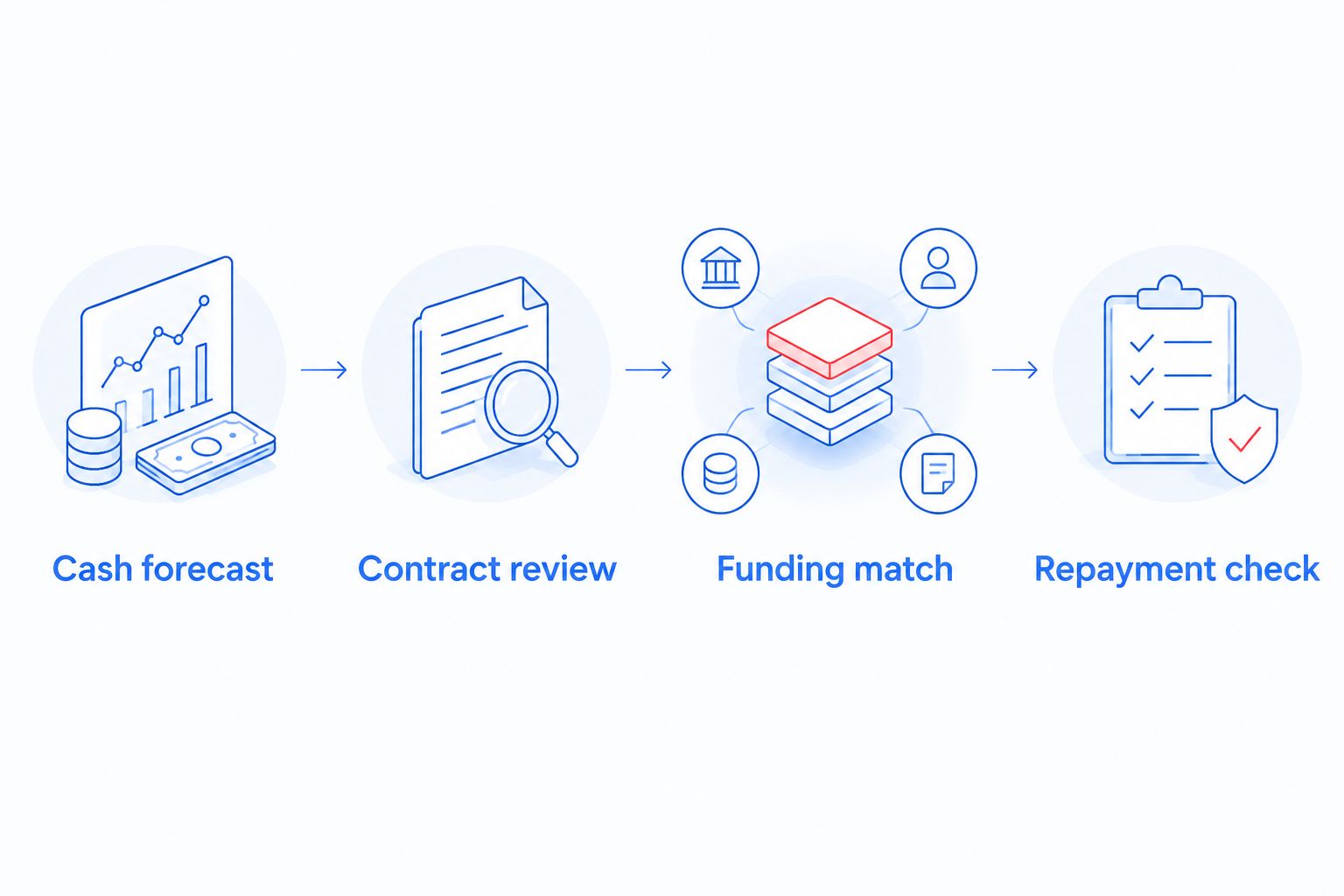
1. Forecast your payroll-to-collection gap
Build a rolling 13-week cash forecast using actual payroll dates, scheduled operating payments, and expected customer collections. Update it every 1 week. These are planning recommendations, not funding eligibility requirements.
Separate issued invoices from work you have not billed. Then identify the lowest projected cash balance before financing; that shortfall is your starting point for sizing the request.
Do not assume that an invoice date is a collection date. Record the client's approval process and your actual collection history wherever you have it. A forecast built on contract language alone misses delays caused by rejected timesheets or incomplete billing documentation.
- List payroll, payroll taxes, insurance payments, and existing financing payments by due date.
- Record expected collections by customer and invoice.
- Separate confirmed assignments from unsigned proposals.
- Identify the cash shortfall and explain any reserve you add.
- Assign one person to refresh the forecast weekly.
2. Calculate profitability by security contract
Review each contract manually before treating new revenue as borrowing capacity. Start with billed work, then subtract wages, employer payroll costs, supervision, insurance allocation, and the other expenses required to deliver that assignment.
Include the expense of covering absences and overtime where those apply. A contract that looks attractive at the quoted staffing level can produce a different result when your actual schedule changes.
A profitable company can still accept an unprofitable contract. Check the individual assignment before funding recruitment, uniforms, or additional coverage. Use the client's signed scope and your operating records rather than a sales estimate.
- Compare contracted billing with the hours you actually staff.
- Include relief coverage and supervisor time.
- Identify onboarding expenses before the first collection.
- Review termination, invoice approval, and dispute provisions.
- Separate timing problems from losses that require repricing or operational changes.
3. Prepare a funding file that explains your business
Create a shared folder and a short written summary yourself. Explain the amount requested, its purpose, the contracts supporting it, and the source of repayment; keep that explanation consistent with your financial records.
Trifecta Business Group is best suited to small and mid-sized companies seeking business funding alongside strategic consulting. That combination fits an owner who needs to connect a funding decision with an expansion plan, rather than consider financing in isolation.
Consulting support is not an approval guarantee. You still need complete records, a supportable request, and a clear view of your obligations. Ask which documents the specific funding provider requires instead of assuming every application uses the same checklist.
- Gather current financial statements and business bank records.
- Prepare an invoice aging report showing unpaid balances.
- Include relevant signed contracts and supporting billing records.
- List existing debts and their payment schedules.
- Provide requested business licensing and insurance documentation.
4. Match the financing structure to the job
Start by describing the use of funds in plain language: payroll bridge, equipment purchase, or expansion project. Then compare structures against that purpose. A recurring cash gap needs different repayment flexibility from a defined purchase.
A business line of credit is worth evaluating for recurring operating gaps because it permits borrowing within an approved limit under the agreement's terms. Invoice factoring instead centers on eligible invoices; equipment financing centers on a specified asset.
Choose the structure before choosing the provider. For your 2026 plan, distinguish cash you need repeatedly from spending that happens once. Do not assume any option is available until a provider reviews your circumstances and supplies written terms.
- Consider a line of credit for recurring payroll-to-collection gaps.
- Evaluate invoice factoring for completed, billed customer work.
- Consider a term loan for a defined expansion project.
- Evaluate equipment financing for eligible vehicles or equipment.
- Keep consulting support separate from the financing agreement itself.
5. Stress-test repayment against slower collections
Use your spreadsheet to test 2 collection scenarios: the expected collection schedule and a delayed schedule based on your own customer history. This is a recommended planning exercise, not a claim about typical security company payment behavior.
Enter the proposed financing payments on their actual scheduled dates. If collections slip, check whether you can still cover wages, taxes, and essential operating expenses without taking another advance.
A repayment obligation does not disappear because your customer disputes an invoice. Review the financing agreement's treatment of missed payments, guarantees, collateral, and any invoice-related obligations before committing.
- Put each financing payment into the cash forecast.
- Delay customer receipts using a documented scenario.
- Test the effect of losing your largest assignment.
- Identify the cash balance needed to protect essential payments.
- Reject structures that require unsupported new sales to meet repayment.
6. Compare written agreements, not sales summaries
Request the agreement and review it yourself before asking an adviser or attorney to explain unclear provisions. A verbal description is not a substitute for the document that controls repayment.
For invoice-related funding, check whether your customer receives notice, where payments must go, and what happens if an invoice is disputed or unpaid. For loans and credit lines, review payment frequency, security interests, guarantees, and early repayment provisions.
Trifecta Business Group's business funding and consulting services provide a place to discuss the business plan surrounding your request. Review the actual provider's agreement separately; the consulting relationship does not replace your responsibility to understand the obligation.
- Confirm who provides the financing and who services it.
- Read payment frequency and default provisions.
- Review collateral requirements and personal guarantees.
- Check customer-notification and collection requirements.
- Ask for written answers to unresolved questions.
7. Track the result after funding
Use a simple dashboard before adding another system. Compare the funded purpose with actual spending, and connect that spending to contract delivery and collections.
For a 2026 expansion, track whether the new assignment generates the cash your forecast assumed. Do not judge the funding decision solely by the deposit into your account; judge whether the work supports repayment while preserving operating cash.
Separate temporary deviations from structural problems. A delayed invoice calls for collection follow-up, while persistent overtime or underpriced coverage calls for an operating change.
- Track spending against the approved internal funding plan.
- Compare expected and actual collections.
- Review contract profitability after staffing begins.
- Monitor financing balances and scheduled payments.
- Reassess the need before borrowing again.
Compare funding options for security guard companies
No single option wins for every security business. Use the table to identify the right structure to investigate, then confirm eligibility and obligations in the provider's written agreement.
| Option | Best for | Main advantage | Key limitation |
|---|---|---|---|
| Business line of credit | Recurring payroll and operating cash gaps | Draw-based borrowing within an approved limit | Approval, renewal, and draw conditions depend on the agreement |
| Invoice factoring | Companies with eligible unpaid customer invoices | Converts qualifying receivables into cash before customer payment | Customer eligibility, disputes, and recourse provisions affect suitability |
| Term loan | A defined expansion project with a repayment plan | Provides funding for a specified business purpose | Scheduled payments remain due when collections fall behind |
| Equipment financing | Eligible patrol vehicles or equipment purchases | Connects financing to a specific asset | Does not directly solve unrelated payroll gaps |
| Internal cash reserve | Companies with enough retained operating cash | Avoids a new financing obligation | Using the reserve reduces cash available for other obligations |
Consulting is support for this decision, not another borrowing structure. Trifecta Business Group offers business funding and strategic consulting, but those services do not establish which agreement is suitable for your company.
Best for recurring gaps: evaluate a credit line. Best for eligible receivables: evaluate factoring. Best for a defined asset purchase: evaluate equipment financing. Each recommendation depends on your records and the proposed agreement—not the category label alone.
Common mistakes security guard companies make
Funding a new site without its startup cash needs
A contract's total value does not tell you how much cash you need before the first collection. Map hiring, training, uniforms, insurance changes, and initial payroll to the start date where those expenses apply.
Correct move: calculate the cash required to deliver the assignment through collection before accepting the funding obligation.
Treating disputed invoices as dependable repayment
An issued invoice is not the same as an accepted invoice. Missing timesheets, billing errors, or disagreements about coverage require resolution; borrowing does not fix the underlying dispute.
Correct move: separate clean receivables from disputed balances in your forecast and funding file.
Ignoring dependence on one large customer
A major customer can account for a significant part of your scheduled collections. Losing that assignment or collecting later than expected changes the cash available for repayment.
Correct move: test the forecast without that customer's expected receipts and define your response before borrowing.
Financing equipment and payroll as one undifferentiated need
Vehicles and recurring wages serve different purposes. Combining them without a spending plan makes it harder to see which expense created the shortfall and whether repayment fits.
Correct move: separate asset purchases, contract onboarding, and ongoing operations in your request.
FAQ
What’s the best business funding for security guard companies?
The best structure is the one that matches your cash gap and repayment source. Evaluate a line of credit for recurring operating gaps, factoring for eligible unpaid invoices, and equipment financing for a defined asset purchase.
Can I use business financing to cover security guard payroll?
Business financing can support payroll when the financing agreement permits that use. Forecast collections and scheduled repayments first so borrowing bridges a timing gap rather than conceals an unprofitable contract.
Is invoice factoring better than a business line of credit?
Invoice factoring is not automatically better than a business line of credit. Factoring depends on qualifying invoices and customer-related conditions, while a credit line depends on its approved limit, draw conditions, and repayment terms.
Can a new security guard company qualify for funding?
Qualification depends on the provider and the company’s circumstances. Prepare your business records, contracts, cash forecast, and repayment explanation; a signed contract alone does not guarantee approval.
What documents should a security guard company prepare for funding?
Prepare financial statements, bank records, an invoice aging report, relevant contracts, and a schedule of existing debts. The provider determines the final checklist, including any licensing or insurance documentation it requires.
Does a signed security contract guarantee financing approval?
A signed security contract does not guarantee financing approval. Its profitability, payment provisions, supporting records, and the rest of your business finances still matter to the funding decision.
What does Trifecta Business Group offer security business owners?
Trifecta Business Group offers business funding, digital marketing, and strategic consulting services for small and mid-sized companies. Discuss your funding purpose and operating plan, then review any proposed financing agreement on its own terms.
One last thing
Before financing another assignment in 2026, ask the customer what documentation makes an invoice ready for approval. Put that requirement into your supervisor's handoff process.
Clean billing supports a cleaner funding plan. Matching timesheets, coverage records, and invoices gives you a stronger basis for forecasting collections than relying on a payment deadline alone.
Related guides
- Working capital loans for staffing agencies
- Accounts receivable financing for B2B companies
- How to prepare your business for a funding application
Plan funding for your next contract
Connect your funding request with payroll needs, customer collections, and your growth plan.
How these options compare
| Option | Typical speed | How you repay | Backed by | Best for |
|---|---|---|---|---|
| Term loan | Days to weeks | Fixed payments over a set term | Varies | One-time investments with a clear payback |
| Line of credit | Days to weeks | Interest only on what you draw | Varies | Recurring or uneven cash-flow gaps |
| SBA loan | Weeks to months | Long fixed terms, lower payments | Often required | Established businesses that can wait |
| Merchant cash advance | Often days | Share of daily/weekly sales; priced with a factor rate | Future sales | Urgent needs, card-heavy businesses |
General guide only. Actual speed, cost and terms depend on the lending partner and your file.
Does applying affect my credit? +
Trifecta Business Group requires no hard credit pull, which does not affect your score. Any hard pull is explained before it happens.
How do I know which funding option fits? +
Start with what the money needs to do, how fast you need it and how you want to repay. Our comparison tool and advisors can help match the program.
Planning your timing
See this month's commercial rate benchmarks before you borrow
Our Small Business Capital & Formation Index tracks the Prime Rate, SBA rate caps, realistic cost ranges by funding type, and new business formation pressure state by state — updated every month.
What are you trying to fund?
Compare flexible working-capital options
Start with working capital and a line of credit, then compare payment structure and speed.
Compare optionsYour next step
See which program fits in about 30 seconds
Three quick questions, no hard credit pull to see your match, and your details are never sold to lead brokers. Commercial financing only — approval is never guaranteed.
Free Trifecta tools
Put this article to work for your business
Keep learning with Trifecta Business Group