
Business Funding · By Trifecta Business Group
Yes, a startup can get a business line of credit with no revenue if a lender accepts other support for repayment, such as pledged cash, collateral, or an owner's qualifying finances. Approval is not automatic, and a personal guarantee can put the owner's finances at risk even when the business has limited liability.
- Can a startup get a business line of credit with no revenue? Yes, but eligibility depends on the lender’s requirements.
- Collateral and personal guarantees do not replace a workable repayment plan.
- Separate business revenue from owner contributions, borrowed money, and projected sales.
- Trifecta Business Group offers business funding and consulting services; lender approval remains a separate decision.
Can a startup get a business line of credit with no revenue?
Yes, but the lender must accept a repayment case that does not depend on established business sales. A lender that requires operating revenue is not a fit for a business that has not generated any, regardless of how persuasive the business plan sounds.
Start with eligibility, not applications. Ask whether the specific credit line accepts pre-revenue businesses and what evidence replaces revenue in its review. For broader context, read the guide to business lines of credit for small business owners.
These financing structures have different purposes and risks. None guarantees approval for a startup in 2026.
| Structure | Best for | Main advantage | Main limitation |
|---|---|---|---|
| Cash-secured business line | Founders with cash they can pledge | Gives the lender cash security | Restricts access to pledged cash |
| Other collateral-backed line | Businesses with acceptable assets | Supports borrowing with pledged assets | Pledged assets are exposed to default risk |
| Unsecured business line | Applicants meeting a lender's unsecured requirements | Does not require specific pledged collateral | Can still require revenue and a personal guarantee |
| Business credit card | Eligible founders paying business expenses by card | Supports purchases without a traditional line | Is not interchangeable with a cash-draw credit line |
Why this matters
A revolving credit line works best when you can explain how a draw gets repaid. Before revenue exists, that explanation needs more than a sales forecast. You need to distinguish expected customer payments from resources already available to meet obligations.
The wrong funding structure creates a second problem while trying to solve the first. You receive spending capacity, but repayments begin before the business has dependable cash coming in. Do not treat an approval as proof that borrowing fits your launch plan.
Trifecta Business Group is a business funding and consulting resource for small and mid-sized companies seeking support with growth planning. That support is distinct from a lender's underwriting decision; it does not establish eligibility for a particular credit line.
Cash-secured credit: access tied to pledged funds
Best for: founders who have cash to pledge and a clear reason to use revolving credit. A cash-secured line uses deposited or otherwise pledged cash as security. Ask how the lender controls those funds and what conditions govern their release.
The benefit is a clear source of security for the lender. The drawback is equally practical: money supporting the line is not freely available for other business needs while restricted.
Compare the arrangement with using your own cash directly. Borrowing against cash does not create new owner equity, and the credit agreement introduces obligations that direct spending does not. Choose this structure only when its purpose justifies those restrictions.
For a 2026 launch budget, show pledged funds separately from unrestricted operating cash. Counting the same money as both collateral and spendable reserves makes the plan look stronger than it is.
Other collateral-backed credit: assets remain at risk
Best for: businesses with assets a lender accepts and a repayment source beyond selling those assets. Collateral supports the lender's recovery if repayment fails. It does not demonstrate that your business can comfortably make payments.
Ask which assets qualify, how the lender values them, and whether an existing lien affects eligibility. Ownership alone does not establish that an asset is acceptable security.
The advantage is that an asset can support the application. The limitation is the possibility of losing pledged property after default, subject to the agreement and applicable law. Read the collateral terms before deciding that a secured line is safer than an unsecured one.
Unsecured credit: no collateral does not mean no requirements
Best for: applicants who meet the lender's stated unsecured eligibility rules. Unsecured describes the collateral arrangement, not the absence of underwriting. A lender can still review credit history, income, business activity, and repayment capacity.
A personal guarantee is also different from a collateral pledge. The guarantee makes the signer responsible under its terms; collateral gives the lender rights in specified property. An offer can involve personal responsibility without requiring a specific pledged asset.
The advantage is avoiding a specific collateral pledge. The limitation for a pre-revenue founder is that the lender's other requirements still apply. Strong personal credit does not override a stated business-revenue requirement.
Why startup line-of-credit eligibility varies
The central question is not simply whether your business has revenue. It is whether the application meets the rules of the particular financing product.
- Revenue policy: Confirm whether the lender accepts businesses that have not made sales. Do not confuse low-revenue eligibility with no-revenue eligibility.
- Repayment evidence: Identify which income, cash reserves, or other resources the lender accepts. Forecasts and existing funds are different kinds of evidence.
- Credit history: Ask whose credit is reviewed and whether the application involves a personal credit inquiry.
- Collateral: Establish what property is pledged, who owns it, and whether another lender already has rights in it.
- Personal responsibility: Read any guarantee and identify the obligations it creates for the signer.
- Operating history: Confirm whether the product requires time in business independently of its revenue requirement.
Use the requirements published for the specific product when researching in 2026. A general statement that a lender serves small businesses does not establish that it serves pre-revenue startups.
How do you prepare a no-revenue application?
Prepare evidence first, then apply to a product that accepts your situation. Sending the same incomplete application to more providers does not resolve an eligibility mismatch.
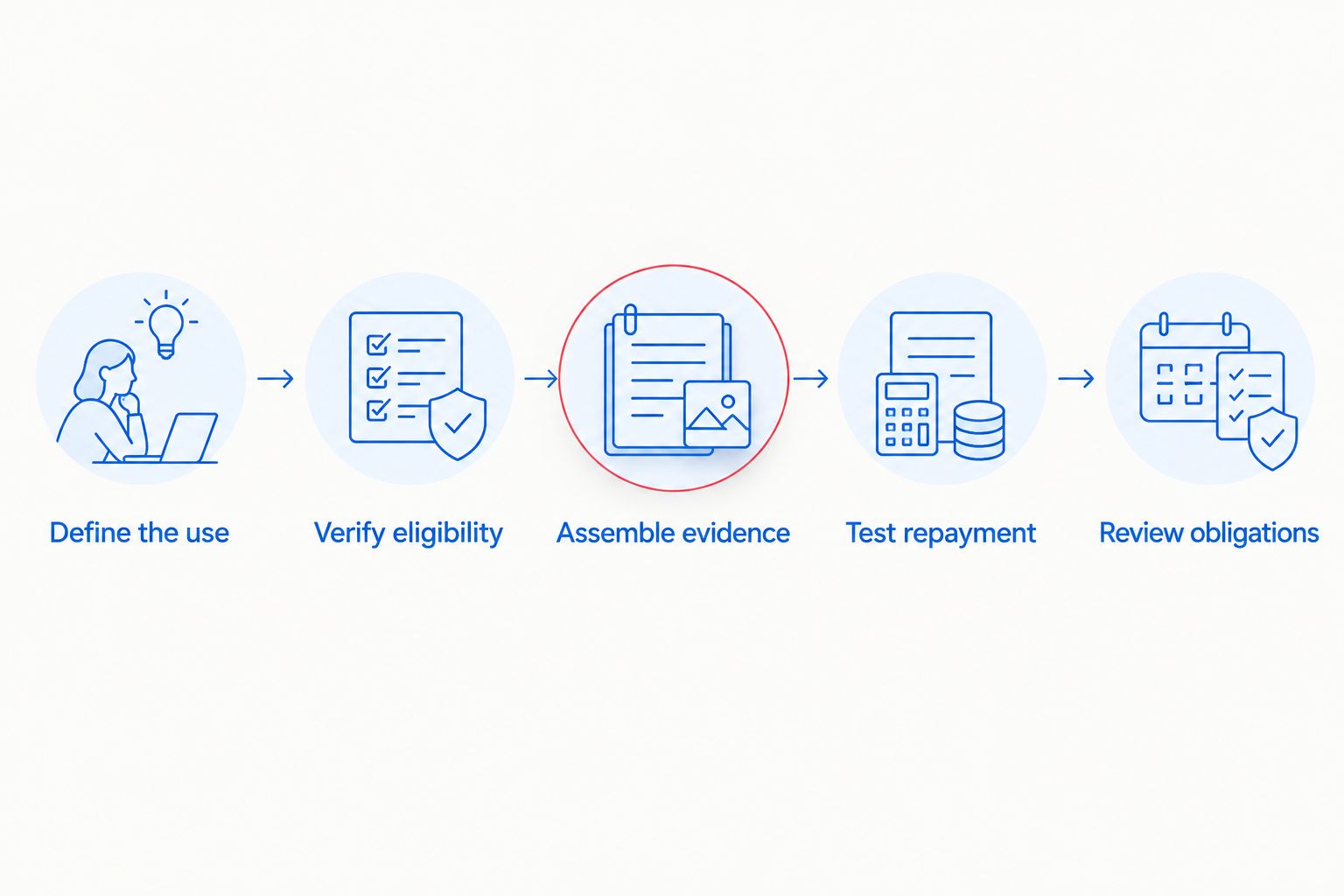
Define the use
Name the expense the credit line would cover. Separate a recurring timing gap from a one-time launch purchase, and identify which expenses remain necessary if customer acquisition takes longer than planned.
A revolving line and a long-term startup funding need are not automatically a match. Your funding structure should follow the expense and repayment plan, not the appeal of having an unused limit.
Verify eligibility
Ask directly whether the product accepts a business with no sales. Then ask whether owner income, pledged cash, or other collateral is relevant to that product's review.
Get product-specific answers before submitting sensitive information. The phrase startup financing describes a broad audience; it does not establish the requirements of any particular offer.
Assemble evidence
Organize business formation records, ownership information, available bank statements, existing obligations, and supporting documents requested by the lender. Keep projections separate from historical results.
A pre-revenue business should say it is pre-revenue. Presenting an owner deposit as customer revenue creates an inaccurate picture of operations.
Test repayment
Build a cash-flow forecast showing when funds leave the business and when customer payments are expected. Include required debt payments and essential operating expenses.
For your 2026 plan, test delayed sales as well as the expected launch. Identify which obligations you can cover without those sales and which expenses you would postpone.
Review obligations
Read the agreement for repayment frequency, interest, fees, collateral, guarantees, and conditions affecting access to future draws. Ask what happens after a missed payment and whether the lender can suspend additional borrowing.
Compare the written terms with the business need you identified at the start. A useful credit line must fit both the spending need and the repayment schedule.
Can I qualify using personal income instead of business revenue?
Personal income supports an application only when the lender accepts it for the specific product. It does not become business revenue because you deposit it into a business account.
Ask how the lender documents and evaluates outside income. Then assess the household impact yourself: money needed for personal obligations is not automatically available to repay business debt.
Does an LLC or EIN qualify me for business credit?
An LLC or EIN does not establish repayment capacity or guarantee credit approval. Formation documents identify the business; underwriting evaluates whether an applicant meets the lender's requirements.
Keep business and personal records separate, but do not assume the business structure prevents personal responsibility. A signed personal guarantee creates obligations according to its terms.
Should I wait until my startup has revenue?
Wait when you cannot identify a credible repayment source without optimistic sales assumptions. Operating revenue gives you actual results to document, but revenue alone does not guarantee approval or make a loan affordable.
Use the waiting period to validate demand, organize records, and reduce nonessential launch spending. In a 2026 funding plan, make borrowing conditional on evidence rather than an arbitrary launch deadline.
What should you check before accepting an offer?
An approval answers whether a provider will extend credit. It does not answer whether you should use it. Review the obligations against your business plan before signing.
- Access to funds: Confirm how draws work and what conditions restrict further borrowing.
- Required payments: Identify when payments begin and whether the schedule fits expected cash receipts.
- Personal exposure: Understand guarantees, collateral pledges, and the consequences of default.
- Credit reporting: Ask which business or personal credit bureaus receive account information.
- Exit terms: Check what happens when you repay, close the account, or request release of collateral.
Compare the written agreement, not just the advertised credit limit. Keep a copy of the terms you accept and a clear record of how borrowed funds will be used.
FAQ
Can a startup get a business line of credit with no revenue in 2026?
Yes, if a lender accepts pre-revenue businesses and the applicant meets its other requirements. Confirm the specific product’s rules before applying; collateral or personal income does not automatically replace a revenue requirement.
Can I get a startup credit line using only my EIN?
An EIN alone does not establish creditworthiness or repayment capacity. Ask which business records, owner information, and financial evidence the lender requires.
Does good personal credit guarantee a business line of credit?
Good personal credit does not guarantee a business line of credit. The lender’s business-revenue, operating-history, and other eligibility requirements still apply.
Is a cash-secured business line better than an unsecured line?
A cash-secured line is not automatically better than an unsecured line. Compare restricted cash, personal responsibility, repayment terms, and the purpose of borrowing before choosing.
Can a business credit card replace a startup line of credit?
A business credit card can support eligible business purchases, but it is not interchangeable with a cash-draw credit line. Check whether your intended expenses can be paid by card and review the repayment obligations.
Does no revenue mean the same thing as no profit?
No revenue means the business has not generated sales; no profit means revenue has not exceeded the relevant expenses. Tell the lender which situation applies and provide records that support it.
Can Trifecta Business Group help with business funding planning?
Trifecta Business Group offers business funding and strategic consulting services for small and mid-sized companies. Approval for a specific financing product remains subject to the provider’s requirements.
One last thing
Owner contributions and loan proceeds are not sales revenue. Your bank balance can rise before you have a customer, but that increase does not demonstrate customer demand or recurring repayment capacity.
Before applying, label the source of each deposit in your records. That simple distinction keeps your funding application accurate and your launch plan grounded in what the business has actually earned.
Related guides
- How to prepare your business for a funding application
- Business credit cards for startups
- How to choose the right funding option for business growth
Plan Your Startup Funding
Put your funding needs and repayment plan in focus before choosing your next step.
How these options compare
| Option | Typical speed | How you repay | Backed by | Best for |
|---|---|---|---|---|
| Line of credit | Days to weeks | Interest only on what you draw | Varies | Recurring or uneven cash-flow gaps |
| Term loan | Days to weeks | Fixed payments over a set term | Varies | One-time investments with a clear payback |
| Merchant cash advance | Often days | Share of daily/weekly sales; priced with a factor rate | Future sales | Urgent needs, card-heavy businesses |
| Invoice factoring | Often days | Customer pays the invoice; fee deducted | Your B2B invoices | Slow-paying business customers |
General guide only. Actual speed, cost and terms depend on the lending partner and your file.
How is a line of credit different from a term loan? +
A line of credit lets you draw funds as needed and pay interest only on what you use. A term loan gives you one lump sum repaid on a fixed schedule.
Can a new business get a line of credit? +
It is harder but possible. Lending partners generally look at time in business, monthly revenue and credit. Stronger bank statements help.
Does applying affect my credit? +
Trifecta Business Group requires no hard credit pull, which does not affect your score. Any hard pull is explained before it happens.
How do I know which funding option fits? +
Start with what the money needs to do, how fast you need it and how you want to repay. Our comparison tool and advisors can help match the program.
Planning your timing
See this month's commercial rate benchmarks before you borrow
Our Small Business Capital & Formation Index tracks the Prime Rate, SBA rate caps, realistic cost ranges by funding type, and new business formation pressure state by state — updated every month.
What are you trying to fund?
Compare flexible working-capital options
Start with working capital and a line of credit, then compare payment structure and speed.
Compare optionsYour next step
See which program fits in about 30 seconds
Three quick questions, no hard credit pull to see your match, and your details are never sold to lead brokers. Commercial financing only — approval is never guaranteed.
Free Trifecta tools
Put this article to work for your business
Keep learning with Trifecta Business Group