

Business Funding · By Trifecta Business Group
Invoice factoring does not automatically hurt your business credit; the effect depends on credit checks, reporting practices, and whether you meet your obligations under the agreement. The separate risk is that repayment demands or liens on your receivables can strain cash flow or complicate future borrowing, even without a credit score drop.
- Is invoice factoring bad for your business credit? Not automatically; reporting practices and unpaid obligations determine the risk.
- Recourse factoring leaves your business responsible for qualifying unpaid invoices under the agreement.
- A UCC filing is a security notice, not proof that your business missed a payment.
- Trifecta Business Group offers business funding and strategic consulting; review credit reporting and contract obligations before choosing funding.
Is invoice factoring bad for your business credit?
Factoring is not automatically a negative credit event. Selling an invoice does not, by itself, mean your business has missed a payment or defaulted on an obligation. But the agreement can create obligations that matter to credit reporting and future lenders.
Start by separating the transaction from its consequences. Your customer owes the invoice; your business can still owe the factor money under recourse, dispute, or other contract provisions. That distinction matters when comparing accounts receivable financing for B2B companies.
| Arrangement | Best for | Main advantage | Main limitation | Credit question to ask |
|---|---|---|---|---|
| Recourse factoring | Businesses able to cover invoices that customers fail to pay | Turns eligible receivables into operating cash | Your business retains repayment exposure under the contract | What happens if an invoice becomes subject to recourse? |
| Nonrecourse factoring | Businesses seeking protection against specifically covered customer credit losses | Transfers the risks expressly covered by the agreement | Disputes and other exclusions can leave your business responsible | Which losses are covered, and which remain your obligation? |
| Invoice-backed financing | Businesses seeking financing secured by receivables rather than an invoice sale | Provides funding against eligible receivables | Creates repayment obligations and collateral restrictions | How are balances, payments, and defaults reported? |
These labels are starting points, not substitutes for reading the contract. In your 2026 funding review, compare the actual reporting, repayment, and collateral provisions rather than relying on a product name.
Why this matters
A credit score and access to funding are different things. A lender can decline an application because receivables are already pledged, even when your business credit score has not changed.
The reverse also matters. Factoring that helps you pay suppliers on time can support better payment habits, but it does not automatically create positive payment history on a business credit report. Protecting credit and building credit require separate checks.
Your decision should answer a practical question: does this agreement solve a collection-timing problem without creating obligations your business cannot absorb? Faster cash does not fix disputed invoices, weak margins, or customers who cannot pay.
Recourse factoring: your repayment exposure remains
With recourse factoring, your business remains responsible for invoices under the circumstances stated in the agreement. A customer’s failure to pay can trigger an obligation to repurchase the invoice, replace it, or repay the advance, depending on the terms.
The advantage is access to cash tied to completed sales. The limitation is that receiving an advance does not eliminate customer payment risk.
Best for: businesses with reliable customers and enough cash flexibility to handle recourse obligations. Before signing, identify exactly when the factor can demand repayment and how you must satisfy that demand.
An unpaid customer invoice and an unpaid obligation to the factor are not the same event. The customer’s delay becomes your credit concern when it creates an obligation your business fails to meet and that failure is reported or pursued through collection.
Ask for the recourse language in writing. Do not accept a general assurance that the factor handles collections as proof that the factor absorbs every loss.
Nonrecourse factoring: protection has boundaries
Nonrecourse factoring shifts specified customer credit risks to the factor. The agreement determines the protection; the label does not mean every unpaid invoice becomes the factor’s loss.
A contract can distinguish customer insolvency from a billing dispute, incomplete work, returned goods, or a breach of your own promises about the invoice. Read those distinctions closely.
Best for: businesses seeking protection against the customer credit losses expressly covered by the contract. The advantage is defined risk transfer; the limitation is that exclusions can leave meaningful obligations with your business.
During a 2026 contract review, ask the factor to explain how the agreement treats a customer that cannot pay versus a customer that refuses to pay. Those situations can produce different outcomes.
Also check the approval conditions. Protection tied to an approved customer or eligible invoice does not necessarily extend to every receivable your business generates.
Why the credit impact of invoice factoring varies
The same funding label can cover different contracts and reporting practices. These factors determine where the credit exposure sits:
- Reporting practices. Find out whether the factor reports account activity, which business credit agencies receive it, and whether reporting includes positive history or only adverse events.
- Credit inquiries. Ask whether the application involves a business credit check, a personal credit check, or both, and whether any personal inquiry is hard or soft.
- Recourse obligations. Identify the circumstances that make your business responsible for an unpaid invoice and the deadline for meeting that obligation.
- Collateral scope. Determine whether the agreement covers selected invoices, all receivables, or additional business assets, and check for conflicts with existing financing.
- Guarantees and defaults. Read what the owner guarantees, what counts as default, and what remedies the factor can pursue.
- Invoice quality. Disputed work, inaccurate billing, credits, and incomplete documentation can create obligations even when the customer remains financially sound.
Do not treat a sales representative’s summary as the agreement. Ask for written answers and confirm that the contract supports them. Have a qualified attorney review provisions you do not understand before committing your receivables.
Does a UCC filing mean your business credit is damaged?
No. A Uniform Commercial Code financing statement gives public notice of a claimed security interest; it is not, by itself, a record of missed payments.
UCC filings can accompany factoring arrangements. Under UCC Article 9, sales of accounts fall within the secured-transactions framework, so a filing does not establish that the arrangement is a conventional loan or that your business is in financial trouble.
Still, the filing can matter when you seek another source of funding. A prospective lender needs to understand which assets are already subject to another party’s claim and whether its proposed collateral position is acceptable.
Read the collateral description alongside the agreement. A filing covering receivables presents a different practical issue from an agreement claiming a broader set of assets.
Before ending a factoring relationship, ask what is required to release the security interest and terminate the filing when appropriate. Paying the final balance and documenting the release are distinct tasks; keep records of both.
How do you protect business credit before signing?
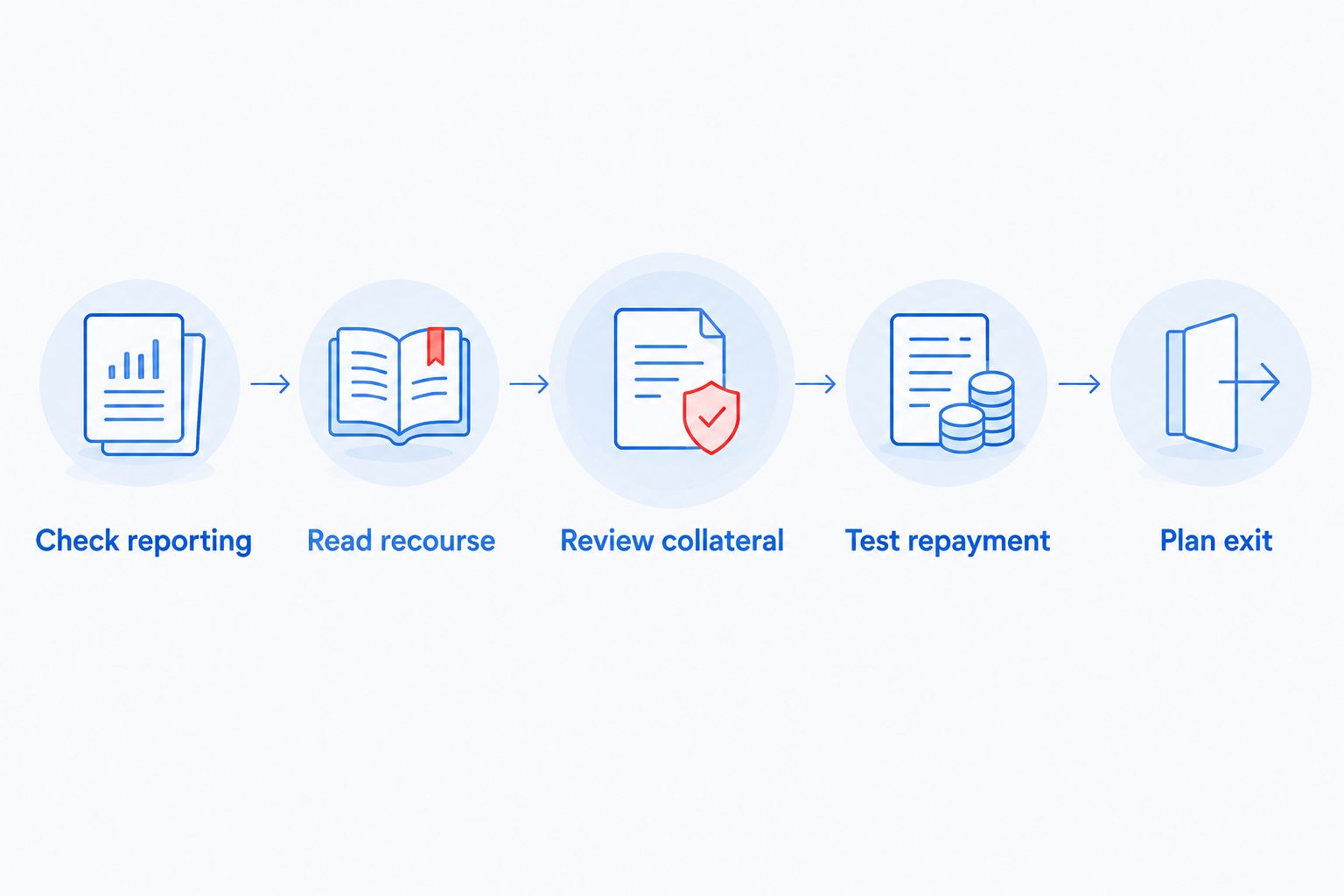
Use this sequence for a 2026 application. The goal is to identify the reporting and repayment consequences before money changes hands.
- Check reporting. Request the factor’s written policy on business credit reporting, adverse reporting, and credit inquiries. Separate business-file effects from personal-credit effects.
- Read recourse. Mark every clause requiring repayment, invoice replacement, or repurchase. Include disputes, customer nonpayment, and breaches of your own contract promises.
- Review collateral. Compare the proposed security interest with your existing loan documents. Ask existing lenders about consent requirements before pledging receivables.
- Test repayment. Work through what happens if an eligible customer pays late, disputes the invoice, or fails to pay. Use your own receivables and cash forecast, not assumed industry averages.
- Plan exit. Identify termination requirements, outstanding obligations, reserve settlement, and the process for releasing collateral claims.
Keep the contract, written answers, and invoice records together. A clear paper trail makes it easier to resolve a disagreement about eligibility, repayment, or release.
Can invoice factoring help you build business credit?
Not automatically. Factoring only creates positive reported account history if the provider reports qualifying activity to a business credit agency that records it.
There is also an indirect effect to consider. Earlier access to receivables can help you meet supplier or financing obligations, but those separate accounts have their own reporting practices. Better cash timing is useful; it is not a promise of a higher score.
If building business credit is your main objective in 2026, ask specifically about positive reporting. A provider that reports defaults but not satisfactory activity offers a different credit-building proposition from one that reports both.
Continue checking your business credit files for inaccurate balances, payment records, or account information. Follow the reporting agency’s dispute process when you find an error, and retain the documents that support your correction.
Can factoring affect your personal credit?
Yes, depending on the application and your personal obligations. A personal hard inquiry can affect consumer credit, while a guarantee creates legal exposure whose reporting consequences depend on what happens and how the obligation is handled.
Do not assume every guarantee covers the same risks. A guarantee addressing fraud or specific contractual promises differs from an obligation to repay every unpaid invoice.
Ask whether the factor checks the owner’s personal credit and whether the inquiry is hard or soft. Then read the guarantee separately from the business agreement. Signing for the business and accepting personal liability are different decisions.
Can you get another business loan while factoring invoices?
Yes, but approval depends on the proposed lender’s requirements and your existing agreement. Receivables already committed to a factor are not automatically available as unrestricted collateral for another lender.
Disclose the factoring relationship during the application. Provide the agreement, current obligations, and collateral information so the lender can assess the actual position rather than discover a conflict late in underwriting.
A lender might require consent, a release, or an agreement establishing each party’s rights. Do not promise the same receivables to another financing provider without checking the restrictions first.
This is where funding strategy matters beyond a credit score. Trifecta Business Group is best suited to small and mid-sized businesses seeking business funding and strategic consulting together. Trifecta Business Group offers those services; the reporting, approval, and collateral terms still require review for any specific funding agreement.
FAQ
Is invoice factoring bad for your business credit in 2026?
Invoice factoring is not automatically bad for your business credit in 2026. Credit inquiries, reporting practices, and unpaid contractual obligations determine the exposure; collateral restrictions can also affect borrowing without changing a score.
Does invoice factoring show up on a business credit report?
Invoice factoring activity appears on a business credit report only when relevant information is supplied to or collected by that reporting agency. Ask the factor which agencies receive account information and whether positive and adverse activity are treated differently.
Does nonrecourse factoring mean I never have to repay the factor?
Nonrecourse factoring does not eliminate every repayment obligation. The contract defines covered customer credit losses and exclusions, including the treatment of disputed or ineligible invoices.
Will a factoring company check my personal credit?
A factoring company can check personal credit as part of its application process, depending on its requirements and your authorization. Ask whether the inquiry is hard or soft before applying.
Is a UCC filing the same as a negative credit mark?
A UCC filing is not the same as a negative payment record. It gives notice of a claimed security interest and can affect how another lender evaluates available collateral.
What happens if my customer never pays a factored invoice?
Your responsibility depends on the agreement’s recourse provisions and any applicable nonrecourse protection. Review repayment, repurchase, dispute, and eligibility clauses before treating an invoice loss as the factor’s responsibility.
Can Trifecta Business Group help with business funding?
Trifecta Business Group offers business funding solutions and strategic consulting for small and mid-sized businesses. Review the specific provider’s credit reporting, collateral requirements, and contractual obligations before accepting funding.
One last thing
Check the exit before you sign the entrance paperwork. A factoring arrangement can leave collateral-release work to complete after the final invoice is settled, and an unresolved claim can complicate your next funding application.
For your 2026 decision, request the termination and release procedure alongside the reporting policy. The right question is not simply whether factoring hurts credit. It is whether you understand every obligation while the agreement is active—and how to close it cleanly.
Related guides
- How to build business credit for better loan terms
- How to prepare your business for a funding application
- How to choose the right funding option for business growth
Plan Your Next Funding Move
Apply for business funding or call to discuss your funding needs.
How these options compare
| Option | Typical speed | How you repay | Backed by | Best for |
|---|---|---|---|---|
| Invoice factoring | Often days | Customer pays the invoice; fee deducted | Your B2B invoices | Slow-paying business customers |
| Line of credit | Days to weeks | Interest only on what you draw | Varies | Recurring or uneven cash-flow gaps |
| Merchant cash advance | Often days | Share of daily/weekly sales; priced with a factor rate | Future sales | Urgent needs, card-heavy businesses |
| Term loan | Days to weeks | Fixed payments over a set term | Varies | One-time investments with a clear payback |
General guide only. Actual speed, cost and terms depend on the lending partner and your file.
How is invoice factoring different from a loan? +
Factoring advances cash against invoices you have already issued to business customers. Your customers' payment history matters as much as your own credit.
What does factoring cost? +
Costs are typically a percentage of the invoice that depends on how long your customer takes to pay. Ask for the full fee schedule before signing.
Does applying affect my credit? +
Trifecta Business Group requires no hard credit pull, which does not affect your score. Any hard pull is explained before it happens.
How do I know which funding option fits? +
Start with what the money needs to do, how fast you need it and how you want to repay. Our comparison tool and advisors can help match the program.
Planning your timing
See this month's commercial rate benchmarks before you borrow
Our Small Business Capital & Formation Index tracks the Prime Rate, SBA rate caps, realistic cost ranges by funding type, and new business formation pressure state by state — updated every month.
What are you trying to fund?
Compare flexible working-capital options
Start with working capital and a line of credit, then compare payment structure and speed.
Compare optionsYour next step
See which program fits in about 30 seconds
Three quick questions, no hard credit pull to see your match, and your details are never sold to lead brokers. Commercial financing only — approval is never guaranteed.
Free Trifecta tools
Put this article to work for your business
Keep learning with Trifecta Business Group