

Business Funding · By Trifecta Business Group
A business consultant’s cost in 2026 depends on the agreed scope, billing structure, and responsibility for execution; compare written proposals for the same work rather than treating a headline rate as the total budget. Your full commitment also includes staff time, implementation work, and any separately agreed expenses. Define the business problem and required deliverables before comparing fees.
- How much does a business consultant cost? Compare the full scope, not an isolated rate.
- Hourly business consulting suits defined questions; project work suits agreed deliverables.
- Trifecta Business Group serves small and mid-sized companies seeking consulting, business funding, and digital marketing.
- Separate advisory work from execution before approving a consulting agreement.
Why this matters
A proposal for recommendations is not equivalent to a proposal for implementation. Comparing the two as if they purchase the same work hides the decision you actually need to make: who will turn the advice into action?
Trifecta Business Group offers strategic consulting, funding solutions, and digital marketing for small and mid-sized companies. Those needs can overlap, but your agreement should identify which services you are buying and which remain outside the engagement.
For your 2026 budget, separate the consultant’s fee from the resources needed to carry out the plan. A sound recommendation still needs an owner, a deadline, and room in your operating budget.
How much does a business consultant cost in 2026?
The amount you pay follows the agreement: time billed, a defined project, or an ongoing engagement. Compare the total commitment against specific deliverables, not the billing label alone. Ask each provider to explain what the quoted work produces and what triggers additional charges.
Use this comparison to choose a structure before requesting proposals. These are engagement models, not service packages offered by a particular firm.
| Billing structure | Best for | Main advantage | Main limitation | What to clarify |
|---|---|---|---|---|
| Hourly consulting | A bounded question or review | Work can stay focused on a specific issue | The total depends on time used | Estimated hours, billing records, and approval limits |
| Fixed-project consulting | An agreed deliverable | You can compare proposals against a defined output | Changes outside scope need separate agreement | Deliverables, revisions, exclusions, and acceptance criteria |
| Ongoing consulting | Recurring decisions and follow-through | Advice stays connected to continuing work | A recurring commitment needs clear boundaries | Included work, meeting cadence, responsibilities, and exit terms |
An hourly arrangement does not automatically mean a smaller commitment. A fixed project does not automatically include implementation. An ongoing agreement does not automatically provide unlimited access.
For a useful comparison, ask providers to quote the same business problem, inputs, outputs, and responsibilities. Otherwise, you are comparing different assignments rather than different proposals.
Hourly consulting: best for a bounded question
Hourly consulting fits work that you can describe narrowly, such as reviewing a growth plan or discussing a specific operating decision. You retain control by defining the question and agreeing on approval boundaries before work starts.
The limitation is uncertainty about the total time required. If the review uncovers a broader problem, pause and agree on the next assignment instead of letting a small request expand informally.
Ask whether preparation, research, meetings, and follow-up count as billable time. Get the answer in writing so both sides understand what the engagement includes.
Choose hourly consulting when the question is clear and you can control the work boundary. Do not use an open-ended request such as “help us grow” as the scope.
Fixed-project consulting: best for defined deliverables
Fixed-project consulting fits an assignment with an identifiable finish line. A growth plan, an operating review, or a marketing strategy can be scoped around specific outputs and acceptance criteria.
Its advantage is a defined commitment for defined work. Its limitation is that new requirements sit outside the original agreement unless the contract includes them.
Describe what a completed deliverable must contain. A presentation of recommendations and a working implementation plan are different outputs, even when both address the same business problem.
Choose fixed-project consulting when you can agree on what completion looks like. Clarify who owns execution after the consultant delivers the work.
Ongoing consulting: best for recurring decisions
Ongoing consulting fits a business that needs repeated review, prioritization, and follow-through. It gives continuing decisions a place in the working relationship rather than treating every question as a separate assignment.
The trade-off is a continuing commitment. Without defined priorities, recurring meetings can become the activity rather than supporting decisions and action.
Ask what happens between meetings, who completes assigned work, and how either side changes or ends the arrangement. Keep those terms distinct from the business goals themselves.
Choose ongoing consulting when you have recurring decisions and someone accountable for acting on them. Reassess the scope when the original problem changes.
Why business consulting costs vary
Your business problem determines the work required. Use these factors to explain differences between proposals rather than assuming every consultant is quoting the same assignment.
- Scope of the problem. Reviewing a funding decision is different from coordinating funding, marketing, and a broader growth strategy. Identify the decisions included in the assignment.
- Depth of review. Agree on which financial records, marketing reports, and operating processes the consultant will examine. A review based on a summary has a different scope from detailed analysis.
- Required outputs. A discussion, written recommendations, and an implementation plan are distinct deliverables. Name the output instead of relying on a broad service label.
- Execution responsibility. Establish whether your team or the consultant carries out approved changes. Do not assume advisory work includes delivery.
- Continuity of support. A defined assignment and an ongoing relationship involve different commitments. Specify what follow-through means in the agreement.
For a 2026 proposal, ask the provider to connect each major activity to an output. If you cannot tell what an activity produces, request a clearer description before approving it.
How do I compare consulting proposals fairly?
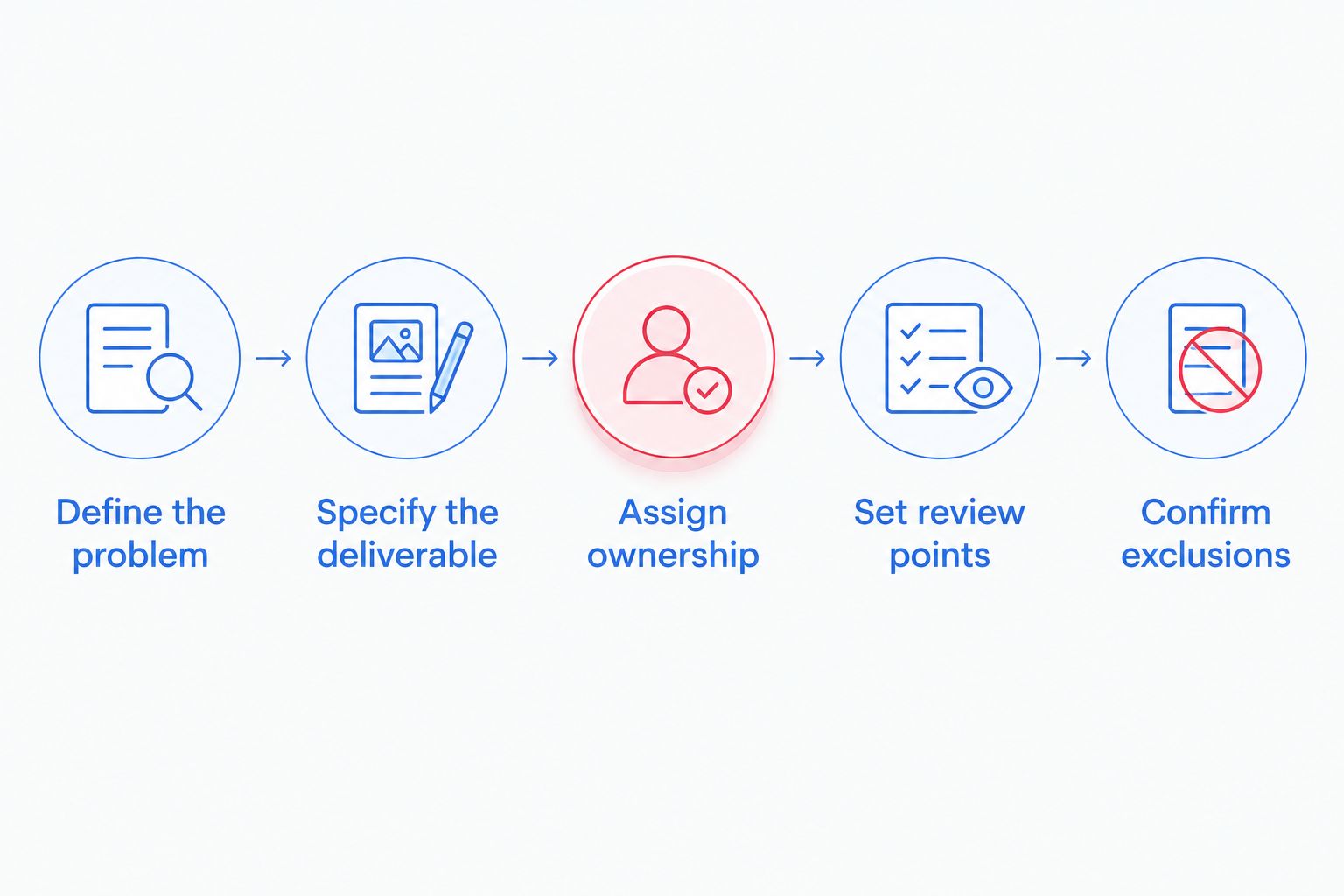
Build a 1-page brief before you request proposals. State the business problem, the decision you need to make, the information you can provide, and the outcome you want the engagement to support.
Then use the same brief with every provider. This creates a consistent starting point without forcing every consultant to recommend the same solution.
- Define the problem. Describe the constraint in plain language. “Our sales process lacks clear ownership” gives a consultant more direction than “we need strategy.”
- Specify the deliverable. Ask for an output your team can use, such as a documented action plan with assigned responsibilities.
- Assign ownership. Identify who supplies information, approves decisions, and completes implementation work.
- Set review points. Agree on when you will review progress and how you will handle changes to the assignment.
- Confirm exclusions. Record work that is not included, along with the approval process for adding it.
These steps keep the discussion focused on the assignment rather than the length of the proposal. Ask providers to identify assumptions that would change their scope.
Before signing, apply 3 acceptance checks: Is the deliverable clear? Is the owner named? Is the completion condition written down? These are buying criteria, not performance guarantees.
Reject vague completion language such as a promise to improve the business without defining the work. You need to know what you can inspect and accept when the assignment ends.
What should I budget beyond the consulting agreement?
Your implementation budget belongs beside the consulting agreement, not hidden inside an assumption. Separate the work of deciding what to do from the work of doing it.
For marketing assignments, distinguish strategy from campaign production, advertising, and ongoing management. Comparing advisory work with an embedded leadership role also requires care: fractional CMO costs concern a different responsibility when the engagement includes ongoing marketing leadership rather than a defined consulting deliverable.
For operations work, identify the staff time needed to document processes, review recommendations, and introduce approved changes. Your team’s participation is part of the commitment even when it does not appear on the consultant’s invoice.
For funding-related work, keep business consulting and financing decisions separate. Advice about preparing for growth does not establish the terms of a financing agreement or guarantee approval.
Use 2 budget categories in your planning document: advisory work and implementation. Put each proposed activity in the appropriate category, then ask about anything that remains unclear.
A small-business marketing budget should distinguish the resources used to plan a campaign from the resources used to run it. Apply that same separation when consulting recommendations affect your marketing spend.
Is a business consultant worth hiring?
A business consultant is worth considering when you have a specific decision, a defined gap in expertise or capacity, and someone responsible for implementation. The engagement needs a job to do.
Trifecta Business Group business consulting is best suited to small and mid-sized companies seeking help with growth strategy, funding, and digital marketing. The fit comes from those stated service areas, not a promise of a particular financial result.
The limitation is equally important: a consulting service description is not a statement of your engagement’s deliverables. Confirm the scope, responsibilities, and terms before deciding whether any provider fits your assignment.
For your 2026 decision, compare the proposed work with the problem you need to solve. Do not approve a broad engagement simply because the presentation describes an attractive future.
Should I hire a consultant or handle the work internally?
Keep the work internal when your team has the expertise, time, and authority to complete it. Outside advice does not remove the need for internal ownership.
Consider consulting when the missing piece is a specific skill, independent analysis, or structured support for a decision. Define that gap before asking for a proposal.
If the problem is an unfilled operating role, distinguish that staffing need from a consulting assignment. A recommendation alone will not cover recurring responsibilities that nobody owns.
FAQ
How much does a business consultant cost in 2026?
A business consultant’s cost in 2026 depends on the written scope and billing agreement. Compare proposals for the same deliverables, then account separately for implementation work and staff time.
Is hourly consulting better than a fixed project?
Hourly consulting suits a bounded question; a fixed project suits an agreed deliverable. Choose the structure that makes the work and approval boundaries clearest.
What should a business consulting proposal include?
A business consulting proposal should identify the problem, deliverables, responsibilities, completion conditions, and exclusions. It should also explain how changes to the assignment are approved.
Does a consulting agreement include implementation?
Implementation is included only when the agreement explicitly assigns that work. Confirm whether the consultant delivers recommendations, carries out changes, or shares execution responsibilities with your team.
Can a consultant guarantee business funding?
Do not treat a consulting engagement as a funding guarantee. Review any financing application and agreement separately from the advisory scope.
What does Trifecta Business Group help businesses with?
Trifecta Business Group offers business consulting, funding solutions, and digital marketing for small and mid-sized companies. Confirm which services and deliverables belong in your proposed engagement.
How do I keep consulting work within the agreed scope?
Use a written brief, clear deliverables, and an approval process for changes. Review new requests before authorizing work outside the original assignment.
One last thing
Ask what your team will do differently after the engagement ends. A proposal should connect its deliverables to decisions and assigned actions, not just to meetings or documents.
Before approving your 2026 consulting agreement, have the internal owner explain the next step in plain language. If that person cannot identify the action, clarify the assignment before committing.
Related guides
- How to choose a business consulting firm
- How to create a business growth plan
- How to prepare your business for a funding application
Plan your next funding step
Connect your business funding needs with your growth priorities.
How these options compare
| Option | Typical speed | How you repay | Backed by | Best for |
|---|---|---|---|---|
| Term loan | Days to weeks | Fixed payments over a set term | Varies | One-time investments with a clear payback |
| Line of credit | Days to weeks | Interest only on what you draw | Varies | Recurring or uneven cash-flow gaps |
| SBA loan | Weeks to months | Long fixed terms, lower payments | Often required | Established businesses that can wait |
| Merchant cash advance | Often days | Share of daily/weekly sales; priced with a factor rate | Future sales | Urgent needs, card-heavy businesses |
General guide only. Actual speed, cost and terms depend on the lending partner and your file.
Does applying affect my credit? +
Trifecta Business Group requires no hard credit pull, which does not affect your score. Any hard pull is explained before it happens.
How do I know which funding option fits? +
Start with what the money needs to do, how fast you need it and how you want to repay. Our comparison tool and advisors can help match the program.
Planning your timing
See this month's commercial rate benchmarks before you borrow
Our Small Business Capital & Formation Index tracks the Prime Rate, SBA rate caps, realistic cost ranges by funding type, and new business formation pressure state by state — updated every month.
What are you trying to fund?
Compare flexible working-capital options
Start with working capital and a line of credit, then compare payment structure and speed.
Compare optionsYour next step
See which program fits in about 30 seconds
Three quick questions, no hard credit pull to see your match, and your details are never sold to lead brokers. Commercial financing only — approval is never guaranteed.
Free Trifecta tools
Put this article to work for your business
Keep learning with Trifecta Business Group