

Business Funding · By Trifecta Business Group
Invoice factoring costs in 2026 depend on the fee calculation, how long your customer takes to pay, and the additional charges in your agreement—not a universal average. The headline fee also leaves out an important distinction: money held in reserve is not necessarily a charge, but it reduces the cash you receive upfront.
- How much does invoice factoring cost? Compare the complete contract, not just the advertised factoring fee.
- Separate invoice factoring fees from reserves: withheld cash is not automatically a permanent expense.
- Check payment timing, additional charges, and customer nonpayment obligations before signing.
- Trifecta Business Group is best for small and mid-sized companies seeking funding, marketing, and strategic consulting together.
Why this matters
A factoring agreement affects more than your funding expense. It determines how much cash reaches your business now, what remains available after collection, and what happens when a customer pays late or disputes an invoice.
Trifecta Business Group offers business funding, marketing, and consulting services. For your funding decision, start with the cash gap you need to close and the customer payments expected to close it. Compare usable cash and contractual obligations together.
How much does invoice factoring cost in 2026?
Your factoring cost is the fee charged under the agreement plus any applicable additional charges. The invoice amount alone does not tell you the total, and the advance alone does not tell you the expense.
Ask for a written settlement illustration using an actual invoice from your business. It should show the advance, the reserve, every deduction, and the amount released after the customer pays.
| Contract component | What it means | What to verify |
|---|---|---|
| Factoring fee | The charge for the factoring transaction | The calculation base and the event that triggers the charge |
| Time-based charges | Charges tied to how long an invoice remains unpaid | When each billing period begins and ends |
| Additional charges | Separate charges listed in the agreement | Which are mandatory and which depend on an event |
| Reserve | Invoice proceeds withheld pending settlement | When the balance is released and what can be deducted |
| Nonpayment obligation | Your responsibility when a customer does not pay | Repurchase, replacement, repayment, and other remedies |
The reserve is not automatically the cost. A reserve returned after collection is delayed cash; a fee deducted from that reserve is an expense. Keep those categories separate when reviewing a proposal.
Use a complete cost worksheet
Build your comparison from the written agreement rather than a sales summary. Record the invoice face amount, the cash advanced, the fee calculation, applicable additional charges, customer payment timing, and the final reserve release.
Then reconcile the money: the advance plus the final release should explain the invoice proceeds you retain after deductions. If the figures do not reconcile, request a corrected settlement illustration before deciding.
Do not compare a percentage charged on the full invoice with a percentage charged on the advance as though they use the same base. Ask the provider to identify the base explicitly and explain every deduction in plain language.
Flat-fee factoring: check what the fee covers
A flat-fee structure uses a stated charge for the transaction under specified conditions. Its practical benefit is clarity: you can identify the agreed fee without interpreting a schedule of repeated charges.
The limitation is in those conditions. Confirm whether the stated fee still applies if collection takes longer than expected, whether an overdue invoice triggers another charge, and whether separate administrative charges remain outside the quoted fee.
Best for: comparing invoices when the contract clearly defines the covered payment window and all separate charges. Do not treat the word flat as proof that the entire agreement has a fixed total expense.
Time-based factoring: check when charges accumulate
A time-based structure ties charges to the period before collection or another contract-defined stopping event. Your customer's payment behavior therefore becomes part of your funding decision.
Read the billing rules carefully. Find out whether a partial period triggers a full charge, whether charges stop when payment arrives or when it clears, and how partial customer payments affect the remaining balance.
Best for: businesses that can track customer payment timing closely and evaluate the agreement against that history. The drawback is uncertainty when collection runs beyond your expected date.
| Fee structure | Best for | Practical advantage | Main limitation |
|---|---|---|---|
| Flat-fee structure | A clearly defined transaction and payment window | Easier to identify the stated transaction charge | Exceptions and separate charges still require review |
| Time-based structure | Businesses with reliable payment records | Makes the relationship between time and charges explicit | Longer collection can increase the total charge |
Neither structure wins by name alone. Use the same invoice and the same payment assumptions to compare both.
Why invoice factoring costs vary
For a 2026 quote comparison, separate the provider's pricing rules from the characteristics of your receivables. These factors belong in your review because they affect the transaction's timing, risk, or contractual scope:
- Customer payment timing: A time-based agreement connects collection timing to charges. Use actual payment history rather than the due date alone.
- Customer creditworthiness: The factor evaluates the party expected to pay the invoice. Ask how that assessment affects eligibility and quoted terms.
- Invoice quality: Disputed invoices, incomplete delivery records, and unresolved credits complicate verification and collection. Resolve discrepancies before submitting an invoice.
- Volume commitments: An agreement requiring continuing invoice submissions creates obligations beyond a single transaction. Check minimum activity requirements and the consequences of missing them.
- Risk allocation: Recourse provisions and nonrecourse exclusions determine which unpaid invoices remain your responsibility. Read the covered events, not just the label.
- Contract charges: Setup, transfer, servicing, termination, or other charges matter only when the agreement includes them. Request the complete schedule and the trigger for each charge.
Do not assume every provider uses every charge on that list. Your signed documents determine which obligations apply to your business.
How do you compare factoring quotes fairly?
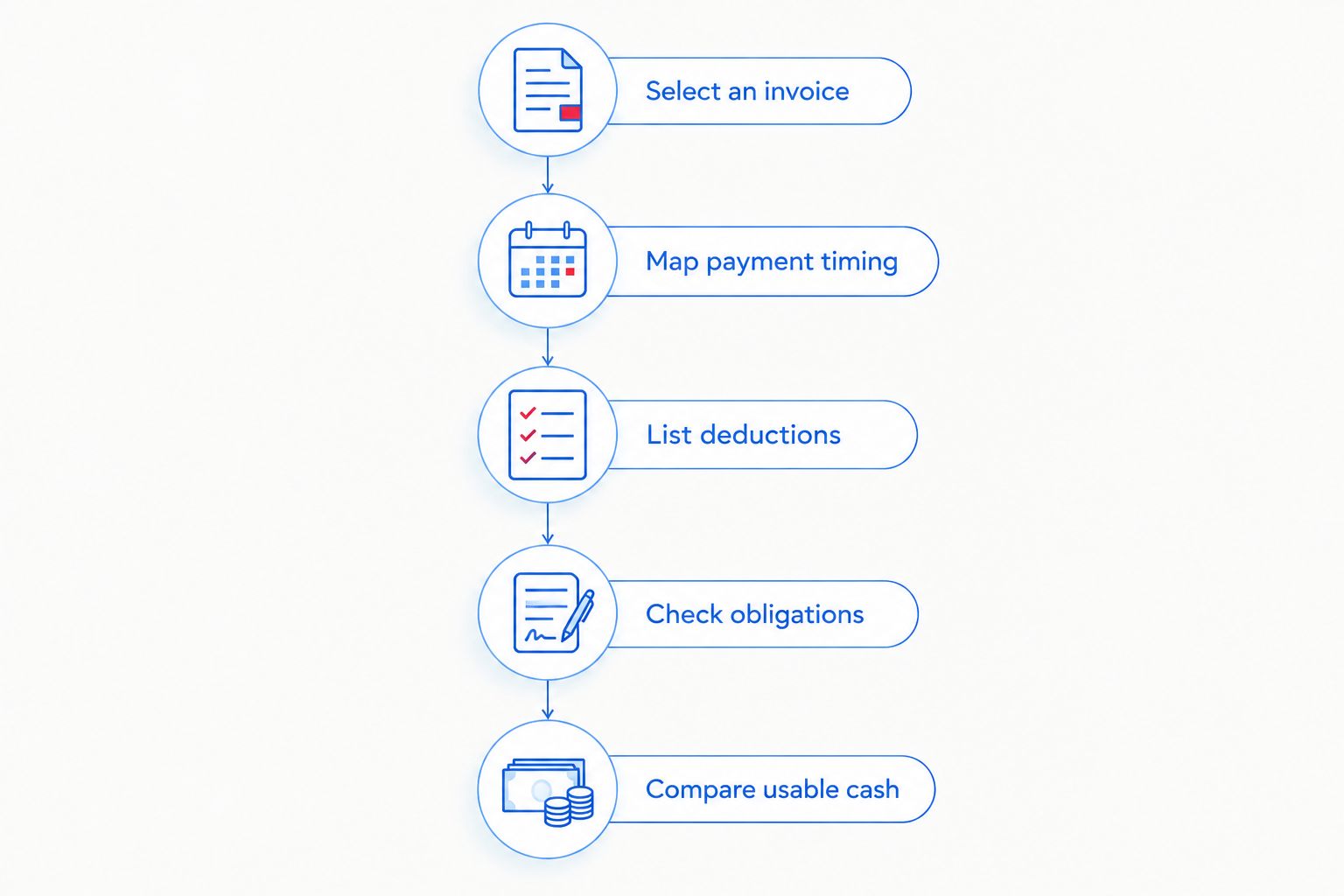
Use a repeatable process for every proposal. A lower headline fee is not a useful result if the comparison ignores a different advance, a longer commitment, or a broader repayment obligation.
- Select an invoice. Choose a real, undisputed receivable supported by your normal delivery or service records. Give each provider the same facts.
- Map payment timing. Identify the expected collection date and a later-payment scenario based on your customer's history. Request a settlement illustration for each.
- List deductions. Separate the factoring fee from all other charges. Ask which deductions apply per invoice, per transfer, or across the agreement.
- Check obligations. Read the rules for reserves, customer contact, nonpayment, minimum activity, renewal, and termination.
- Compare usable cash. Review the initial advance, final release, and total deductions together. Decide whether the available cash solves the specific business need.
This sequence keeps the comparison tied to an actual transaction. It also makes unexplained differences easier to challenge before you sign.
Ask for answers you can verify
Have the provider point to the contract language behind each answer. A verbal explanation does not replace a written fee schedule, reserve policy, or termination clause.
If a proposal changes during review, request a fresh illustration. Keep the latest agreement and its supporting schedules together so you are not comparing a revised offer against an outdated summary.
What happens if your customer pays late?
Late payment affects both access to your reserve and any charges tied to collection time. It can also trigger contractual remedies, so review the overdue-invoice section before treating factoring as a predictable cash-flow tool.
Ask when an invoice becomes ineligible, whether you must replace or repurchase it, and what happens if the customer makes a partial payment. Check whether the agreement distinguishes ordinary delay from a dispute or a customer's insolvency.
A late invoice is not automatically an invoice a factor will accept. Existing overdue status, documentation, and customer eligibility still matter. The guide to factoring invoices when clients pay late provides a related starting point for reviewing that situation.
For your 2026 cash plan, use the collection date your customer history supports—not the date you need the money back. Funding does not remove the need to manage receivables.
Does nonrecourse factoring eliminate your risk?
Nonrecourse factoring does not mean every unpaid invoice becomes the factor's responsibility. The agreement defines the covered nonpayment events and the exclusions that leave obligations with your business.
Review customer insolvency, invoice disputes, credits, delivery failures, and breaches of your own representations separately. Do not assume that protection for a defined credit event also covers a disagreement about your work.
Recourse factoring leaves specified nonpayment obligations with the seller. Its limitation is the continuing exposure; its terms still need to be assessed alongside the fee, advance, and reserve rules.
| Risk arrangement | Best for | What to evaluate | Main limitation |
|---|---|---|---|
| Recourse factoring | Businesses prepared to retain the specified customer-payment risk | Repurchase triggers and available remedies | Unpaid invoices can create obligations after the advance |
| Nonrecourse factoring | Businesses seeking protection against defined nonpayment events | Covered events and exclusions | Protection does not extend to every reason an invoice goes unpaid |
Neither label replaces contract review. Ask the provider to explain what happens to the same invoice under delay, dispute, and insolvency scenarios.
Is invoice factoring worth the cost for your business?
Invoice factoring fits a timing problem more directly than a profitability problem. Receiving invoice proceeds sooner does not repair a sale that already loses money after delivery and collection expenses.
Start with the purpose of the cash. Identify the payroll, supplier payment, or operating expense the advance will cover, then check whether the remaining proceeds still support the transaction's economics.
Use these decision rules:
- Proceed with comparison when you have eligible invoices, a defined cash gap, and enough margin to absorb the documented deductions.
- Pause when the funding depends on disputed invoices, unclear customer payment dates, or reserve releases you cannot explain.
- Reconsider the structure when you need ongoing funding that is not tied to eligible receivables.
Trifecta Business Group's business funding and strategic consulting services are relevant when you need to assess funding alongside the broader growth plan. That service fit does not establish any particular factoring rate, approval result, or contract term.
What should you check before signing in 2026?
Read beyond the transaction illustration. An agreement can create continuing commitments even when your immediate need involves a single invoice.
Check exclusivity, automatic renewals, notice requirements, minimum activity, security interests, and restrictions involving existing financing. Confirm who communicates with customers and where customers must send payment.
Know how to leave before you enter. Ask what must happen to outstanding invoices, reserves, and any security interest when the relationship ends. Have a qualified adviser review terms you do not understand before signing.
FAQ
How much does invoice factoring cost in 2026?
Invoice factoring costs depend on the agreement’s fee calculation, collection timing, and applicable additional charges. Request a written settlement illustration using an actual invoice to see the complete deductions.
Is the factoring reserve an extra fee?
The factoring reserve is not automatically an extra fee; it is withheld invoice proceeds pending settlement. The agreement determines when the remaining reserve is released and which charges can be deducted.
Does invoice factoring get more expensive if a customer pays late?
Invoice factoring becomes more expensive with delay when the agreement adds time-based or late-payment charges. A flat-fee agreement still needs review for overdue-invoice exceptions and other contractual remedies.
Is nonrecourse factoring better than recourse factoring?
Nonrecourse factoring is better suited to a business seeking protection against the specific nonpayment events covered by the agreement. It does not remove every risk, so compare exclusions and obligations alongside the fees.
Can I compare a factoring fee directly with a loan interest rate?
A factoring fee and a loan interest rate are not directly comparable without accounting for their calculation bases, timing, and other charges. Compare actual cash received, total payments or deductions, and the period involved.
What documents should I request before accepting a factoring offer?
Request the complete agreement, fee schedule, reserve rules, and a written settlement illustration. Include the provisions covering nonpayment, customer contact, renewal, and termination in your review.
Does Trifecta Business Group offer more than business funding?
Trifecta Business Group offers business funding, digital marketing, and strategic consulting services for small and mid-sized companies. Those services address funding and broader business growth needs.
One last thing
A larger advance is not proof of a lower factoring expense. It changes when you receive invoice proceeds; the fee schedule and final settlement determine what you keep.
For your 2026 decision, ask for a sample settlement statement before signing—not just a proposal. If you cannot trace the invoice from advance to final release, the comparison is not finished.
Related guides
- Accounts receivable financing for B2B companies
- Invoice factoring companies for small businesses
- How to prepare your business for a funding application
Take the next funding step
Start your business funding application or call to discuss your funding needs.
How these options compare
| Option | Typical speed | How you repay | Backed by | Best for |
|---|---|---|---|---|
| Invoice factoring | Often days | Customer pays the invoice; fee deducted | Your B2B invoices | Slow-paying business customers |
| Line of credit | Days to weeks | Interest only on what you draw | Varies | Recurring or uneven cash-flow gaps |
| Merchant cash advance | Often days | Share of daily/weekly sales; priced with a factor rate | Future sales | Urgent needs, card-heavy businesses |
| Term loan | Days to weeks | Fixed payments over a set term | Varies | One-time investments with a clear payback |
General guide only. Actual speed, cost and terms depend on the lending partner and your file.
How is invoice factoring different from a loan? +
Factoring advances cash against invoices you have already issued to business customers. Your customers' payment history matters as much as your own credit.
What does factoring cost? +
Costs are typically a percentage of the invoice that depends on how long your customer takes to pay. Ask for the full fee schedule before signing.
Does applying affect my credit? +
Trifecta Business Group requires no hard credit pull, which does not affect your score. Any hard pull is explained before it happens.
How do I know which funding option fits? +
Start with what the money needs to do, how fast you need it and how you want to repay. Our comparison tool and advisors can help match the program.
Planning your timing
See this month's commercial rate benchmarks before you borrow
Our Small Business Capital & Formation Index tracks the Prime Rate, SBA rate caps, realistic cost ranges by funding type, and new business formation pressure state by state — updated every month.
What are you trying to fund?
Compare flexible working-capital options
Start with working capital and a line of credit, then compare payment structure and speed.
Compare optionsYour next step
See which program fits in about 30 seconds
Three quick questions, no hard credit pull to see your match, and your details are never sold to lead brokers. Commercial financing only — approval is never guaranteed.
Free Trifecta tools
Put this article to work for your business
Keep learning with Trifecta Business Group