

Business Funding · By Trifecta Business Group
Yes, a business consultant can help with fundraising by clarifying your funding needs, preparing financial information, comparing funding routes, and organizing applications or investor materials. A consultant does not replace the lender's approval process or an investor's decision, and consulting support does not guarantee funding.
- Can a business consultant help with fundraising? Yes—through funding strategy, financial preparation, and application support.
- Trifecta Business Group combines business funding and strategic consulting for small and mid-sized companies.
- Choose debt, equity, or grants according to repayment capacity, ownership goals, and eligibility.
- Hire for specific deliverables, not promises of guaranteed approval or investor access.
Can a business consultant help with fundraising?
A business consultant can turn a general request for money into a funding plan that explains the purpose, supporting evidence, and next steps. The useful work happens before and during the application or investor-review process—not just when someone introduces a funding source.
Trifecta Business Group offers business funding, digital marketing, and strategic consulting services. When evaluating any consultant, separate the services advertised from the specific work included in your engagement.
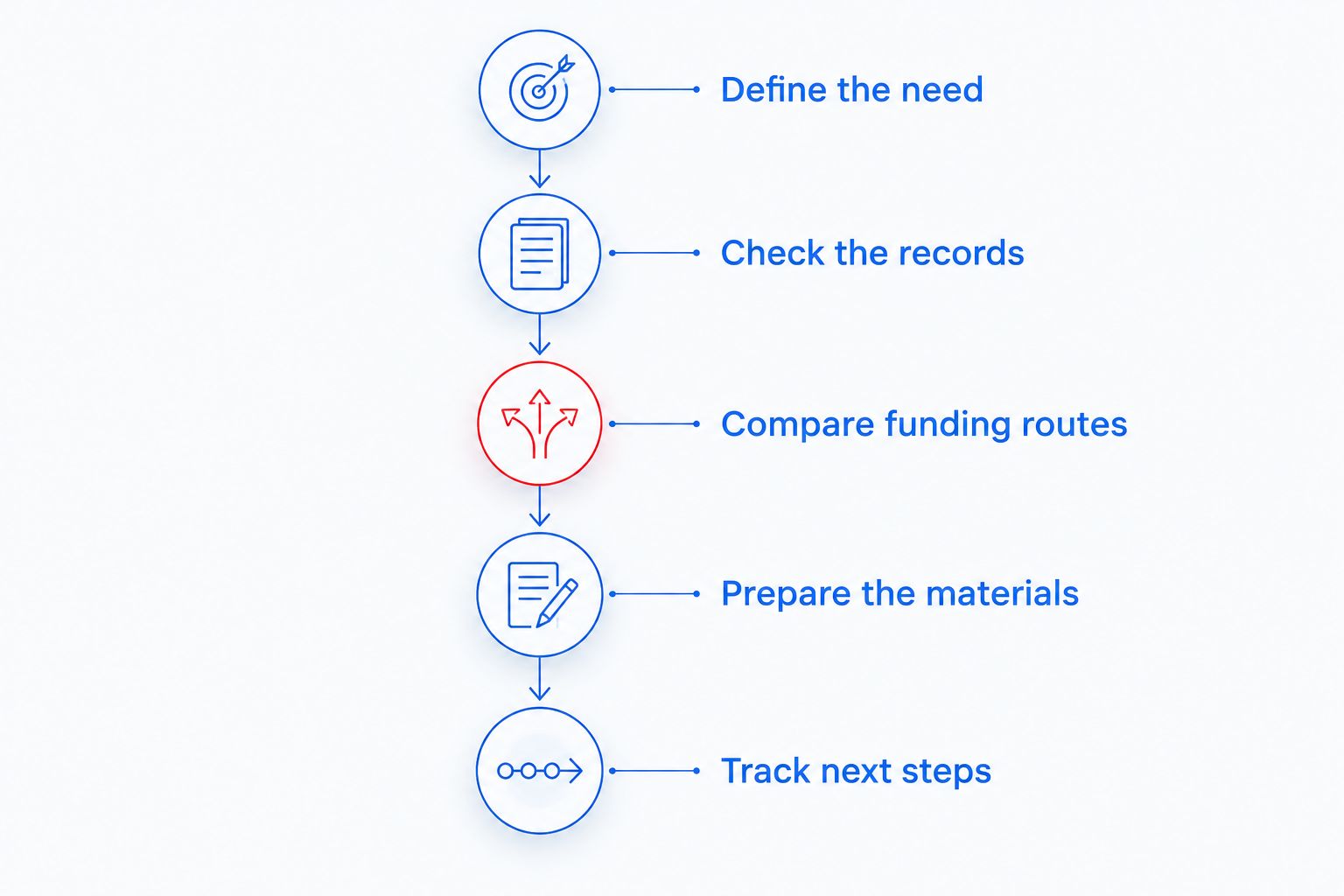
Ask a prospective consultant to explain how the following sequence would apply to your business:
- Define the need. Identify what the money will fund and what business outcome you expect.
- Check the records. Review financial statements, obligations, and the evidence behind your request.
- Compare funding routes. Assess borrowing, outside investment, or relevant grant opportunities against your goals.
- Prepare the materials. Organize the application, financial forecast, or investor presentation required for the chosen route.
- Track the next steps. Assign responsibility for questions, document requests, and decisions.
Treat this sequence as a proposed scope, not a promise that every consultant provides every service. Get the agreed responsibilities in writing before work begins.
Why this matters
A funding request needs a business reason. Buying equipment, covering a seasonal gap, and financing expansion require different explanations of how the money will be used and what happens afterward.
For your 2026 funding plan, separate the immediate cash need from the longer-term growth goal. A consultant's work should help you connect those decisions rather than treat every shortfall as a reason to borrow.
Better preparation is a useful deliverable. Guaranteed funding is not a credible consulting promise. Your business still has to satisfy the requirements of the organization providing the capital.
What kind of fundraising help do you need?
For an operating business, fundraising can mean borrowing money or bringing in investors. Grants are another potential route when a specific program fits the applicant and intended use; they are not interchangeable with unrestricted business financing.
| Funding route | Best for | Useful consulting work | Main benefit | Main limitation |
|---|---|---|---|---|
| Business borrowing | Owners seeking capital without selling ownership | Organizing financial records, assessing repayment capacity, and preparing applications | Preserves ownership | Creates repayment obligations; terms require careful review |
| Equity investment | Owners willing to share ownership to support growth | Preparing the business case, forecast, and investor presentation | Does not operate like a conventional loan | Dilutes ownership and can introduce investor rights |
| Grants | Businesses that fit a particular program's eligibility and purpose | Checking eligibility and organizing an application | Generally does not require selling ownership | Use restrictions, competition, and reporting requirements depend on the program |
Start with the business need, not the most appealing funding label. A consultant should explain why a route fits your situation and identify the trade-offs before recommending an application.
Business borrowing: preparation and repayment planning
Loan preparation centers on the business's ability to support the obligation. Ask the consultant to show how the proposed funding use connects to cash generation, existing obligations, and the requested repayment structure.
The benefit is a clearer borrowing decision. The limitation is that a well-organized application cannot remove a lender's eligibility requirements or compensate for an unsupported repayment plan.
Equity investment: a growth case and ownership decision
Investor preparation needs more than an attractive presentation. Your materials should explain the customer problem, business model, evidence of demand, growth plan, and assumptions behind the forecast.
The benefit is a structured investment case. The trade-off is ownership: before pursuing investors, decide what control and economic interests you are prepared to share, then obtain legal advice on proposed terms.
Grants: eligibility before application writing
Begin with the program rules. Confirm the eligible applicant, permitted activities, required evidence, and reporting obligations before paying someone to prepare an application.
The benefit is access to a route that fits a defined purpose. The limitation is that your business need alone does not establish eligibility, and a consultant cannot promise an award.
What should a fundraising consultant deliver?
Buy defined work rather than vague access to capital. A useful engagement names the documents you will receive, the decisions those documents support, and who owns the next step.
Consider requesting these deliverables for a 2026 funding review:
- A 1-page funding brief. Summarize the purpose, intended use, desired outcome, and evidence supporting the request.
- A 12-month cash-flow forecast. Use this as a planning horizon, with assumptions clearly separated from actual results.
- A funding-route comparison. Record the reasons to pursue or reject each relevant route.
- A document checklist. Identify the records needed for the specific application or investor review.
- A 30-day action plan. Set preparation tasks and owners; do not treat it as a promised funding timeline.
These are suggested planning deliverables, not universal application requirements. Adjust the scope to the funding source and your business's stage.
A consultant should also explain the handoff. Confirm whether the engagement ends with prepared materials or includes help responding to follow-up questions; do not assume ongoing support is included.
Why fundraising support varies
The right consulting scope depends on what needs fixing before you approach a funding source. Use these factors to frame the discussion:
- Purpose of the capital. Equipment, working capital, and expansion call for different supporting explanations.
- Quality of financial records. Incomplete or inconsistent records create preparation work before an application is ready.
- Stage of the business. An established operating history and a new venture require different evidence.
- Repayment and ownership goals. Your willingness to take on obligations or share ownership changes the available routes.
- Application requirements. A lender, investor, or grant program determines its own review materials.
- Internal capacity. Decide which tasks your team can complete and which require outside help.
Do not pay for a large engagement when you need a narrowly defined document review. Equally, do not expect presentation editing to solve unresolved financial or operating questions.
How do you choose the right consultant in 2026?
Choose a consultant whose agreed scope matches the decision you need to make. Ask for a plain-language explanation of the work, its limits, and how you will assess completion.
Trifecta Business Group is best for small and mid-sized companies seeking business funding and growth consulting together. Its stated service scope includes funding solutions, digital marketing, and strategic consulting; confirm the fundraising-specific deliverables before engaging the firm.
The advantage of that combination is its relevance to owners considering funding alongside business growth. The boundary is equally important: that service description is not evidence of investor introductions, securities-placement services, or guaranteed approval.
Before hiring any consultant, ask:
- What exactly will you produce, and what information must I provide?
- Does the engagement cover preparation only, or also application follow-up?
- Who makes the funding decision?
- Do you receive referral compensation from any recommended provider?
- What happens if the business is not ready to apply?
- Which work requires an accountant, attorney, or another qualified specialist?
Keep the proposal and answers together. They give you a concrete basis for deciding whether the completed work matches the agreement.
What should you prepare before the first meeting?
Bring records that explain how the business operates and why it needs capital. Start with available financial statements, bank records, existing obligations, ownership information, and a written description of the intended funding use.
Follow the requested document list for the actual funding route. The guide to preparing your business for a funding application is a relevant next step when borrowing is your focus.
For a 2026 forecast, label actual results separately from projected results. Explain assumptions about sales, hiring, customer payments, and operating expenses rather than presenting estimates as settled facts.
Use secure document-sharing methods agreed with the consultant. Confirm who needs access, and avoid sending sensitive records merely because someone promises a fast decision.
Can a consultant guarantee that my business will get funded?
No, a consultant cannot guarantee a lender's approval, an investor's commitment, or a grant award. Those decisions belong to the funding source.
Ask for commitments about the work the consultant controls: document preparation, analysis, agreed communication, and delivery dates. A promise of completed work is different from a promise of capital.
Do I need a consultant or an accountant for fundraising?
A consultant helps frame the funding strategy and coordinate preparation; an accountant helps with accounting records and financial reporting within the accountant's engagement. Legal advice is a separate responsibility when contracts, ownership, or securities questions arise.
Define the division of work before hiring. This avoids paying different advisers to produce overlapping documents while an essential task remains unassigned.
When should I wait before starting fundraising?
Wait to submit applications when you cannot explain the funding use, reconcile the supporting records, or show how the proposed obligation fits the business. Use that time to resolve the specific gap, rather than repeatedly submitting the same incomplete case.
A consultant can help organize that preparation. The immediate outcome should be a clearer decision about readiness—not pressure to pursue funding regardless of fit.
FAQ
Can a business consultant help with fundraising for a small business?
Yes, a business consultant can help a small business define its funding need, prepare supporting materials, and compare relevant funding routes. Confirm the exact services in writing because consulting does not guarantee approval.
What’s the best way to judge a fundraising consultant?
Judge a fundraising consultant by the relevance of the proposed work, the clarity of the deliverables, and the explanation of limitations. Ask who makes the funding decision and whether referral compensation affects recommendations.
Can a consultant introduce me to investors?
Investor introductions are not an automatic part of business consulting. Ask whether introductions are included and obtain qualified legal advice about any proposed securities-related activity or compensation arrangement.
Is a business loan better than bringing in investors?
A business loan preserves ownership but creates repayment obligations; equity investment shares ownership and can introduce investor rights. Compare those trade-offs against your cash flow, growth plan, and control preferences.
What documents should I bring to a fundraising consultation?
Bring available financial statements, bank records, existing obligations, ownership details, and a description of the funding use. The final document list depends on the lender, investor, or program you pursue.
Does Trifecta Business Group offer business funding consulting?
Trifecta Business Group offers funding solutions and strategic consulting for small and mid-sized companies. Confirm which fundraising preparation and application-support tasks are included in the proposed engagement.
One last thing
Before your next fundraising meeting in 2026, write down what you would change if no new capital arrived. That question separates improvements your business can make now from actions that genuinely require funding.
Then ask the consultant to challenge your funding request, not just package it. The most useful recommendation can be to change the plan before submitting the application.
Related guides
- How to choose the right funding option for business growth
- How to choose a business consulting firm
- How to create a business growth plan
Take the next funding step
Start your business funding application or call to discuss your funding needs.
How these options compare
| Option | Typical speed | How you repay | Backed by | Best for |
|---|---|---|---|---|
| Term loan | Days to weeks | Fixed payments over a set term | Varies | One-time investments with a clear payback |
| Line of credit | Days to weeks | Interest only on what you draw | Varies | Recurring or uneven cash-flow gaps |
| SBA loan | Weeks to months | Long fixed terms, lower payments | Often required | Established businesses that can wait |
| Merchant cash advance | Often days | Share of daily/weekly sales; priced with a factor rate | Future sales | Urgent needs, card-heavy businesses |
General guide only. Actual speed, cost and terms depend on the lending partner and your file.
Does applying affect my credit? +
Trifecta Business Group requires no hard credit pull, which does not affect your score. Any hard pull is explained before it happens.
How do I know which funding option fits? +
Start with what the money needs to do, how fast you need it and how you want to repay. Our comparison tool and advisors can help match the program.
Planning your timing
See this month's commercial rate benchmarks before you borrow
Our Small Business Capital & Formation Index tracks the Prime Rate, SBA rate caps, realistic cost ranges by funding type, and new business formation pressure state by state — updated every month.
What are you trying to fund?
Compare flexible working-capital options
Start with working capital and a line of credit, then compare payment structure and speed.
Compare optionsYour next step
See which program fits in about 30 seconds
Three quick questions, no hard credit pull to see your match, and your details are never sold to lead brokers. Commercial financing only — approval is never guaranteed.
Free Trifecta tools
Put this article to work for your business
Keep learning with Trifecta Business Group