

Business Funding · By Trifecta Business Group
Revenue-based financing is not automatically better than a bank loan: choose it when the contract ties payments to sales and that flexibility fits your cash flow; choose a bank loan when its repayment schedule and obligations better fit your business. A smaller payment during a slow period does not necessarily reduce your total repayment obligation. In 2026, the deciding factor is the written agreement—not the funding label.
- Is revenue-based financing better than a bank loan? Only when its repayment terms better fit your business cash flow.
- Revenue-based financing ties payments to revenue; verify how and when the contract adjusts collections.
- Bank loans offer defined repayment terms, but scheduled payments still need to fit your cash flow.
- Trifecta Business Group serves small and mid-sized companies seeking business funding and strategic consulting.
Is revenue-based financing better than a bank loan?
Revenue-based financing wins on flexibility only when the contract actually delivers flexible payments. A bank term loan is the better fit when its scheduled payments remain manageable and its obligations suit your funding purpose.
Trifecta Business Group serves small and mid-sized companies seeking business funding and strategic consulting.
| Decision point | Revenue-based financing | Bank term loan |
|---|---|---|
| Best for | Businesses whose sales-linked payments fit their operating cash flow | Businesses that can support scheduled payments throughout the term |
| Repayment structure | Payments tied to contract-defined revenue, subject to adjustment rules | Payments follow a loan schedule; terms depend on the agreement |
| Main advantage | Payments can track revenue when the contract provides for it | A defined schedule supports repayment planning |
| Main drawback | Collections can absorb cash needed for operating expenses | Scheduled payments remain due during slow sales periods |
| Key contract check | Revenue definition, collection method, reconciliation, and repayment obligation | Payment schedule, interest terms, security, guarantees, and restrictions |
| Further reading | How to use revenue-based financing to grow your business | Term loans for small business expansion |
This comparison concerns revenue-linked funding and bank term loans. A bank line of credit has a different borrowing structure, so do not treat every bank product as an installment loan.
Why this matters
Your business pays funding obligations from cash, not from a sales forecast. Revenue can rise while available cash tightens because you must buy inventory, pay employees, or wait for customers to settle invoices.
For a 2026 funding decision, examine what remains after operating expenses and existing obligations. The best repayment structure is the one your business can support without depending on another financing agreement. Approval alone does not establish affordability.
Keep funding separate from the underlying growth decision. Borrowing to support a defined expansion is different from borrowing to cover an unresolved operating loss; changing the repayment method does not repair the loss.
Revenue-based financing: best for sales-linked repayment needs
Revenue-based financing deserves consideration when you have an established revenue stream and want payments tied to that revenue. Its practical benefit is alignment: under a genuinely variable arrangement, lower covered sales mean a lower calculated payment.
That benefit depends on the mechanics. Ask whether collections adjust automatically or whether you must request a reconciliation that brings collections into line with actual revenue. Also establish which transactions count as revenue and how refunds, chargebacks, and sales taxes are treated.
Where revenue-based financing helps
Sales-linked repayment gives you a structure to evaluate against fluctuating receipts. It is useful when the financed activity has a clear connection to future sales and you can track those sales accurately.
For example, replenishing inventory has an identifiable operating cycle: purchase, sale, collection, and repayment. Review that entire cycle rather than assuming stronger sales will automatically leave enough cash for every obligation.
Where revenue-based financing falls short
Revenue is not profit. A payment calculated from sales can strain a business with narrow margins, particularly when suppliers and payroll must be paid before customer cash becomes available.
Higher sales can also increase collections under a revenue-linked formula. Check whether faster repayment changes the amount owed; do not assume that finishing sooner produces a saving.
Choose revenue-based financing for verified repayment flexibility, not because the word revenue sounds safer than debt.
Bank term loans: best for planned, supportable repayments
A bank term loan deserves consideration when you can forecast cash flow well enough to support scheduled payments. The defined repayment structure gives you an obligation to build into your operating plan.
Predictability still requires careful reading. A fixed interest rate and a variable interest rate do not create the same payment exposure, and the agreement determines how changes affect your obligations.
Where a bank term loan helps
A term loan gives a defined funding project a repayment framework. Match that framework to when the project starts producing cash—not merely when you expect to finish the purchase or installation.
For an expansion, include the period between spending the funds and receiving additional customer payments. Your existing operations need to carry the obligation during that gap.
Where a bank term loan falls short
Scheduled payments do not disappear because sales decline. Review any collateral requirements, personal guarantees, and financial conditions alongside the payment schedule.
Application requirements also deserve attention. Ask the bank which records it needs and when it can make a decision; do not build a project schedule around an assumed approval date.
Choose a bank term loan when its full set of obligations fits the project and your operating cash flow.
Why the better funding choice varies
The same financing structure can fit one business and strain another. These factors explain why a product-level verdict is less useful than an agreement-level comparison:
- Revenue variability. Uneven receipts make the timing of collections important. Verify whether revenue-linked payments actually adjust during slower periods.
- Operating margin. A sales-based payment comes out of revenue before you know what remains for the owner. Test it against the cash left after operating expenses.
- Use of funds. Inventory replenishment and a long-term expansion have different cash recovery patterns. Match repayment to the activity being financed.
- Existing obligations. Evaluate new payments alongside current debt, supplier commitments, payroll, and taxes—not in isolation.
- Contract terms. Guarantees, security interests, default provisions, and collection rights determine your exposure beyond the headline payment.
- Timing requirements. Establish when funds are needed and obtain a specific application process from each provider. An unsuitable agreement does not become suitable because a deadline is close.
How do you compare actual offers in 2026?
Compare written offers using the same business assumptions. A funding decision becomes clearer when you separate the amount received, the payment mechanism, the total obligation, and the consequences of a difficult trading period.
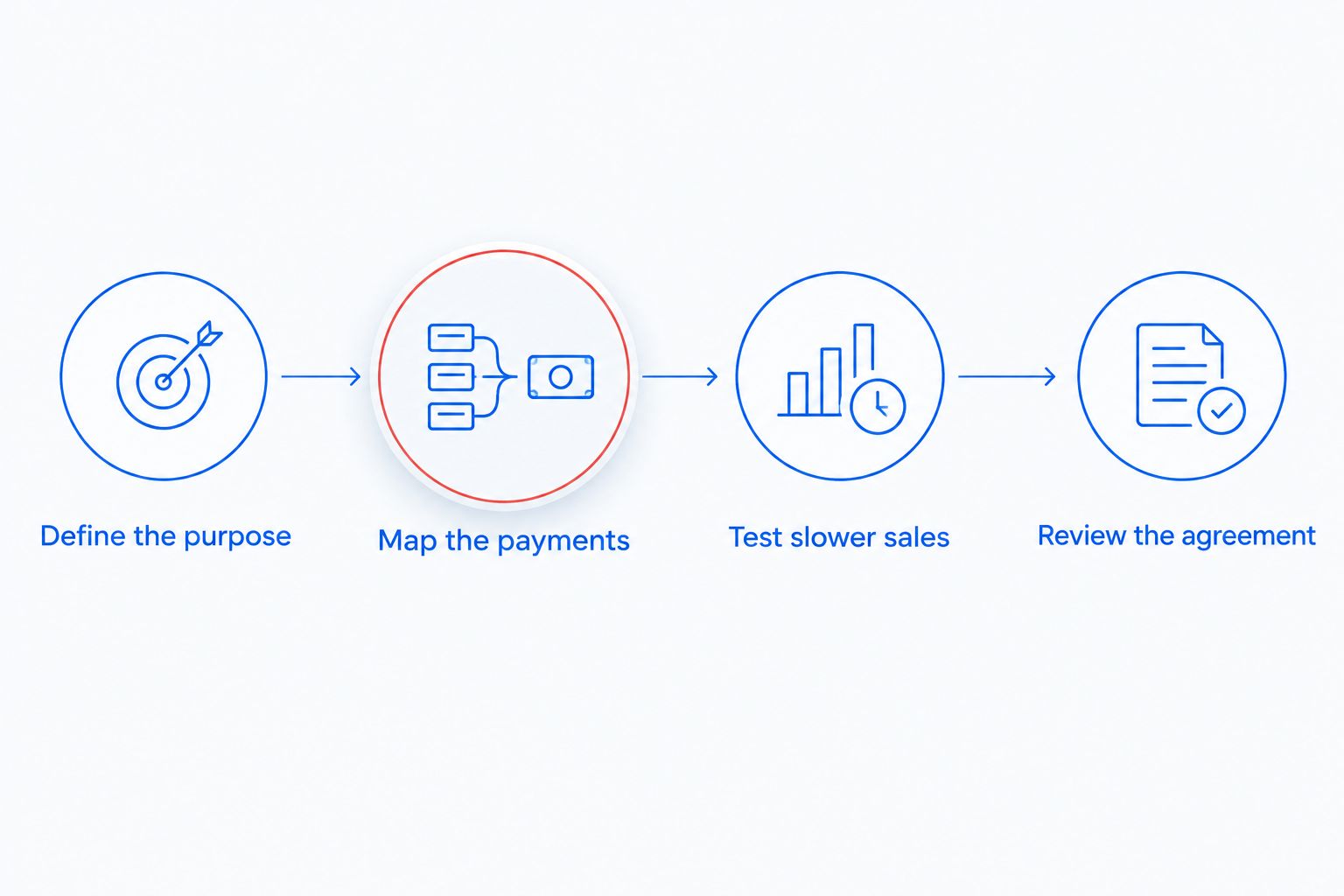
Define the purpose
Write down what the funds will pay for and how that spending supports cash generation. Specify what must happen before the investment produces cash you can use for repayment.
If you cannot explain the connection, pause the financing decision. A vague growth objective is not a repayment plan.
Map the payments
Place each proposed payment on your cash-flow calendar. Include existing commitments and distinguish customer invoices from money actually collected.
For revenue-linked financing, model how the contract calculates collections. For a bank term loan, use the actual payment schedule and account for any rate-related changes described in the agreement.
Test slower sales
Run a slower-sales scenario, an expected-sales scenario, and a stronger-sales scenario. Use your own operating records to set the assumptions rather than borrowing a generic decline percentage.
Then ask what remains after payments in each case. A structure that works only in the strongest scenario leaves your business dependent on an optimistic outcome.
Review the agreement
Confirm the payoff terms, adjustment process, guarantees, security, and default provisions. Ask for written clarification wherever the explanation and contract appear inconsistent.
Have an accountant review repayment affordability and an attorney review legal obligations when needed. Their work addresses different risks; a cash-flow calculation does not replace contract review.
What should you ask before signing?
Use this checklist for a 2026 offer review. The goal is not to collect reassuring answers; it is to identify the exact language that controls payments and business exposure.
- What amount will reach the business after any deductions?
- Which revenue is included in the payment calculation?
- How frequently will money leave the account?
- How do collections change when sales decline?
- Is an adjustment automatic, or must you request it?
- What determines the total repayment obligation?
- What happens if you repay earlier than expected?
- Are you personally guaranteeing any obligation?
- What assets are subject to a security interest?
- Does the agreement restrict additional borrowing?
- What triggers default, and what happens afterward?
Do not treat a provider's verbal description as a substitute for the agreement. If repayment flexibility is the reason you are choosing the offer, locate the clause that creates that flexibility.
Is revenue-based financing better for seasonal businesses?
Revenue-based financing is better for a seasonal business only when its collection rules accommodate the business's actual sales pattern. Verify how the agreement treats slow periods, temporary closures, and the delay between earning revenue and receiving payment.
Also consider the cash required before peak season. A payment linked to sales still competes with stock purchases, staffing, and other expenses needed to fulfill those sales.
Is a bank loan better for long-term expansion?
A bank term loan is a better fit for long-term expansion when its repayment schedule matches the project's cash generation and the business can meet the agreement's conditions. Start with the cash recovery timeline rather than the size of the planned investment.
Allow for the period when the expansion consumes cash but has not yet produced additional receipts. Neither a fixed schedule nor a revenue-linked formula removes that operating gap.
Does revenue-based financing protect you when sales fall?
Revenue-based financing protects cash flow from falling sales only to the extent the contract reduces collections accordingly. A lower payment is not the same as cancellation of the remaining obligation.
Check the reconciliation process, any minimum requirements, and the treatment of interrupted operations. The phrase revenue-based financing does not answer those questions by itself.
Where funding advice fits
Trifecta Business Group offers business funding, digital marketing, and strategic consulting services for small and mid-sized companies. That scope fits an owner who needs to connect a funding decision with a broader growth plan.
The limitation is straightforward: consulting does not replace the provider's written offer or your assessment of affordability. Keep your cash-flow records central to the decision, and evaluate the specific agreement rather than assuming that access to funding makes a project sound.
FAQ
Is revenue-based financing better than a bank loan for a small business?
Revenue-based financing is better only when its sales-linked repayment terms fit your business more closely than a bank loan’s obligations. Compare actual agreements using the same cash-flow assumptions, including a slower-sales scenario.
Do revenue-based financing payments automatically drop when sales fall?
Payments automatically drop only if the agreement provides for automatic adjustment. Some collection arrangements require reconciliation, so confirm the process and the records you must supply.
Does paying off revenue-based financing early reduce what I owe?
Early payoff reduces what you owe only when the agreement provides for a reduction. Request the written payoff terms before treating faster repayment as a financial benefit.
Is revenue-based financing the same as a merchant cash advance?
Revenue-based financing and merchant cash advance are not interchangeable descriptions of a single standard contract. Examine the legal structure, payment calculation, reconciliation provisions, and remedies rather than relying on the label.
Can a bank loan payment change during the loan?
A bank loan payment can change when the agreement allows it, including under certain variable-rate structures. Review the rate terms, payment schedule, and any final payment obligation before signing.
Does revenue-based financing require a personal guarantee?
A personal guarantee depends on the specific agreement, not simply on whether funding is revenue-based. Read the guarantee and security provisions and get legal advice on obligations you do not understand.
Can Trifecta Business Group help with business funding and growth planning?
Trifecta Business Group offers business funding solutions, digital marketing, and strategic consulting for small and mid-sized companies. Assess any proposed financing separately against your cash flow and the written agreement.
One last thing
For your 2026 decision, test the strongest-sales scenario as carefully as the weakest. When repayment is tied to revenue, growth itself can increase collections while your business is also spending more to fulfill orders.
Choose the agreement that leaves your business able to operate, not simply the agreement with the most appealing payment description. That is the difference between obtaining funding and putting funding to work.
Related guides
- How to prepare your business for a funding application
- How to choose the right funding option for business growth
Take the next funding step
Start your business funding application or call to discuss your funding needs.
How these options compare
| Option | Typical speed | How you repay | Backed by | Best for |
|---|---|---|---|---|
| Revenue-based financing | Days to weeks | Percentage of monthly revenue | Future revenue | Seasonal or growing revenue |
| Merchant cash advance | Often days | Share of daily/weekly sales; priced with a factor rate | Future sales | Urgent needs, card-heavy businesses |
| Term loan | Days to weeks | Fixed payments over a set term | Varies | One-time investments with a clear payback |
| Line of credit | Days to weeks | Interest only on what you draw | Varies | Recurring or uneven cash-flow gaps |
General guide only. Actual speed, cost and terms depend on the lending partner and your file.
Does applying affect my credit? +
Trifecta Business Group requires no hard credit pull, which does not affect your score. Any hard pull is explained before it happens.
How do I know which funding option fits? +
Start with what the money needs to do, how fast you need it and how you want to repay. Our comparison tool and advisors can help match the program.
Planning your timing
See this month's commercial rate benchmarks before you borrow
Our Small Business Capital & Formation Index tracks the Prime Rate, SBA rate caps, realistic cost ranges by funding type, and new business formation pressure state by state — updated every month.
What are you trying to fund?
Compare flexible working-capital options
Start with working capital and a line of credit, then compare payment structure and speed.
Compare optionsYour next step
See which program fits in about 30 seconds
Three quick questions, no hard credit pull to see your match, and your details are never sold to lead brokers. Commercial financing only — approval is never guaranteed.
Free Trifecta tools
Put this article to work for your business
Keep learning with Trifecta Business Group