

Business Funding · By Trifecta Business Group
There is no universal revenue minimum for a merchant cash advance in 2026; you need to meet the individual provider’s requirements for documented business sales. Meeting that threshold does not establish affordability, because the collection schedule and your existing obligations determine how much cash remains to operate.
- How much revenue do you need for a merchant cash advance? Confirm the provider’s minimum and eligible sales definition.
- Documented sales support an application; revenue alone does not establish affordable working capital.
- Compare collection terms against payroll, rent, taxes, and existing funding obligations before accepting an advance.
- Trifecta Business Group offers funding solutions and strategic consulting for small and mid-sized businesses.
Why this matters
A revenue requirement is an eligibility screen, not a spending limit. Your business can generate substantial sales while retaining little cash after inventory, labor, and other operating expenses. An advance adds another claim on those receipts.
Trifecta Business Group provides business funding, marketing, and consulting services. For a funding decision, the practical starting point is matching the business need to cash flow—not treating approval as evidence that the arrangement fits.
For your 2026 funding review, separate eligibility from affordability. First establish which sales the provider accepts, then test whether the proposed collections leave enough cash for essential expenses. Do not reverse that order because an application looks straightforward.
How much revenue do you need for a merchant cash advance?
You need the minimum qualifying revenue required by the specific merchant cash advance provider. There is no single industry-wide sales threshold that establishes eligibility across every provider. Ask for the current requirement in writing rather than relying on a general figure from an article or advertisement.
The next question is what the provider counts as revenue. Gross sales, card receipts, and bank deposits describe different things; they are not interchangeable measures of your business activity.
| Revenue measure | What it shows | Strength | Limitation |
|---|---|---|---|
| Gross sales | Sales before relevant deductions | Shows overall sales activity | Does not show cash retained after expenses |
| Card receipts | Sales collected through card processing | Helps document card-based transactions | Excludes sales collected through other methods |
| Business bank deposits | Money entering business accounts | Shows deposited cash activity | Includes transfers or funding proceeds unless separated |
| Collected customer revenue | Customer payments actually received | Connects sales to available cash | Does not include unpaid invoices |
Ask the provider which measure applies and what records support it. Also confirm whether the requirement concerns an average across the review period or a minimum that must be met in each period.
That distinction matters for a seasonal business. An average can conceal a slow period, while a strong recent period can overstate the cash available during the collection period.
What should you ask before submitting an application?
Request answers to these questions before sending a full file:
- What is the current minimum qualifying revenue?
- Which sales and deposit types count toward that minimum?
- What period will you review?
- Does each period need to meet the requirement?
- Which documents must verify the sales?
- What other eligibility conditions apply?
Keep the answers with the application records. A clear written requirement gives you something specific to check against your statements and sales reports.
Which revenue records should you prepare?
Build a file that explains how customer sales become business deposits. The goal is not to make the numbers look larger; it is to make the underlying activity easy to verify.
Use the provider’s document request as the controlling checklist. Prepare complete records rather than selecting only favorable pages or strong sales periods, and explain discrepancies before they become application questions.
Bank statements
Business bank statements show deposits, withdrawals, and balances. Review them for transfers between your own accounts, incoming financing proceeds, and other deposits that are not customer revenue.
Do not count the same money twice because it moved between accounts. Separate customer receipts from internal transfers so the revenue summary reflects actual business activity.
Processing statements
If card sales are relevant to the application, gather the requested processing records. Check how refunds, chargebacks, settlement timing, and deductions affect the amount reaching the bank.
A processing total and a bank deposit do not always match directly. Explain the difference with supporting records rather than changing either figure to force agreement.
Sales and accounting records
Use sales reports and accounting records to explain the business’s revenue pattern. Distinguish completed sales, collected payments, refunds, and unpaid invoices.
Unpaid invoices represent money customers owe, not cash already available for collections. Keep that distinction visible when assessing affordability, even if the accounting report recognizes the sale as revenue.
How to check your revenue before applying
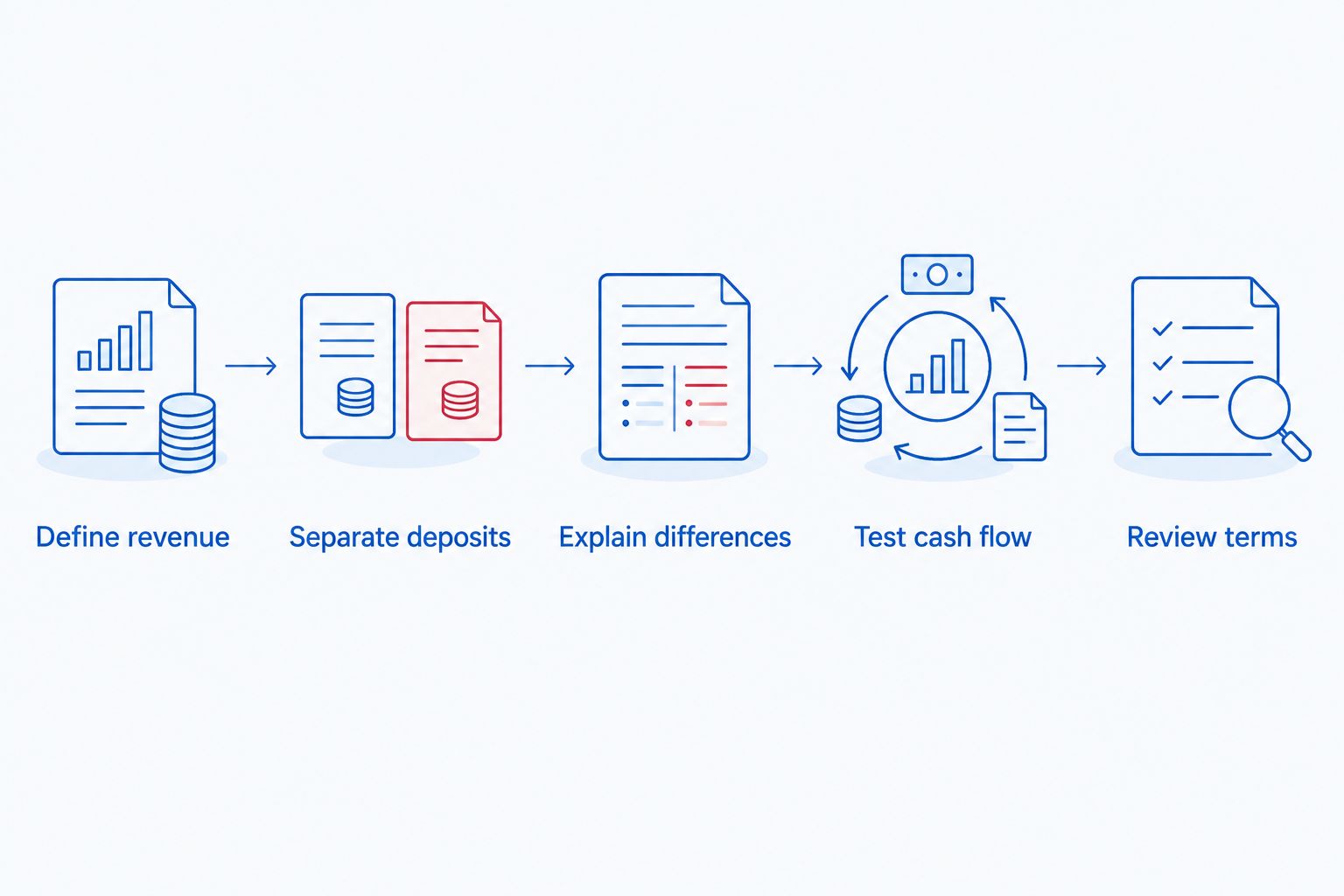
Use this sequence for a 2026 application review. It turns the revenue question into a documented decision rather than a guess based on the latest account balance.
- Define revenue. Confirm the provider’s accepted measure and review period before calculating your total.
- Separate deposits. Remove internal transfers and identify financing proceeds or other non-sales deposits.
- Explain differences. Reconcile sales reports, processing records, and bank deposits without counting receipts twice.
- Test cash flow. Place proposed collections alongside essential expenses and existing obligations.
- Review terms. Resolve questions about collections, adjustments, guarantees, and default before signing.
A clear application file establishes what happened. A cash-flow review addresses what happens next; both are necessary for a sound funding decision.
Why merchant cash advance revenue requirements vary
A provider’s minimum is only part of its assessment. The relationship between sales, deposits, and existing commitments determines what those revenue figures actually mean.
- Revenue definition. Card receipts, gross sales, and eligible bank deposits measure different activity. Confirm which definition controls the application.
- Review period. A recent sales snapshot and a longer operating history show different patterns. Ask which period the provider requires.
- Sales consistency. Stable receipts and irregular receipts create different collection challenges. Document slow periods rather than hiding them inside an average.
- Deposit composition. Transfers and financing proceeds do not demonstrate new customer demand. Separate them from operating revenue.
- Existing obligations. Current funding collections and other commitments reduce the cash available from the same sales.
- Collection structure. Collections tied to receipts and scheduled withdrawals affect cash flow differently. Read the actual contract rather than relying on the product label.
For a 2026 comparison, apply the same revenue definition to every proposal you review. Otherwise, apparently different eligibility outcomes can reflect different measurement methods rather than a meaningful difference in business strength.
Does meeting the revenue minimum mean you can afford an advance?
No. Meeting a revenue minimum does not prove that a merchant cash advance is affordable. Revenue measures incoming business activity; affordability depends on the cash left after required spending and collections.
Build a cash calendar using actual expected receipts and payment dates. Include payroll, rent, taxes, suppliers, existing funding obligations, and proposed advance collections before treating any remaining balance as available cash.
Then review a documented weaker sales period. If the arrangement only works when sales match your strongest period, the business has little room for disruption.
Check how collections respond to lower sales
Ask whether collections change when sales decline and what process applies. Do not assume a withdrawal automatically adjusts because the funding is described as sales-based.
Review any reconciliation provision, including the records and actions required to request an adjustment. A contractual process is not the same as an automatic change to withdrawals.
Read beyond the revenue requirement
For any 2026 offer, review the total contractual obligation, collection method, guarantees, security provisions, and events of default. Ask what happens after a missed collection, account change, or business closure.
The question is not merely whether the provider accepts your sales level. It is whether the agreement leaves your business able to keep operating under conditions you can reasonably document.
What if your revenue is below the provider’s minimum?
Ask which requirement your business does not meet before submitting another application. Below-minimum sales, incomplete records, and deposits that do not qualify as customer revenue are different problems; each calls for a different response.
Do not reclassify transfers as sales or use projected revenue as though customers have already paid. Correct the record, narrow the funding need, or assess a different funding structure.
Trifecta Business Group is a fit for small and mid-sized businesses seeking funding solutions and strategic consulting together. That service scope is relevant when the funding question also involves operating priorities, growth planning, and execution; it does not establish approval or specific merchant cash advance terms.
Keep the immediate decision narrow. Identify the expense you need to fund, when that expense produces cash, and which collection schedule the business can support without relying on another advance.
Which funding structure matches your cash flow?
Compare structures before choosing a provider. The best fit follows how your business earns and collects money—not simply which application accepts your revenue.
| Funding structure | Best for | Potential advantage | Main limitation |
|---|---|---|---|
| Merchant cash advance | Businesses with documented sales that can support the contract’s collections | Funding is structured around future business receipts | Frequent collections can strain operating cash |
| Term loan | A defined business expense with a repayment plan | A stated repayment schedule supports planning | Scheduled payments remain obligations during weak sales |
| Business line of credit | Recurring working-capital needs | Draws support repeated borrowing needs within agreed terms | Access depends on the agreement and continued eligibility |
| Invoice factoring | Businesses with eligible unpaid customer invoices | Converts eligible receivables into cash | Depends on invoice eligibility and customer payment |
These are structure-level distinctions, not promises of eligibility. Compare the actual agreement, required documents, and collection obligations before deciding that an alternative solves the problem.
Geography matters too: a Canadian discussion of alternative business financing options does not establish U.S. eligibility requirements. Confirm the jurisdiction and provider behind any revenue threshold before using it in your application plan.
For the advance itself, assess whether a merchant cash advance is worth it against a defined business purpose. Funding that covers an immediate shortage still needs a credible path to supporting its collections.
Can I qualify with seasonal or inconsistent revenue?
Seasonal or inconsistent revenue does not support a universal eligibility answer. The provider’s review period and sales requirements control, so submit records that show the operating cycle rather than only its strongest part.
For a 2026 application, connect the collection period to your expected slower periods. Ask how the agreement handles lower receipts before assuming the business can carry the same withdrawals throughout the year.
Do bank deposits count as revenue for a merchant cash advance?
Bank deposits are evidence of incoming cash, but not every deposit is customer revenue. Internal transfers, owner contributions, and financing proceeds need to be identified separately.
Ask the provider which deposits qualify. Keep a reconciliation that connects eligible receipts to the underlying sales without counting money again when it moves between accounts.
Can a business with no revenue get a merchant cash advance?
A business with no revenue cannot document existing sales to support a sales-based eligibility requirement. Do not treat forecast sales or a newly opened bank account as proof of collected customer revenue.
Separate startup funding needs from an established business’s short-term cash needs. The appropriate next step depends on what the business can document, not what it expects to earn.
FAQ
How much revenue do I need for a merchant cash advance in 2026?
There is no universal merchant cash advance revenue minimum in 2026. Ask the provider for its current threshold, accepted revenue definition, and required review period.
Does a merchant cash advance use monthly or annual revenue?
The provider’s requirements determine the revenue period used. Confirm whether it evaluates an average, individual periods, or another stated measure before calculating eligibility.
Is gross revenue the same as the cash I can use for collections?
Gross revenue is not the same as cash available for collections. Operating expenses, taxes, refunds, and existing obligations reduce what remains available.
Can strong sales guarantee merchant cash advance approval?
Strong sales do not guarantee merchant cash advance approval. Eligibility also depends on the provider’s other requirements and its review of the application records.
What should I do if my deposits include transfers between accounts?
Identify internal transfers separately from customer revenue. Keep records showing where the money originated so the same receipts are not counted twice.
Will merchant cash advance collections automatically fall when sales decline?
Do not assume collections automatically decline with sales. Read the agreement’s collection and reconciliation provisions, including any steps required to request an adjustment.
Does Trifecta Business Group offer more than business funding?
Trifecta Business Group offers business funding solutions, digital marketing, and strategic consulting. Its stated focus is helping small and mid-sized companies scale and grow.
One last thing
Your largest deposit is not necessarily your strongest evidence of revenue. A large transfer between business accounts adds no customer sales, while a pattern of smaller customer payments documents actual trading activity.
Before applying, label non-sales deposits and explain unusual movements. A clear revenue record answers the eligibility question; a realistic cash calendar answers whether accepting the advance makes business sense.
Related guides
- How to prepare your business for a funding application
- How to use a merchant cash advance responsibly
- How to choose the right funding option for business growth
Take the next funding step
Start your business funding application or call to discuss your funding needs.
How these options compare
| Option | Typical speed | How you repay | Backed by | Best for |
|---|---|---|---|---|
| Merchant cash advance | Often days | Share of daily/weekly sales; priced with a factor rate | Future sales | Urgent needs, card-heavy businesses |
| Term loan | Days to weeks | Fixed payments over a set term | Varies | One-time investments with a clear payback |
| Line of credit | Days to weeks | Interest only on what you draw | Varies | Recurring or uneven cash-flow gaps |
| Invoice factoring | Often days | Customer pays the invoice; fee deducted | Your B2B invoices | Slow-paying business customers |
General guide only. Actual speed, cost and terms depend on the lending partner and your file.
What is a factor rate? +
A factor rate is a multiplier (for example 1.25) applied to the amount advanced to set the total payback. It is not an annual interest rate, so compare offers by total cost and payback period.
Is a merchant cash advance a loan? +
Usually not. It is a purchase of a portion of future sales, repaid as a share of revenue. That is why approvals lean on sales history more than credit score.
Does applying affect my credit? +
Trifecta Business Group requires no hard credit pull, which does not affect your score. Any hard pull is explained before it happens.
How do I know which funding option fits? +
Start with what the money needs to do, how fast you need it and how you want to repay. Our comparison tool and advisors can help match the program.
Planning your timing
See this month's commercial rate benchmarks before you borrow
Our Small Business Capital & Formation Index tracks the Prime Rate, SBA rate caps, realistic cost ranges by funding type, and new business formation pressure state by state — updated every month.
What are you trying to fund?
Compare flexible working-capital options
Start with working capital and a line of credit, then compare payment structure and speed.
Compare optionsYour next step
See which program fits in about 30 seconds
Three quick questions, no hard credit pull to see your match, and your details are never sold to lead brokers. Commercial financing only — approval is never guaranteed.
Free Trifecta tools
Put this article to work for your business
Keep learning with Trifecta Business Group