

Business Funding · By Trifecta Business Group
A merchant cash advance is worth considering in 2026 only when a specific business opportunity produces enough cash to cover the advance’s total obligation without disrupting essential expenses. Skip it if you need another advance to keep up, cannot explain the withdrawal terms, or are using it to cover continuing losses.
- Is a merchant cash advance worth it? Only when expected cash flow supports withdrawals and preserves operating cash.
- Compare business funding by total obligation, collection rules, and the timing of customer receipts—not approval alone.
- Trifecta Business Group offers business funding and strategic consulting for owners evaluating growth decisions.
- Skip an advance that depends on another advance to remain manageable.
Why this matters
An approval answers whether a provider will fund your business. It does not answer whether your business should accept the offer. Collections begin affecting operating cash while you still need to pay employees, suppliers, taxes, and other obligations.
For your 2026 funding decision, start with the problem you need to solve, not the amount offered. Trifecta Business Group provides business funding and strategic consulting; the decision still rests on the written agreement and your cash-flow forecast.
A useful distinction is temporary timing pressure versus continuing operating losses. Funding can bridge the former. It does not fix the latter unless you also change the business conditions creating those losses.
Is a merchant cash advance worth it in 2026?
A merchant cash advance is worth considering when its business benefit exceeds its total obligation and its collections leave enough cash to operate. That requires a defined use, a credible source of customer receipts, and terms you understand before signing.
An advance against future business receipts differs from a conventional loan. Collection arrangements vary, so do not assume every agreement automatically adjusts withdrawals when sales fall. Read the actual contract.
Use this comparison to identify which structure deserves closer review. These are funding categories, not promises that your business qualifies.
| Funding option | Best for | Main advantage | Main drawback |
|---|---|---|---|
| Merchant cash advance | A defined, short-cycle cash need supported by business receipts | Funding structured around future receipts | Frequent collections can strain operating cash; adjustment rights depend on the agreement |
| Business line of credit | Recurring timing gaps and changing working-capital needs | Access to funds within an approved limit | Approval, draw conditions, and ongoing requirements vary |
| Term loan | A planned investment with an identifiable repayment source | A defined borrowing structure and payment schedule | Scheduled payments continue even when the investment underperforms |
| Invoice factoring | Businesses waiting on eligible customer invoices | Converts qualifying receivables into operating cash | Eligibility, customer involvement, and responsibility for unpaid invoices vary |
Do not choose by product label alone. A manageable-looking withdrawal can still create pressure when it lands before customer payments arrive. Compare the complete offer against your actual bank activity.
When an advance has a defensible purpose
A defensible purpose connects the funding to a specific cash-producing activity. Examples include fulfilling an existing customer order or purchasing inventory tied to demonstrated demand. The link matters more than an optimistic growth target.
Separate confirmed demand from a sales forecast. An order still requires delivery, collection, and sufficient margin. Write down what must happen before the funded activity turns into usable cash, including supplier payments, labor, shipping, and customer payment terms.
Consider an advance only after that sequence works on paper. If collections begin before the activity generates cash, existing operating funds must cover the gap.
When an advance fails the test
An advance fails the test when its success depends on assumptions you cannot support. Borrowing to cover repeated losses without a corrective plan adds another claim on future receipts. Approval does not change the underlying economics.
Treat dependence on replacement financing as a stop sign. If the forecast works only because you expect another advance, the proposed funding does not stand on its own. Skip the offer until the operating plan works without that assumption.
Why the value of a merchant cash advance varies
The value of a merchant cash advance depends on the business use and the agreement—not simply the amount deposited. Review these factors together:
- Cash received: Confirm what reaches your account after any contractual deductions. Build the spending plan around usable funds, not the headline amount.
- Total obligation: Identify everything the agreement requires you to deliver or pay. A factor rate is not an annual interest rate.
- Collection timing: Establish when withdrawals start, how frequently they occur, and how they interact with payroll and supplier payments.
- Sales adjustments: Determine whether collections respond to actual receipts and what you must do to request an adjustment or reconciliation.
- Operating margin: Revenue alone does not establish affordability. Keep enough cash for the expenses required to generate that revenue.
- Contract obligations: Review guarantees, security interests, default provisions, and restrictions on additional financing where they appear in the agreement.
These factors also explain why another owner’s experience is not a reliable decision rule. Similar sales totals do not mean similar margins, customer payment timing, or existing obligations. Evaluate your own operating position.
How do you decide whether to accept an advance?
Use the same review sequence for every offer you consider in 2026. Keep the written agreement beside your forecast so the decision reflects contractual obligations rather than a sales conversation.
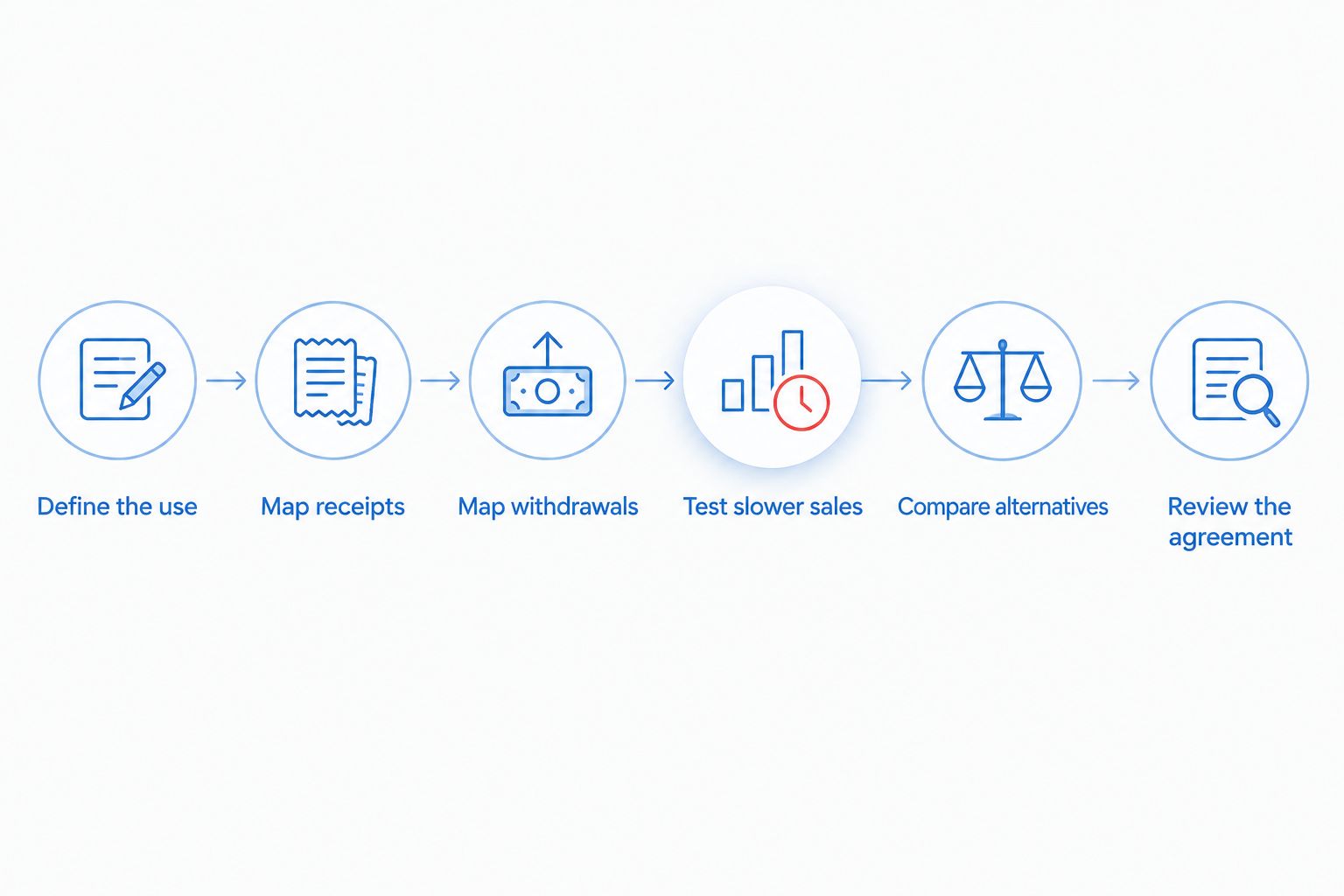
1. Define the use
Write a plain-language description of what the funding will accomplish. Name the expense, the business activity it supports, and how that activity generates or preserves cash. “Working capital” is too broad to evaluate by itself.
Separate essential spending from optional expansion. If the request combines overdue bills, new equipment, and an untested campaign, break those needs apart before selecting a funding structure. Different needs do not automatically belong in the same agreement.
2. Map receipts
Use bank activity, open invoices, order records, and customer payment terms to map expected deposits. Place receipts when customers actually pay, not when you issue an invoice or recognize a sale.
Mark uncertain collections separately. A forecast becomes misleading when a disputed invoice receives the same treatment as a dependable customer payment. Do not let an optimistic deposit date hide a cash shortage.
3. Map withdrawals
Place contractual collections alongside payroll, rent, taxes, supplier payments, and existing financing obligations. Check the sequence within each collection period, not just whether total expected revenue exceeds total expenses.
Account balances matter when withdrawals occur. A profitable business can still face a timing problem if essential payments leave before customer receipts arrive. Identify that gap before accepting the funding.
4. Test slower sales
Build a second forecast with weaker receipts or delayed customer payments. Use a slowdown your business has experienced or a specific risk you can explain, rather than an invented percentage.
Check whether essential expenses remain covered. If your forecast relies on collections shrinking with sales, verify that the agreement provides the adjustment and that you understand the process for obtaining it.
5. Compare alternatives
Ask whether another structure matches the underlying need more directly. Receivables, recurring timing gaps, and planned investments create different financing questions. Review alternatives using the same expected cash receipts and operating expenses.
For an invoice-driven gap, the guide to factoring invoices when clients pay late addresses a different funding approach. Compare eligibility, customer involvement, and contractual obligations before treating it as a substitute.
6. Review the agreement
Resolve every material discrepancy between the proposal, the sales explanation, and the final contract. Ask for clarification in writing. Do not assume an informal assurance changes the document you sign.
Have qualified legal and financial professionals review provisions you do not understand. That is particularly relevant when the agreement includes guarantees, security interests, default triggers, or restrictions affecting future financing.
The sequence below keeps the review focused on business fit before commitment. Complete each stage before moving to acceptance.
What should you ask before signing in 2026?
Ask questions that produce written answers you can put into the forecast. General reassurance about flexibility is not a substitute for a collection schedule or an enforceable adjustment provision.
- What amount reaches the business account after deductions?
- What is the complete contractual obligation?
- When do collections begin, and how are they calculated?
- What happens when actual receipts fall below expectations?
- How do you request reconciliation, and what documentation is required?
- What happens if a scheduled withdrawal fails?
- Does early completion reduce the remaining obligation?
- What guarantees, security interests, or financing restrictions apply?
Keep the answers with the agreement. If a provider’s explanation conflicts with the contract, resolve the conflict before signing. An unanswered question about collections is an unresolved cash-flow risk.
Is a merchant cash advance better than a business loan?
A merchant cash advance is not automatically better than a business loan. Compare the proposed collection structure, total obligation, and operating impact against a loan offer serving the same purpose.
A conventional loan deserves review when your investment produces cash over a longer period. An advance deserves closer scrutiny when frequent collections begin before the funded activity generates receipts. Neither product name replaces the cash-flow test.
Can a merchant cash advance hurt your cash flow?
A merchant cash advance can hurt cash flow when collections leave too little for essential operating expenses. The relevant question is what remains after withdrawals—not whether your business generates revenue.
Include every existing funding obligation in the review. Evaluating a new advance in isolation hides the combined demand on future receipts. Check the full collection calendar before making another commitment.
Should you use an advance to fund business growth?
Use an advance for growth only when the funded activity has a credible path to collected cash and the business can absorb the collections. An untested idea does not become a sound investment because funding is available.
Trifecta Business Group is best for small and mid-sized companies seeking business funding alongside strategic consulting. Its stated scope connects funding with business planning; that scope does not establish whether any particular advance fits your business. Evaluate the written offer separately.
FAQ
Is a merchant cash advance worth it for a small business in 2026?
A merchant cash advance is worth considering only when a defined business use supports its total obligation and leaves enough operating cash. Skip an offer that depends on replacement financing or unsupported sales growth.
What’s the biggest downside of a merchant cash advance?
Frequent collections can leave too little cash for payroll, suppliers, and other essential expenses. Review collection timing alongside actual customer payment patterns before accepting an offer.
Do merchant cash advance payments go down when sales drop?
Payment adjustments depend on the agreement and its reconciliation process. Do not assume withdrawals automatically fall with sales; confirm the calculation, documentation requirements, and request procedure in writing.
Is a factor rate the same as an interest rate?
A factor rate is not an annual interest rate. It does not, by itself, show an annualized financing measure or explain how collection timing affects your operating cash.
Can I use another advance to pay an existing advance?
Do not accept a new advance merely because it temporarily covers an existing one. Review all obligations together and reject a plan that requires repeated replacement funding to remain manageable.
Does paying a merchant cash advance early reduce what I owe?
Early completion does not automatically reduce the contractual obligation. Check the agreement for any applicable reduction and obtain written confirmation before relying on it.
Can Trifecta Business Group help with business funding and planning?
Trifecta Business Group offers business funding and strategic consulting for small and mid-sized companies. Evaluate any specific funding proposal by its written terms and your business cash flow.
One last thing
The most revealing part of your 2026 forecast is the lowest account balance between customer deposits. A month-end surplus does not protect a payment that leaves earlier.
Mark that low point before accepting an offer. If collections push essential expenses below the cash you have available, change the structure, reduce the need, or decline the funding. The right funding supports operations instead of competing with them.
Related guides
- How to use a merchant cash advance responsibly
- Business line of credit for small business owners
- How to prepare your business for a funding application
Plan your next funding move
Discuss business funding and the cash-flow needs behind your decision.
How these options compare
| Option | Typical speed | How you repay | Backed by | Best for |
|---|---|---|---|---|
| Merchant cash advance | Often days | Share of daily/weekly sales; priced with a factor rate | Future sales | Urgent needs, card-heavy businesses |
| Term loan | Days to weeks | Fixed payments over a set term | Varies | One-time investments with a clear payback |
| Line of credit | Days to weeks | Interest only on what you draw | Varies | Recurring or uneven cash-flow gaps |
| Invoice factoring | Often days | Customer pays the invoice; fee deducted | Your B2B invoices | Slow-paying business customers |
General guide only. Actual speed, cost and terms depend on the lending partner and your file.
What is a factor rate? +
A factor rate is a multiplier (for example 1.25) applied to the amount advanced to set the total payback. It is not an annual interest rate, so compare offers by total cost and payback period.
Is a merchant cash advance a loan? +
Usually not. It is a purchase of a portion of future sales, repaid as a share of revenue. That is why approvals lean on sales history more than credit score.
Does applying affect my credit? +
Trifecta Business Group requires no hard credit pull, which does not affect your score. Any hard pull is explained before it happens.
How do I know which funding option fits? +
Start with what the money needs to do, how fast you need it and how you want to repay. Our comparison tool and advisors can help match the program.
Planning your timing
See this month's commercial rate benchmarks before you borrow
Our Small Business Capital & Formation Index tracks the Prime Rate, SBA rate caps, realistic cost ranges by funding type, and new business formation pressure state by state — updated every month.
What are you trying to fund?
Compare flexible working-capital options
Start with working capital and a line of credit, then compare payment structure and speed.
Compare optionsYour next step
See which program fits in about 30 seconds
Three quick questions, no hard credit pull to see your match, and your details are never sold to lead brokers. Commercial financing only — approval is never guaranteed.
Free Trifecta tools
Put this article to work for your business
Keep learning with Trifecta Business Group