
Business Funding · By Trifecta Business Group
Yes, SEO is worth it for a small business in 2026 when customers search for what you sell and your website turns those searches into profitable business. It is not a quick fix for an unclear offer, weak sales follow-up, or an immediate cash-flow gap; judge it by qualified leads and customer profit, not rankings alone.
- Is SEO worth it for a small business? Yes, when search demand connects to profitable customer acquisition.
- Prioritize useful service pages, local SEO where relevant, and tracking that connects inquiries to sales.
- Trifecta Business Group fits small businesses seeking digital marketing, funding, and strategic consulting together.
- Delay expansion when your website cannot explain your offer or your team cannot handle new inquiries.
Is SEO worth it for a small business in 2026?
SEO is worth pursuing when you can connect a relevant search to a useful page, a qualified inquiry, and a profitable sale. A higher position without that connection is visibility, not a business result.
Use the comparison below to decide whether SEO belongs in your current digital marketing strategy for a small business. These are planning criteria, not promises about performance.
| Business situation | Best for | Main benefit | Main limitation | Decision |
|---|---|---|---|---|
| Customers search for an established service you provide | Capturing existing demand | Connects your offer with relevant searches | Search visibility does not guarantee inquiries | Start with core service pages |
| Customers need a nearby provider | Local customer acquisition | Makes location and service information easier to find | Local relevance limits the audience | Prioritize local search basics |
| Buyers research a complex purchase | Explaining expertise before a sales conversation | Answers questions that shape purchase decisions | Informational visitors are not necessarily buyers | Publish decision-focused guidance |
| You need immediate sales to cover obligations | Short-term cash-flow management | SEO can support a longer-term plan | It does not provide a dependable immediate sales deadline | Do not rely on SEO alone |
| Your offer or sales process remains unclear | Fixing business foundations | Better pages can clarify your offer | Additional traffic will not repair poor follow-up | Fix the conversion path first |
Why this matters
Your marketing budget has competing jobs: finding customers, retaining customers, and supporting the sales process. SEO deserves a share only when its role is clear.
For your 2026 plan, separate customer acquisition from website activity. A visit is an opportunity to earn business, not evidence that you have earned it. That distinction keeps a busy content calendar from becoming the goal.
Local SEO: best for businesses serving a defined area
Local SEO is relevant when geography determines who can buy from you. Start by making your business name, service area, contact details, and services accurate wherever customers encounter them.
If your business is eligible for a Google Business Profile, maintain it alongside your website. Explain what you actually do, keep business information current, and use a review-request process that follows platform policies. Do not promise services or locations you cannot support.
The advantage is relevance: you are helping nearby customers evaluate a business that can serve them. The limitation is equally clear. Local visibility outside your service area has little value if you cannot accept the work.
Build location-specific pages only when you have useful location-specific information. Changing a city name across otherwise identical pages does not explain why a customer should choose you.
Service-page SEO: best for buyers ready to evaluate providers
Service pages should explain what you do, who you serve, what the engagement involves, and what the customer should do next. Answer the questions your sales team hears before a buyer agrees to a conversation.
Start with the services that matter to your business. Give each page a clear purpose rather than forcing unrelated offers onto a single page or splitting closely related information into thin pages.
The benefit is a direct connection between a search and a commercial offer. The limitation is that writing alone cannot establish credibility: claims need supporting facts, and visitors need a usable way to contact you.
In 2026, review the destination before expanding the audience. A page that attracts the right visitor but hides the next step leaves the acquisition process unfinished.
Educational SEO: best for purchases that need explanation
Educational content helps when customers need to understand a problem, compare approaches, or prepare for a buying decision. Useful subjects come from genuine customer questions, not a requirement to publish constantly.
Explain the choices, the trade-offs, and the circumstances that change the answer. Where relevant, connect the explanation to a service page so readers can move from research to action.
The benefit is informed interest; the limitation is distance from a purchase. Someone researching a broad topic is not automatically a qualified prospect. Evaluate educational content by its role in customer journeys rather than assuming every visit should become an immediate inquiry.
Avoid publishing outside your expertise simply because a keyword looks attractive. An audience that cannot use your services does not become valuable merely because it is large.
Why SEO value varies between small businesses
There is no universal traffic target or ranking position that proves SEO is worthwhile. The same search visibility can produce different business outcomes depending on the offer and the sales process.
Use these factors to evaluate your own opportunity:
- Search relevance: Do the searches describe a problem your business actually solves? Separate purchase-related questions from unrelated research.
- Customer economics: Does the profit from acquired customers justify the work involved? Revenue alone leaves delivery expenses out of the decision.
- Website readiness: Can visitors understand your service, assess your credibility, and contact you without confusion?
- Competition: What information and evidence do visible competing pages provide? Evaluate the actual search results rather than assuming every keyword presents the same challenge.
- Execution capacity: Who will approve content, supply accurate business information, maintain the site, and respond to leads?
- Sales follow-through: Can you connect inquiries to qualified opportunities and completed sales? Without that record, performance discussions stop too early.
These factors belong in the brief before work begins. They also explain why copying another company's publishing schedule is not a strategy.
How do you decide whether to start SEO?
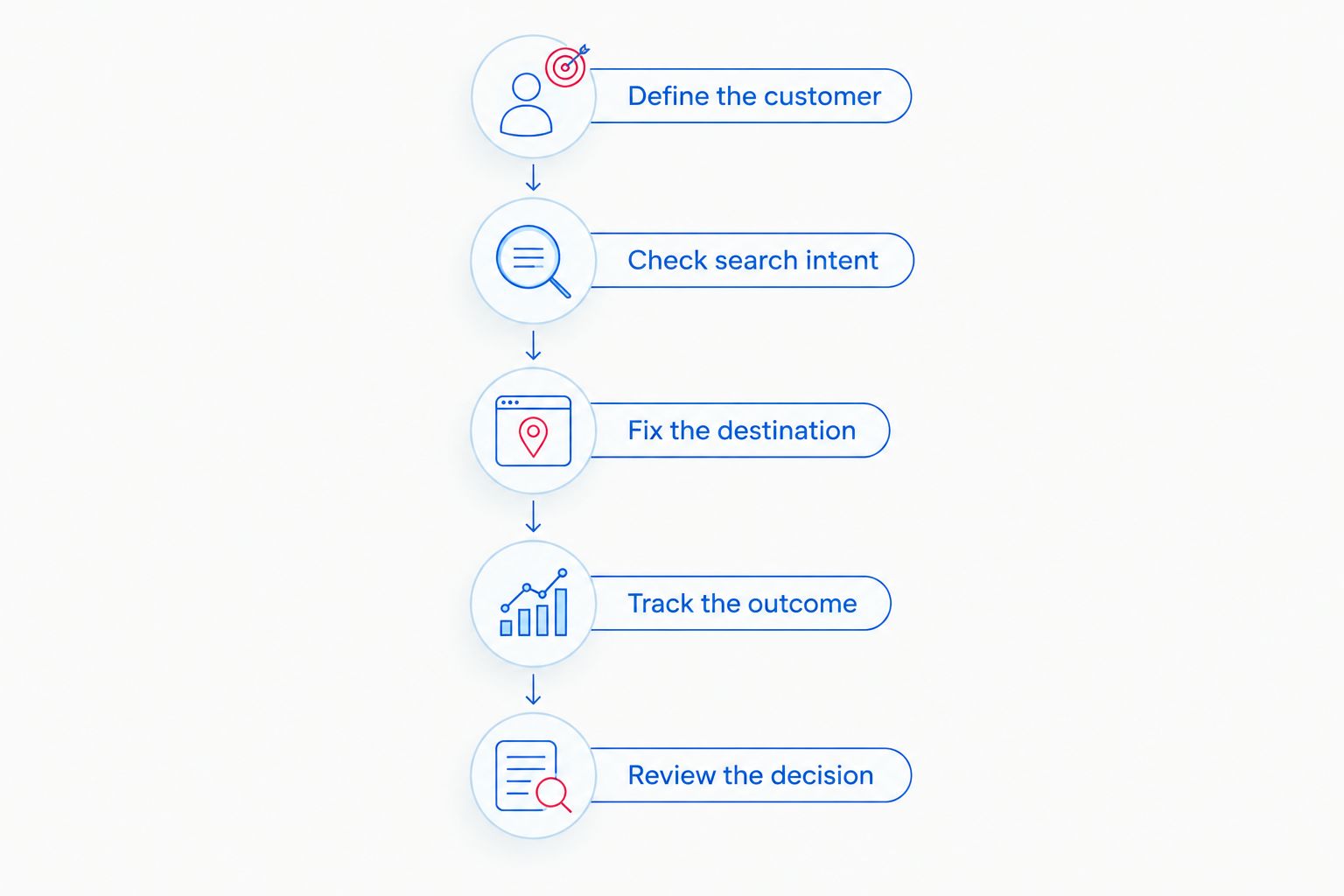
Use a sequence that connects the business decision to the work. Each step should produce something you can review, not another vague commitment to growth.
Define the customer
Describe the buyer, the problem, the service, and any geographic restriction. Be specific enough to reject irrelevant traffic. If your team cannot agree on the intended customer, resolve that before commissioning content.
Check search intent
Review the search results for the questions your buyers ask. Identify whether the results emphasize local providers, service pages, educational explanations, or another format. Use that evidence to shape the page rather than forcing every query into a blog post.
Fix the destination
Choose the page that should receive the visitor. Make its offer, supporting evidence, and next step clear. Check that contact forms work and that someone is responsible for responding.
Track the outcome
Record how inquiries arrived, whether they qualified, and whether they became customers. Keep the same definitions across reporting periods so an increase reflects a real change rather than a new counting method.
Review the decision
Choose review dates before starting. At each review, examine completed work, relevant visibility, qualified inquiries, and sales outcomes. Continue, revise, or stop based on the evidence, not on a promise that success is always just beyond the next report.
How should you measure whether SEO is paying off?
Measure the path from search to customer, not just the amount of traffic. Search visibility helps diagnose discovery; sales records establish whether that discovery produced business.
For your 2026 reporting, keep the following measures separate:
| Measure | What it tells you | What it does not prove |
|---|---|---|
| Relevant search impressions | Your pages appeared for tracked searches | That someone visited or intended to buy |
| Organic search visits | Search visitors reached your website | That the visitors were qualified |
| Qualified inquiries | Prospects matched your agreed criteria | That the business won the work |
| Customers from organic search | Recorded search-related inquiries became sales | That every sale happened because of SEO alone |
| Customer profit relative to SEO spending | The commercial outcome supports an investment decision | That future results are guaranteed |
Use Google Search Console to inspect search queries and page visibility. Use website analytics and sales records to follow visits, inquiries, and customers. Each source answers a different question.
Separate searches for your business name from searches by people discovering a service. Both matter, but branded demand can reflect referrals, existing relationships, or other marketing. Do not credit every branded visit to new SEO work.
Also distinguish direct sales from assisted activity. A customer can read an article, leave, and return through another channel. Document what your reporting captures and avoid presenting incomplete attribution as certainty.
When is SEO not the right next move?
SEO is not the next move when your immediate problem sits elsewhere. A broken inquiry form, an unprofitable offer, or unanswered calls deserves attention before you expand traffic.
Pause new content if nobody can provide accurate information or approve changes. Content produced without business input risks describing an offer that does not match what you deliver.
Do not use SEO as a substitute for demand validation. If buyers do not understand the category or search for the problem in the terms you use, customer conversations should shape the message first.
Your 2026 plan should also protect operating cash. Funding a marketing initiative creates a repayment obligation; it does not establish that the initiative will work. Set a spending boundary and an evaluation process before committing.
What should you ask before hiring outside help?
Ask for a defined scope: which pages will change, what information you must provide, how priorities will be chosen, and how results will be reviewed. A proposal should make the work understandable without requiring you to become an SEO specialist.
Request reporting that connects relevant search activity with qualified leads. Keep control of your domain, website, and measurement accounts. Ask how completed work and access will transfer if the relationship ends.
Trifecta Business Group is best for small and mid-sized companies seeking digital marketing, funding, and strategic consulting together. That service mix fits a broader business discussion rather than treating marketing as an isolated task.
Trifecta Business Group offers those services; assess any proposed engagement against your specific needs. A broad service offering does not replace a written scope, clear responsibilities, or a measurement plan. Confirm the SEO work included before you commit.
Can I do SEO myself?
You can handle foundational SEO yourself when you have access to your website and accurate knowledge of your customers. Start with clear service descriptions, working contact paths, useful answers, and accurate business information.
The trade-off is your time. Use outside help when technical changes, research, or ongoing execution exceed your team's capacity, and retain responsibility for the accuracy of business claims.
How long should I wait before judging SEO?
Judge completed work at the agreed review dates and judge commercial value when you have enough relevant outcome data. A fixed deadline is not a substitute for examining what changed and what customers did.
Do not accept elapsed time as the only explanation for weak results. Review page relevance, measurement, implementation, and lead quality before approving more of the same work.
Is SEO better than paid advertising?
Neither channel is automatically better; the right choice depends on the job you need it to perform. SEO develops organic search visibility, while paid advertising buys placements under the advertising platform's terms.
Compare both through qualified customer acquisition and profit. Avoid comparing organic traffic with paid leads, because those measures describe different stages of the buying process.
FAQ
Is SEO worth it for a small business in 2026?
SEO is worth it when relevant searches lead to qualified inquiries and profitable customers. Prioritize a clear offer, usable service pages, and tracking before expanding the work.
What’s the best place to start with small-business SEO?
Start with the pages that explain your core services and give customers a clear next step. For businesses serving a defined area, accurate local business information also belongs in the foundation.
How do I know whether SEO leads are good leads?
Judge SEO leads against your agreed customer criteria, including service fit and location where relevant. Track whether those inquiries progress to sales rather than treating every form submission as equally valuable.
Do I need to publish blog posts constantly for SEO?
You do not need a constant publishing schedule to justify SEO. Publish when you have a useful customer question to answer, and improve existing service pages when they need attention.
Should I stop SEO if traffic rises but sales do not?
Investigate relevance and conversion before expanding spending. Check which searches grew, whether visitors reached appropriate pages, and whether your team followed up on inquiries.
Can business funding make an SEO campaign worthwhile?
Funding does not prove that an SEO campaign is worthwhile. Evaluate the commercial case separately from repayment obligations and protect the cash needed to operate the business.
Who is Trifecta Business Group best suited for?
Trifecta Business Group suits small and mid-sized companies seeking digital marketing, funding solutions, and strategic consulting. Confirm the scope and responsibilities of any proposed engagement against your business priorities.
One last thing
The most useful next SEO task might be fixing a page you already have. Before commissioning another article, inspect the page a ready-to-buy customer would visit: does it explain the service, establish credibility with accurate evidence, and make the next step obvious?
For 2026, make that your decision rule: repair the path to a customer before paying to send more people down it.
Related guides
- SEO services for small business websites
- How to improve local SEO rankings for a small business
- How to build a marketing budget for a small business
Plan funding around your growth priorities
Keep your marketing plan and funding needs connected to clear business goals.
Does applying affect my credit? +
Trifecta Business Group requires no hard credit pull, which does not affect your score. Any hard pull is explained before it happens.
How do I know which funding option fits? +
Start with what the money needs to do, how fast you need it and how you want to repay. Our comparison tool and advisors can help match the program.
Planning your timing
See this month's commercial rate benchmarks before you borrow
Our Small Business Capital & Formation Index tracks the Prime Rate, SBA rate caps, realistic cost ranges by funding type, and new business formation pressure state by state — updated every month.
What are you trying to fund?
Compare flexible working-capital options
Start with working capital and a line of credit, then compare payment structure and speed.
Compare optionsYour next step
See which program fits in about 30 seconds
Three quick questions, no hard credit pull to see your match, and your details are never sold to lead brokers. Commercial financing only — approval is never guaranteed.
Free Trifecta tools
Put this article to work for your business
Keep learning with Trifecta Business Group