
Business Funding · By Trifecta Business Group
Purchase order financing is better than a business loan when you need to pay a supplier to fulfill a confirmed customer order; a business loan is better when you need funding for broader business expenses. The deciding factors are how the money can be used, when repayment starts, and whether the order remains profitable after financing. In 2026, compare the written terms against your actual cash-flow gap—not just the amount offered.
- Is purchase order financing better than a business loan? Yes for qualifying supplier payments; no for general operating expenses.
- Purchase order financing connects funding to a confirmed order, while a business loan supports approved business uses.
- Compare payment timing, customer requirements, supplier requirements, and the profit remaining after financing.
- Trifecta Business Group offers business funding and consulting services for small and mid-sized companies.
Is purchase order financing better than a business loan?
Purchase order financing wins on order-specific supplier funding. A business loan wins on broader spending flexibility. Neither is automatically the better financial decision: the contract and your cash-flow forecast determine the fit.
The distinction matters most when a customer wants to buy goods but your supplier requires payment before you can collect. The guide to purchase order financing for wholesalers addresses that order-driven funding need.
| Decision point | Purchase order financing | Business loan |
|---|---|---|
| Best for | Paying an approved supplier for a confirmed customer order | Funding approved operating expenses or longer-term business needs |
| Main advantage | Connects supplier funding to a specific sale | Gives you more flexibility across permitted uses |
| Main limitation | Does not function as unrestricted operating cash | Creates repayment obligations under the loan agreement |
| Where the money goes | Typically to the supplier rather than your operating account | Generally to your business, subject to the agreement |
| What the provider reviews | The order, customer, supplier, transaction economics, and your business | Your business finances, repayment ability, credit, and any required security |
| Repayment structure | Commonly settled through proceeds from the financed order | Follows the payment schedule in the loan agreement |
| Main risk to examine | Delays, disputes, or deductions that weaken the order's economics | Payments that strain cash flow before the funded activity produces cash |
A confirmed order is not automatic approval. Purchase order finance providers still evaluate whether the transaction meets their requirements.
Why this matters
A sale on paper does not pay a supplier. Your business needs a workable path from accepting the order to delivering the goods and collecting payment.
Funding can solve the supplier-payment gap without solving every expense surrounding the sale. You still need to identify who pays freight, insurance, duties, storage, and other obligations that apply to the transaction.
For your 2026 funding decision, separate the order's needs from the company's needs. Do not treat funding for a supplier invoice as cash available for payroll, rent, or marketing. That distinction prevents you from accepting financing that leaves the original cash shortage partly unresolved.
Purchase order financing: best for confirmed goods orders
Purchase order financing is a strong fit when you have a confirmed customer order for goods and need funding to pay an approved supplier. The provider typically pays the supplier, allowing fulfillment to proceed under the financing arrangement.
The advantage is focus: the funding addresses a specific transaction rather than a general request for operating cash. The limitation is equally important: the arrangement depends on the customer, supplier, order terms, and delivery process being acceptable to the provider.
Before choosing purchase order financing, establish:
- Customer commitment: Confirm the order, acceptance requirements, and cancellation terms.
- Supplier readiness: Verify the goods, payment requirements, and fulfillment obligations.
- Payment routing: Understand where your customer sends payment and who receives it first.
- Remaining profit: Account for fulfillment obligations and financing charges before committing.
Do not assume the arrangement transfers every risk to the finance provider. Ask who bears the loss if the customer disputes delivery, rejects goods, or fails to pay.
Recommendation: choose purchase order financing for an eligible supplier-payment gap, not as a substitute for unrestricted working capital.
A business loan: best for broader business spending
A business loan is a stronger fit when the funding need extends beyond a particular supplier payment. Depending on the agreement, permitted uses can include operating expenses, inventory, equipment, or expansion.
That flexibility comes with a repayment obligation. Your business must meet the payment schedule even when the activity funded by the loan has not yet produced the expected cash.
A loan also lets you manage purchases within its permitted uses without making every expense part of a separate purchase order financing arrangement. That matters when your plan combines supplier payments with staffing, delivery preparation, and other operating needs.
The trade-off is qualification and repayment capacity. A desirable use of funds does not establish that your business can carry the debt.
Build your 2026 loan decision around the cash available for repayment after normal operating expenses. Include existing obligations rather than evaluating the proposed payment in isolation.
Recommendation: choose a business loan when you need broader funding and can support the contractual payments from a realistic cash-flow forecast.
Why the better funding choice varies
The right structure depends on the transaction you need to complete and the obligations you can support. Compare these factors before you apply:
- Use of funds: Supplier payments for a confirmed order differ from general operating expenses. Match the financing to the expense you actually need to cover.
- Customer and supplier requirements: Purchase order financing involves parties beyond your business. Confirm their eligibility and willingness to follow the arrangement.
- Cash-flow timing: Map when suppliers need payment, when goods ship, when customers accept delivery, and when cash arrives.
- Order profitability: Financing and fulfillment obligations reduce the amount you retain. A large order is not necessarily a profitable order.
- Contract obligations: Review guarantees, security interests, payment routing, default provisions, and responsibility for customer disputes.
- Recurring needs: A single order creates a different problem from a repeated shortage across payroll, inventory, and other expenses.
These factors belong in the same decision. Strong customer demand does not cancel out weak margins, and flexible spending does not cancel out an unaffordable payment schedule.
How do you compare the offers before signing?
Use the same business need when reviewing both offers. Comparing a supplier-only arrangement with a loan intended to fund your entire operating plan creates a misleading comparison.
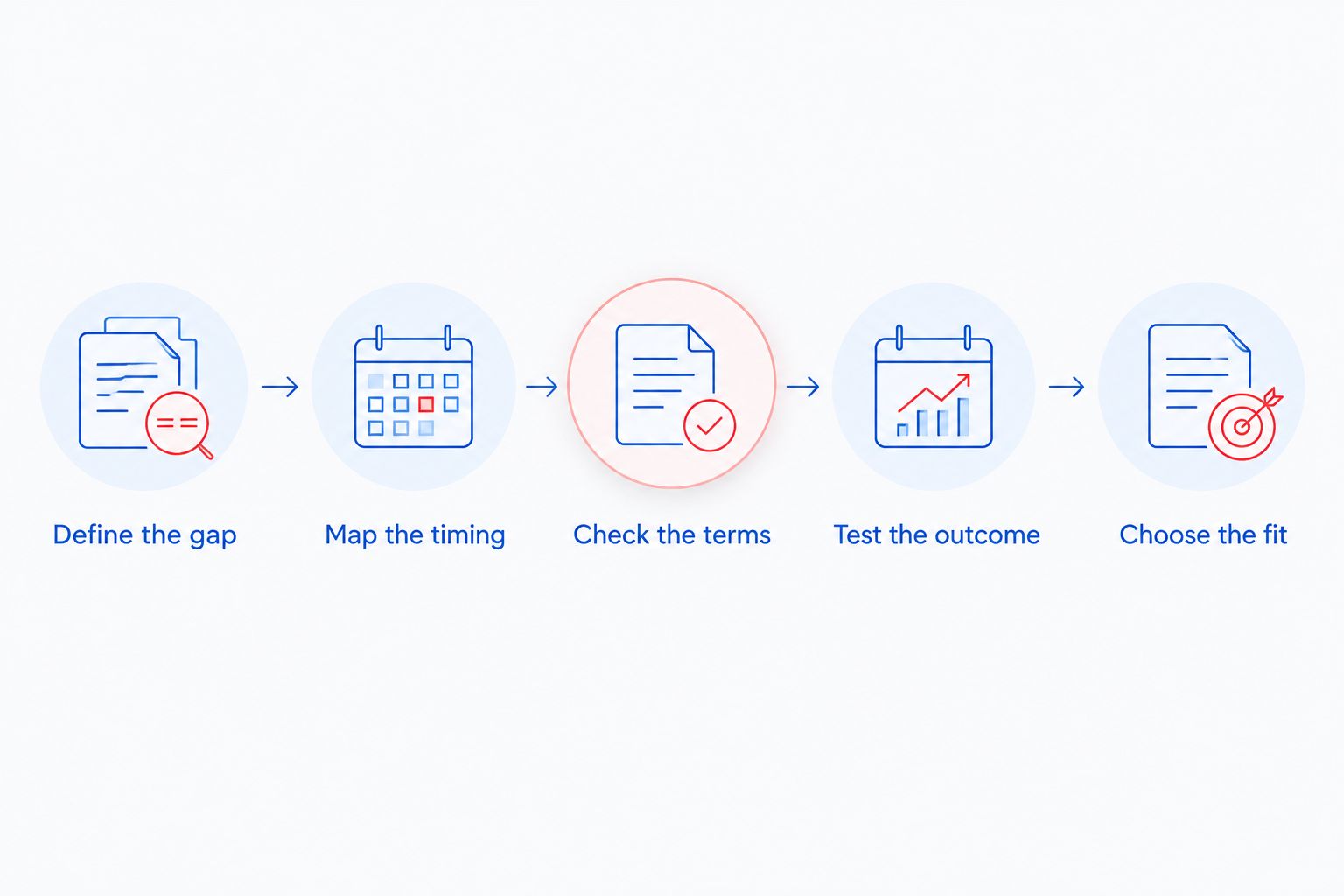
Follow this sequence for a 2026 funding review:
- Define the gap. Identify the exact obligation you cannot cover and the event that creates the shortage.
- Map the timing. Put supplier payment, shipment, customer acceptance, collection, and financing payments on one timeline.
- Check the terms. Confirm permitted uses, required payments, security, guarantees, and responsibilities if the transaction changes.
- Test the outcome. Rework the forecast for delayed delivery, delayed collection, or a customer deduction.
- Choose the fit. Select the arrangement that covers the need without creating an unsupported cash obligation.
Ask for written clarification when an offer leaves a responsibility unclear. A verbal assurance does not replace the agreement you sign.
Review 3 documents together
Start with the customer order, the supplier quote, and the proposed financing agreement. Together, these 3 documents let you check whether the funding terms align with the commercial transaction.
Look for mismatched descriptions, quantities, delivery conditions, and payment instructions. Resolve discrepancies before accepting obligations that depend on those details.
Build 2 timelines
Create a fulfillment timeline and a cash timeline. The first tracks supplier readiness, shipment, and acceptance; the second tracks outgoing payments, incoming collections, and financing obligations.
Comparing these 2 timelines exposes gaps that an order total alone cannot show. If a payment falls due before the expected collection, identify the cash source that covers it.
Ask 4 questions about delays
Ask what happens if the supplier ships late, the customer accepts late, the customer pays late, or the customer disputes the goods. Those 4 questions turn a general risk discussion into specific contract checks.
Get the answers in writing. Then reflect the obligations in your forecast rather than assuming the original schedule will hold.
Can purchase order financing cover payroll and rent?
Purchase order financing generally pays approved suppliers for a specific order, rather than providing unrestricted cash for payroll and rent. If those expenses are part of your shortage, evaluate them separately instead of assuming the supplier funding covers them.
This is a common reason the financing decision needs more than an order review. Your business must remain able to operate while the order moves through fulfillment and collection.
Is purchase order financing easier to qualify for?
Purchase order financing places substantial attention on the customer, supplier, and transaction, but that does not make approval automatic or universally easier. Business loan underwriting focuses on the borrower's ability to meet the lender's requirements and repay the debt.
Ask each provider which documents and conditions apply to your business. Do not translate a different underwriting approach into a promise of approval.
Should you choose a business loan if you qualify?
Qualifying for a business loan does not establish that it is the better choice. The loan still needs to cover the right expenses with payments your cash flow can support.
Compare the complete obligation against the purchase order arrangement. Approval is a gate, not a recommendation. Choose based on the business outcome and contractual responsibility, not simply the availability of an offer.
Where funding advice fits
Trifecta Business Group is best suited to small and mid-sized companies seeking business funding and strategic consulting support. The firm offers funding solutions alongside digital marketing and consulting services.
That combination is relevant when your funding decision sits inside a broader growth plan. Supplier funding, operating cash, and expansion spending need to work together rather than compete for the same incoming customer payment.
Trifecta Business Group's business funding services are not a substitute for reviewing the terms of a specific offer. Use Trifecta Business Group as a starting point for discussing your funding needs, then evaluate any proposed agreement on its own requirements and obligations.
FAQ
Is purchase order financing better than a business loan in 2026?
Purchase order financing is better for an eligible supplier-payment gap tied to a confirmed order; a business loan is better for broader permitted spending. Compare the payment timing, remaining profit, and contractual obligations before choosing.
Do I receive the purchase order financing money in my bank account?
Purchase order financing typically pays the approved supplier rather than depositing unrestricted funds into your operating account. Confirm the payment process and any expenses you must cover separately.
Can I use a business loan to fulfill a purchase order?
A business loan can fund order fulfillment when the loan agreement permits that use. Your business must still meet the repayment schedule, regardless of when the customer pays.
Does a confirmed purchase order guarantee financing approval?
A confirmed purchase order does not guarantee financing approval. The provider evaluates the customer, supplier, transaction, and business against its requirements.
What happens if my customer pays late?
Your financing agreement determines your obligations when a customer pays late. Review the consequences for financing charges, payment deadlines, collections, and your responsibility for the unpaid amount.
Can purchase order financing help a service business?
Traditional purchase order financing is generally structured around supplier-funded goods rather than payroll-driven service delivery. Confirm eligibility before treating a signed service contract as a qualifying order.
Can Trifecta Business Group help me discuss business funding needs?
Trifecta Business Group offers business funding and strategic consulting services for small and mid-sized companies. Bring your use of funds, customer payment terms, supplier requirements, and cash-flow forecast to the discussion.
One last thing
A profitable order can still create a cash shortage. Profit describes what remains after expenses; cash timing determines whether you can pay each obligation when it falls due.
Before signing in 2026, identify the cash source for every payment between supplier funding and customer collection. If any payment has no clear source, the funding plan is unfinished—even if the order looks attractive.
Related guides
- How to prepare your business for a funding application
- Term loans for small business expansion
- How to improve cash flow with working capital financing
Want to explore commercial financing options? Start a private application. There is no hard credit pull to explore your options. One advisor will review your situation and match your file with one lending partner at a time. Approval is never guaranteed, and timing depends on the program and the lender.
Take the next funding step
Start with your supplier-payment gap, operating needs, and repayment plan.
How these options compare
| Option | Typical speed | How you repay | Backed by | Best for |
|---|---|---|---|---|
| Invoice factoring | Often days | Customer pays the invoice; fee deducted | Your B2B invoices | Slow-paying business customers |
| Line of credit | Days to weeks | Interest only on what you draw | Varies | Recurring or uneven cash-flow gaps |
| Term loan | Days to weeks | Fixed payments over a set term | Varies | One-time investments with a clear payback |
| Merchant cash advance | Often days | Share of daily/weekly sales; priced with a factor rate | Future sales | Urgent needs, card-heavy businesses |
General guide only. Actual speed, cost and terms depend on the lending partner and your file.
Does applying affect my credit? +
Trifecta Business Group requires no hard credit pull, which does not affect your score. Any hard pull is explained before it happens.
How do I know which funding option fits? +
Start with what the money needs to do, how fast you need it and how you want to repay. Our comparison tool and advisors can help match the program.
Planning your timing
See this month's commercial rate benchmarks before you borrow
Our Small Business Capital & Formation Index tracks the Prime Rate, SBA rate caps, realistic cost ranges by funding type, and new business formation pressure state by state — updated every month.
What are you trying to fund?
Compare flexible working-capital options
Start with working capital and a line of credit, then compare payment structure and speed.
Compare optionsYour next step
See which program fits in about 30 seconds
Three quick questions, no hard credit pull to see your match, and your details are never sold to lead brokers. Commercial financing only — approval is never guaranteed.
Free Trifecta tools
Put this article to work for your business
Keep learning with Trifecta Business Group