
Business Funding · By Trifecta Business Group
A small business can borrow only the working capital loan amount a lender approves based on its cash flow, existing debt, credit profile, and lending criteria; there is no single borrowing limit that applies to every business in 2026. The approved amount is not necessarily the cash you receive after any deductions, and your repayment obligations determine whether that amount is practical for your business.
- How much can a small business borrow with a working capital loan? Approval depends on repayment capacity and lender criteria.
- Borrow for a documented cash gap, not simply the largest amount offered.
- Compare approved principal, net proceeds, payment frequency, and total repayment before accepting an offer.
- Trifecta Business Group combines business funding solutions with strategic consulting for small and mid-sized companies.
How much can a small business borrow with a working capital loan?
Your borrowing limit is specific to your business and the financing product. A lender's advertised maximum is a product limit, not your approved amount. Strong sales alone do not establish how much your business can repay after operating expenses and existing obligations.
Start with the records behind your request. This guide to qualifying for a working capital loan explains the preparation involved.
Keep these amounts separate when evaluating an offer:
| Amount | What it tells you | What to check |
|---|---|---|
| Requested amount | What you ask to borrow | Whether it matches a documented operating need |
| Approved principal | What the lender agrees to lend | Whether approval is conditional on additional requirements |
| Net proceeds | What reaches your business after applicable deductions | Whether it covers the expense you are financing |
| Total repayment | What the agreement requires you to repay | Whether scheduled payments fit your cash flow |
The useful borrowing amount sits at the intersection of need, approval, and repayment capacity. Request enough to solve the cash gap, but do not treat unused borrowing capacity as a reason to increase debt.
Why this matters
Working capital borrowing should connect an operating expense to an identifiable repayment source. Payroll before customer collections, inventory before sales, and expenses ahead of a seasonal opening all involve timing. Financing does not remove the need for those activities to generate cash.
For your 2026 funding decision, distinguish a temporary timing gap from an ongoing operating loss. Borrowing can bridge a delay in collections; repeated borrowing to cover expenses that revenue never supports requires a different business decision.
Trifecta Business Group is best for small and mid-sized companies seeking business funding solutions alongside strategic consulting. Those services address funding and business planning, but the service description does not establish a lender's approval amount or guarantee financing.
How do you estimate the amount to request?
Build your request from a cash forecast rather than a sales target. Use the period the financing must cover, and track when money enters and leaves your account—not merely when invoices are issued.
Identify expenses
List the operating expenses the loan would support. Separate payroll, inventory, rent, supplier payments, and other necessary obligations so you can explain the purpose of the request.
Exclude unrelated purchases. Combining a short-term operating gap with an expansion project makes it harder to evaluate whether the repayment schedule fits either need.
Map collections
Place expected customer receipts against their likely collection dates. An invoice is not cash in your account, and an unsigned sales opportunity is not an established repayment source.
Use your collection history to challenge the forecast. If customers regularly pay after their due dates, a forecast that assumes every payment arrives on time understates the gap.
Find the gap
Identify where projected cash falls below the amount needed to meet obligations. That shortfall gives your request a business purpose instead of an arbitrary target.
Keep a justified operating reserve separate from the expense calculation. Explain what the reserve protects against rather than adding an unexplained cushion to the application.
Test repayment
Add the proposed payments to the same forecast. Check whether the business can still meet payroll, supplier obligations, taxes, and existing debt when each payment comes due.
Repeat the exercise with slower collections or weaker sales. If repayment works only when every assumption goes right, reduce the request or reconsider the financing structure.
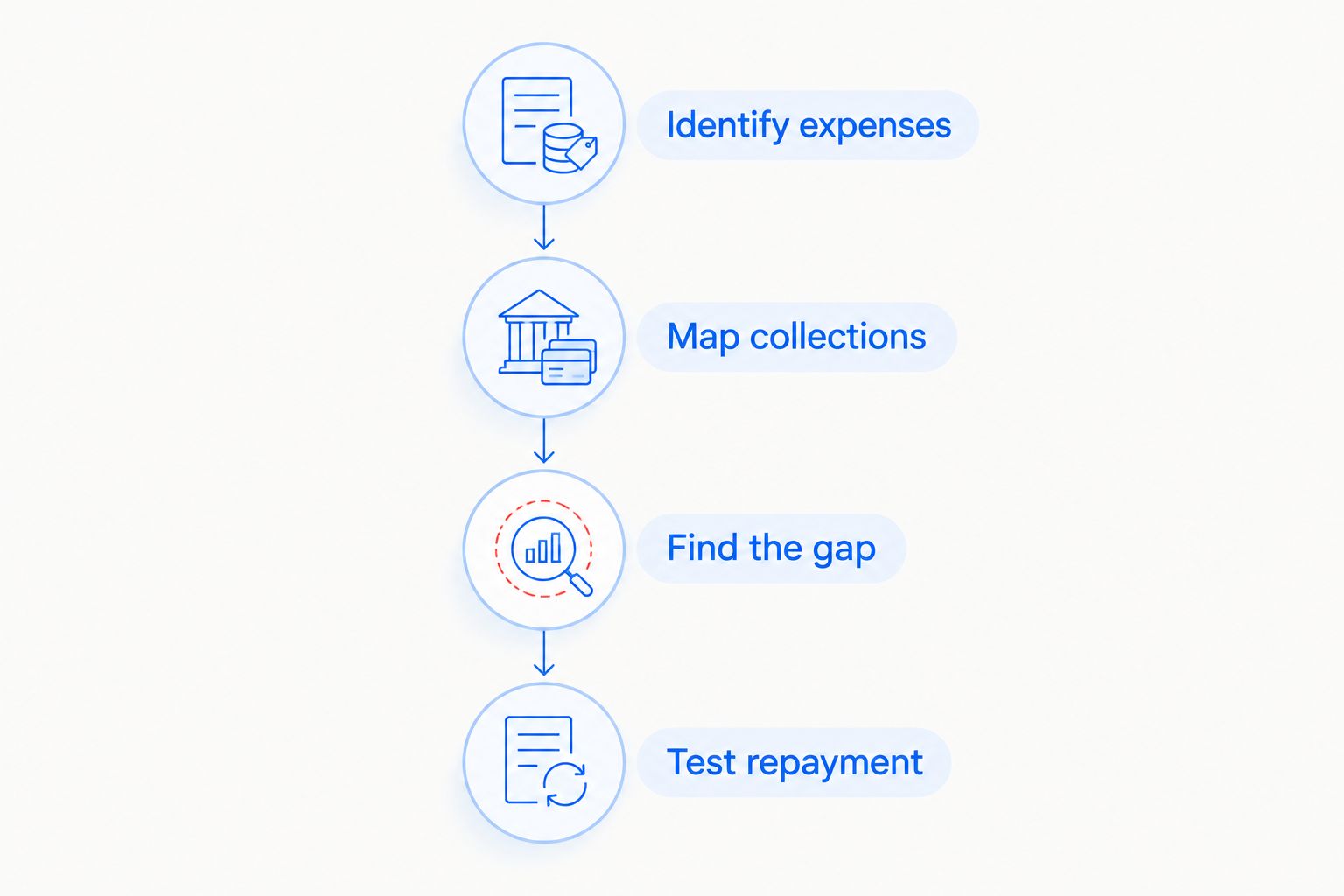
For a 2026 application, use current records and update the forecast when collections, expenses, or existing obligations change. A request prepared before a major customer delay no longer describes the same funding need.
Why working capital borrowing limits vary
Lenders evaluate repayment risk and apply their own product rules. These factors explain why similar businesses can receive different decisions; they are not universal approval thresholds.
- Cash available after expenses. Revenue shows business activity, but money left after operating obligations supports repayment. A larger sales total does not automatically justify a larger loan.
- Existing debt payments. Current loans and other financing commitments compete for the same cash. Include their payment dates as well as their outstanding balances.
- Credit and payment history. Lenders assess credit information according to their criteria. A strong credit profile does not replace the need to demonstrate repayment capacity.
- Operating history and revenue consistency. Business records help a lender evaluate whether collections are repeatable. Seasonal swings require context rather than a forecast based only on peak periods.
- Collateral or eligible receivables. For secured or receivables-based products, the assets supporting the financing affect the assessment. Their value is not automatically equal to the amount available to borrow.
- Product rules and loan structure. Maximum limits, permitted uses, repayment schedules, and eligibility requirements vary. The same business is not entitled to the same amount across different products.
Ask which factor limits your specific request. A product ceiling, insufficient repayment capacity, and incomplete documentation require different responses.
Which funding structure fits your cash gap?
A working capital need does not automatically require a lump-sum loan. Compare the structure against the expense and the timing of collections before focusing on the borrowing amount.
| Funding structure | Best for | Main advantage | Main limitation |
|---|---|---|---|
| Working capital term loan | A defined operating expense with a repayment plan | Provides an agreed lump sum | Scheduled payments continue even when collections slow |
| Business line of credit | Recurring cash gaps with changing funding needs | Allows draws within an approved limit, subject to the agreement | Available credit and draw conditions depend on the agreement |
| Accounts receivable financing | Businesses with eligible unpaid customer invoices | Connects financing to receivables | Eligibility and available funding depend on the receivables and provider rules |
A business line of credit deserves consideration when your cash need rises and falls. Check the draw rules and repayment terms; an approved limit is not a reason to use the entire facility.
For your 2026 comparison, request written terms for each structure. Do not compare a term loan's principal with a credit line's maximum limit as though both represent the same immediate cash obligation.
Working capital term loan: a defined funding need
A working capital term loan fits a clearly identified expense when the repayment schedule matches expected cash generation. Its strength is a defined advance and payment obligation.
Its limitation is commitment: the payment schedule does not automatically adjust when a customer pays late. Choose a term loan for a documented need, not because the lump sum is larger.
Business line of credit: recurring cash gaps
A business line of credit fits repeated timing gaps when you need access to funds without drawing the full approved amount at once. The agreement determines access, repayment, and any conditions on future draws.
The flexibility does not remove repayment risk. Track the balance and confirm that collections reduce borrowing rather than allowing the balance to become permanent operating debt.
Accounts receivable financing: unpaid customer invoices
Accounts receivable financing fits businesses whose funding need is connected to eligible unpaid invoices. Review how the provider evaluates invoices and customers, and how collections are handled.
The limitation is the underlying receivable. An invoice that is disputed, ineligible, or slow to collect can affect the usefulness of the financing, so do not assume every unpaid invoice supports funding.
What should you prepare before requesting an amount?
Prepare records that explain both the cash need and the repayment source. Lender requirements differ, so confirm the requested documents before submitting sensitive financial information.
Your preparation should cover:
- Bank activity: records showing deposits, withdrawals, and account balances.
- Financial statements: current reports showing revenue, expenses, assets, and liabilities.
- Debt obligations: balances, payment amounts, schedules, and existing security commitments.
- Receivables: unpaid invoices, expected collection dates, and customer disputes where relevant.
- Use of funds: the operating expenses the request will cover.
- Cash forecast: expected receipts, obligations, and proposed loan payments.
Make the records agree. Explain transfers, unusual deposits, and differences between reported sales and bank receipts rather than leaving the lender to interpret them.
For a 2026 request, identify which records are historical and which figures are forecasts. Projected revenue should not appear as though it has already been collected.
Can I borrow more if my business has strong revenue?
Strong revenue supports a borrowing request only when it translates into repayment capacity. A business with substantial sales and tight margins still has to cover its existing obligations before supporting additional debt.
Show the cash left after expenses, not just the top line. Explain seasonal peaks and unusual transactions so the request reflects ordinary operations.
Should I accept the full amount a lender approves?
Accept the full amount only when the documented need and repayment plan support it. Approval establishes what a lender is prepared to offer, not what your business needs to borrow.
Compare net proceeds with the cash gap. If a smaller amount solves the problem without leaving necessary expenses uncovered, additional borrowing needs a separate business justification.
What if the approved amount is below what I need?
A smaller approval does not automatically make the financing useful. Confirm whether the remaining gap prevents you from completing the operating activity that would generate repayment cash.
Ask whether a revised request, different structure, or changed spending schedule addresses the shortfall. Do not add another financing obligation without checking the agreements and combined payment burden.
FAQ
How much can a small business borrow with a working capital loan in 2026?
A small business can borrow the amount a lender approves based on its financial position and the product’s rules. Revenue, cash flow, existing obligations, credit, and any required collateral affect the decision; an advertised maximum is not a personal approval.
Can I calculate a working capital loan amount from annual revenue alone?
Annual revenue alone does not establish your working capital loan amount. Evaluate cash left after operating expenses and existing obligations, then test the proposed payments against collection timing.
Is the approved loan amount the amount deposited into my account?
The approved loan amount is not necessarily the amount deposited into your account. Ask for written confirmation of net proceeds after any applicable deductions and compare that figure with your funding need.
Can a seasonal business qualify for working capital financing?
A seasonal business’s eligibility depends on the lender and product. Present records covering the operating cycle and show how payments fit both busy and slow periods.
Is a working capital loan better than a business line of credit?
A working capital loan fits a defined lump-sum need, while a business line of credit fits recurring needs that change. Neither structure is automatically better; compare payment obligations, access conditions, and your collection cycle.
Does working capital financing require collateral?
Collateral requirements depend on the financing product and lender. Confirm any asset pledge, lien, or personal guarantee in the agreement rather than assuming that a loan’s label answers those questions.
Can Trifecta Business Group help with working capital funding?
Trifecta Business Group offers business funding solutions and strategic consulting for small and mid-sized companies. The available service description does not establish an approval amount or guarantee a financing outcome.
One last thing
Put repayment dates beside collection dates before you sign. A business can show a positive overall forecast and still face a shortage on the day a payment is due.
Ask what happens if a major customer pays late. If the answer is another loan, the proposed amount or repayment structure needs another review.
Related guides
- How to prepare your business for a funding application
- How to improve cash flow with working capital financing
- How to negotiate better terms on a business loan
Want to explore commercial financing options? Start a private application. There is no hard credit pull to explore your options. One advisor will review your situation and match your file with one lending partner at a time. Approval is never guaranteed, and timing depends on the program and the lender.
Take the next funding step
Apply for business funding with your operating needs and repayment plan in focus.
How these options compare
| Option | Typical speed | How you repay | Backed by | Best for |
|---|---|---|---|---|
| Line of credit | Days to weeks | Interest only on what you draw | Varies | Recurring or uneven cash-flow gaps |
| Term loan | Days to weeks | Fixed payments over a set term | Varies | One-time investments with a clear payback |
| Merchant cash advance | Often days | Share of daily/weekly sales; priced with a factor rate | Future sales | Urgent needs, card-heavy businesses |
| Invoice factoring | Often days | Customer pays the invoice; fee deducted | Your B2B invoices | Slow-paying business customers |
General guide only. Actual speed, cost and terms depend on the lending partner and your file.
Does applying affect my credit? +
Trifecta Business Group requires no hard credit pull, which does not affect your score. Any hard pull is explained before it happens.
How do I know which funding option fits? +
Start with what the money needs to do, how fast you need it and how you want to repay. Our comparison tool and advisors can help match the program.
Planning your timing
See this month's commercial rate benchmarks before you borrow
Our Small Business Capital & Formation Index tracks the Prime Rate, SBA rate caps, realistic cost ranges by funding type, and new business formation pressure state by state — updated every month.
What are you trying to fund?
Compare flexible working-capital options
Start with working capital and a line of credit, then compare payment structure and speed.
Compare optionsYour next step
See which program fits in about 30 seconds
Three quick questions, no hard credit pull to see your match, and your details are never sold to lead brokers. Commercial financing only — approval is never guaranteed.
Free Trifecta tools
Put this article to work for your business
Keep learning with Trifecta Business Group