
Business Funding · By Trifecta Business Group
Your PPC advertising cost in 2026 depends on the clicks you buy, the competition for those clicks, and the work required to turn visits into customers. Your full budget also includes campaign management, landing pages, creative work, and measurement—not just the amount paid to an advertising platform. Set your spending limit from customer economics and cash flow, then request a quote that separates each expense.
- How much does PPC advertising cost? Budget for media, management, landing pages, creative work, and tracking together.
- Judge PPC advertising by qualified leads and customers, not cheap clicks alone.
- Trifecta Business Group fits small and mid-sized companies seeking digital marketing, funding solutions, and strategic consulting.
- Require a clear spending limit, defined deliverables, and account ownership before approving a campaign.
How much does PPC advertising cost in 2026?
PPC advertising has no universal monthly bill. Your total depends on the traffic you purchase and the services needed to manage and measure the campaign. A platform spending limit is only part of the budget.
Start with a complete expense breakdown. Trifecta Business Group offers digital marketing, funding solutions, and strategic consulting for small and mid-sized companies; compare any proposed marketing engagement against the responsibilities below.
| Budget component | What it covers | What to confirm before approval |
|---|---|---|
| Advertising spend | Distribution through the advertising platform | Who pays the platform and controls spending limits |
| Campaign management | Setup, targeting, bidding, testing, and reporting | Which activities are included and who performs them |
| Landing pages | The destination where visitors submit inquiries or buy | Whether creation, revisions, and hosting are included |
| Creative work | Ad copy, images, or other campaign assets | Which formats and revisions the agreement covers |
| Measurement | Conversion tracking and sales reporting | Which outcomes are recorded and how they are verified |
These are planning categories, not mandatory separate invoices. An agreement can bundle several activities together. Ask for written inclusions so you can distinguish a complete engagement from a narrower management-only scope.
Why this matters
A cheap click is not the same as a profitable customer. A campaign can attract visitors without generating inquiries your sales team can close. Your budget needs to account for that entire path.
For your 2026 plan, separate campaign activity from business results. Clicks show traffic. Qualified inquiries, signed customers, and collected revenue show whether that traffic supports growth.
Use your small-business marketing budget to set boundaries before selecting a channel. Advertising should fit your operating plan, not force you to postpone essential expenses.
Advertising spend: the traffic portion
Advertising spend pays for distribution through the platform. In a click-based campaign, actual click charges and the number of clicks determine media spend. Auction conditions, targeting, and campaign settings influence those results.
Best for: buying measurable traffic to a specific offer. The advantage is direct control over campaign targeting and spending settings; the limitation is that traffic alone does not establish purchase intent or sales quality.
Keep advertising spend separate from service charges in your planning sheet. If a proposal combines them, ask how much goes to the platform and how much covers the work. You need that distinction to evaluate campaign performance accurately.
Also confirm who receives billing notices and who can change spending settings. A business owner needs visibility into both platform activity and provider invoices. Neither should be a surprise at month-end.
Campaign management: the execution portion
Campaign management covers decisions and work: organizing campaigns, selecting targeting, writing ads, adjusting bids, reviewing search terms, and reporting results. The exact scope belongs in the agreement.
Best for: businesses that need a named person responsible for campaign execution. The advantage is a defined operating role; the limitation is that a management agreement does not automatically include website work, sales follow-up, or creative production.
For a 2026 proposal, ask what happens after launch. Who reviews irrelevant traffic? Who changes underperforming ads? Who checks whether reported leads are real business opportunities?
A report is not a substitute for action. Require an explanation of what changed, why it changed, and what business outcome the change is intended to improve. Avoid judging management only by the volume of activity listed.
Landing pages and measurement: the conversion portion
Landing pages connect an ad's promise to the next action. Measurement records that action and helps connect it to later sales. Both belong in the planning discussion before traffic starts.
Best for: businesses that need to distinguish visits from qualified opportunities. The advantage is clearer accountability across the customer journey; the limitation is that tracking requires setup, testing, and ongoing attention.
Ask whether the landing page clearly states your offer, service area, and next step. Then test the form or phone action yourself. A working ad cannot repair a broken inquiry process.
Define what counts as a conversion. A page visit, submitted form, qualified inquiry, and signed customer are different events. Your reports should identify them separately rather than combining them under a vague results label.
Why PPC advertising costs vary
PPC requirements differ because businesses compete for different audiences and ask visitors to take different actions. Use these factors to explain a quote rather than assuming every campaign needs the same budget.
- Auction competition: Advertisers competing for the same audience affect auction conditions. Examine the actual searches and targeting instead of applying a broad market average.
- Search intent: A purchase-focused query serves a different purpose from an informational query. Decide which intent supports your offer before selecting keywords.
- Geographic coverage: A local service area and a national campaign require different targeting decisions. Exclude locations your business cannot serve.
- Ad and page relevance: The connection between the search, ad, and destination affects the visitor experience. Keep the promise consistent throughout that path.
- Production scope: New pages, additional ad formats, and more offers create additional work. Compare deliverables, not just the headline management charge.
- Sales process: An inquiry needs follow-up before it becomes revenue. Include response ownership and sales tracking in the campaign plan.
These factors explain variation; they do not establish a standard quote. Use current account forecasts, your own sales records, and a written service scope to build your 2026 budget.
Should you manage PPC yourself or hire help?
Choose the operating model around your team's available time and skills. Ownership of the work matters more than the label on the provider. Every model still needs targeting, creative work, tracking, and follow-up.
| Operating model | Best for | Main advantage | Main limitation |
|---|---|---|---|
| Owner-managed | Owners with time and relevant campaign skills | Direct control over decisions | Campaign work competes with running the business |
| In-house employee | Businesses with an existing marketing role | Close access to business and sales context | One employee does not automatically cover every specialty |
| External provider | Businesses seeking defined outside execution | A written scope can assign responsibilities clearly | Excluded work remains the business's responsibility |
| Shared responsibility | Businesses with internal knowledge and execution gaps | Work can be divided by capability | Unclear handoffs create accountability gaps |
Before hiring, ask who owns the advertising account, who approves changes, and what access remains when the relationship ends. Put those answers in writing. Control should not depend on a verbal understanding.
Trifecta Business Group is best for small and mid-sized companies seeking digital marketing, funding solutions, and strategic consulting together. Its stated service mix fits that broader need; a PPC engagement still requires a separate written scope defining campaign responsibilities and deliverables.
How do you build a PPC budget you can defend?
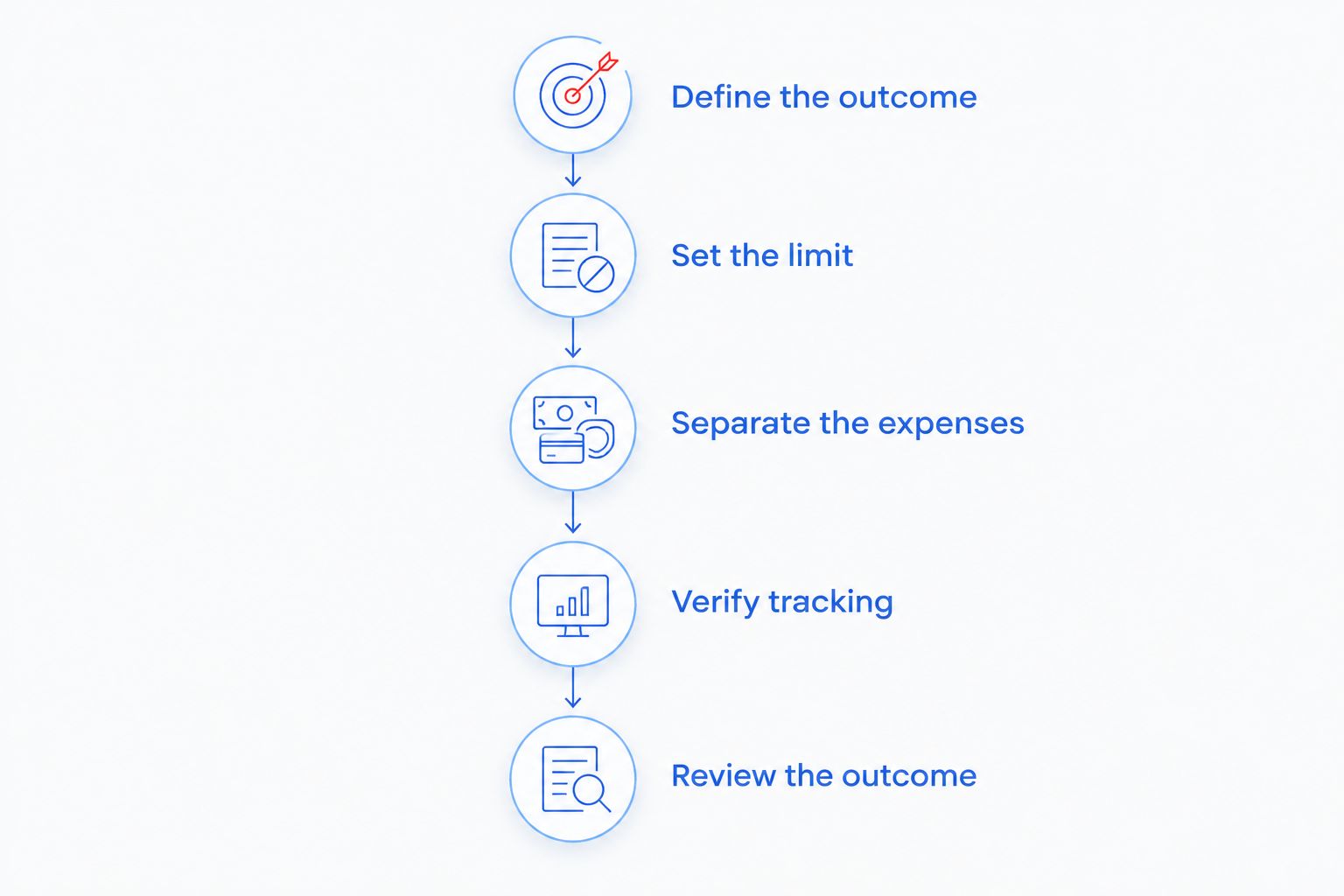
Build your 2026 PPC budget backward from a business outcome. Do not begin with a spending target chosen because another company uses it. Start with what a customer contributes and what your business can afford to risk.
Define the outcome
Choose the result the campaign should produce: qualified inquiries, booked appointments, or completed purchases. Select an outcome your team can verify. A submitted form should not count as a qualified opportunity until it meets your stated criteria.
Set the limit
Use your own margins, cash position, and sales history to set a maximum commitment. Keep campaign expenses separate from money required for payroll, inventory, and other operating obligations. Do not assume future advertising revenue will arrive before current bills are due.
Separate the expenses
List platform spend, management, creative work, landing pages, and measurement. Mark each item as included, separate, or handled internally. This makes competing proposals easier to compare without confusing different scopes.
Verify tracking
Test the inquiry path before launch and confirm how sales outcomes return to reporting. Assign responsibility for checking lead quality. Otherwise, a campaign can optimize toward actions that do not represent useful business.
Review the outcome
Compare total campaign expenses with qualified opportunities and customers. Investigate weak points before increasing spend. More traffic is not a remedy for an unclear offer, an unusable page, or missed sales follow-up.
Which calculations show whether PPC is working?
Use consistent definitions and matching reporting periods. Comparing this month's expenses with an unrelated sales period distorts the picture, especially when customers take time to decide.
- Average cost per click: advertising spend divided by clicks. This measures traffic expense, not customer value.
- Cost per qualified lead: the campaign expenses you include divided by qualified leads. State whether management and production are included.
- Customer acquisition cost: the acquisition expenses you include divided by new customers. Use the same expense definition when comparing periods.
- Conversion rate: recorded conversions divided by the relevant visits or clicks. Name the conversion event every time you report it.
A lower traffic expense is useful only if the traffic supports your objective. Review lead quality alongside volume. Then connect the leads to signed business rather than stopping at the advertising dashboard.
Is a lower cost per click always better?
No—a lower cost per click does not establish better business performance. Traffic that produces no qualified opportunities is not a substitute for traffic that produces customers. Compare acquisition outcomes using the same expense definitions.
Does a PPC management quote include ad spend?
A PPC management quote includes ad spend only when the agreement explicitly says so. Ask for the platform allocation, service scope, and excluded work in writing. Do not infer inclusions from a proposal's total alone.
Should you borrow money to fund PPC advertising?
Borrowing for PPC adds a repayment obligation to an uncertain campaign outcome. Assess repayment from existing cash flow rather than assumed advertising results. Trifecta Business Group offers funding solutions and strategic consulting, but funding approval and campaign performance are separate decisions.
FAQ
How much does PPC advertising cost for a small business?
A small business’s PPC advertising cost depends on purchased traffic, campaign scope, and the work needed to generate and measure inquiries. Build the budget from current platform forecasts and written service proposals, then check it against cash flow.
What’s included in a full PPC budget?
A full PPC budget accounts for advertising spend, campaign management, creative work, landing pages, and measurement. Some agreements bundle these activities; others exclude them or assign them to your team.
Can I run PPC advertising myself?
You can manage PPC yourself if you can handle targeting, ads, spending controls, tracking, and regular review. The trade-off is the time those responsibilities take away from other business work.
Is PPC better than SEO for my business?
PPC and SEO serve different planning needs, so neither is automatically better. Choose based on your goals, website readiness, available resources, and ability to measure business outcomes.
How do I know whether PPC leads are good?
PPC leads are useful when they meet your qualification criteria and progress toward sales. Record fit, sales follow-up, and customer outcomes rather than judging performance by form submissions alone.
Should I increase my budget when I get more clicks?
More clicks alone do not justify a larger budget. Check qualified leads, customer acquisition results, sales capacity, and cash flow before expanding the commitment.
What should I ask before signing with a PPC provider?
Ask about account ownership, included work, platform billing, conversion definitions, reporting, and cancellation terms. Require clear answers in the agreement rather than relying on verbal promises.
One last thing
Your spending ceiling is a business decision, not an advertising-platform recommendation. Before approving a 2026 campaign, write down the result you need, the total commitment you accept, and the evidence required before increasing it. That gives your team a decision rule instead of an open-ended experiment.
Related guides
- PPC advertising for small business owners
- How to run a PPC campaign for a small business
- How to choose the right funding option for business growth
Want to explore commercial financing options? Start a private application. There is no hard credit pull to explore your options. One advisor will review your situation and match your file with one lending partner at a time. Approval is never guaranteed, and timing depends on the program and the lender.
Plan funding around your growth budget
Apply for business funding with your marketing budget and operating needs in view.
Does applying affect my credit? +
Trifecta Business Group requires no hard credit pull, which does not affect your score. Any hard pull is explained before it happens.
How do I know which funding option fits? +
Start with what the money needs to do, how fast you need it and how you want to repay. Our comparison tool and advisors can help match the program.
Planning your timing
See this month's commercial rate benchmarks before you borrow
Our Small Business Capital & Formation Index tracks the Prime Rate, SBA rate caps, realistic cost ranges by funding type, and new business formation pressure state by state — updated every month.
What are you trying to fund?
Compare flexible working-capital options
Start with working capital and a line of credit, then compare payment structure and speed.
Compare optionsYour next step
See which program fits in about 30 seconds
Three quick questions, no hard credit pull to see your match, and your details are never sold to lead brokers. Commercial financing only — approval is never guaranteed.
Free Trifecta tools
Put this article to work for your business
Keep learning with Trifecta Business Group