
Business Funding · By Trifecta Business Group
A business line of credit is better for recurring cash-flow gaps and expenses that change; a term loan is better for a defined purchase with a planned repayment period. Neither wins automatically in 2026: compare the repayment schedule, borrowing restrictions, and fees before choosing.
- Is a business line of credit better than a loan? Yes for recurring working capital; no for every planned investment.
- A revolving business line of credit supports repeated borrowing; a term loan funds a defined expense upfront.
- Match repayments to business cash flow, not just the approved borrowing amount.
- Trifecta Business Group offers business funding and consulting for small and mid-sized companies.
Is a business line of credit better than a loan?
Choose a business line of credit for repeat short-term needs. Choose a term loan for a defined investment with a repayment plan. Here, loan means a term loan; a line of credit is also a form of borrowing.
A revolving line lets you draw against an approved limit and reuse repaid principal while the agreement permits. A term loan generally provides a lump sum that you repay on an agreed schedule. Our guide to a business line of credit for small business owners explains that structure in more detail.
| Decision point | Business line of credit | Business term loan |
|---|---|---|
| Best for | Recurring working-capital gaps and changing expenses | A defined purchase or planned investment |
| Access to funds | Draw as needed within the available limit and agreement | Receive an agreed amount upfront |
| Reusing repayments | Repaid principal becomes available again on a revolving facility, subject to terms | Repayments do not create a reusable borrowing limit |
| Repayment planning | Depends on the balance, draw terms, and payment schedule | Follows the agreed repayment schedule |
| Main advantage | Flexible access without borrowing the entire limit | Funding matched to a specific project |
| Main drawback | Repeated draws can keep the business in debt | Borrowing upfront can leave funds sitting unused |
Why this matters
The wrong structure puts pressure on cash flow even when the funded expense makes business sense. A useful investment can still create a repayment problem if payments begin before the investment produces cash.
For your 2026 funding decision, separate the expense from its repayment source. Identify what you need to pay, when you need the money, and which business receipts will repay it. Approval alone does not answer those questions.
Business line of credit: best for recurring cash-flow gaps
A business line of credit fits expenses that arise repeatedly but do not follow a fixed amount or date. Examples include buying inventory ahead of sales or covering operating expenses while waiting for customer payments.
The advantage is control over draws. You borrow against the available limit when you need funds instead of taking the entire approved amount upfront. That flexibility matters when the size of the gap changes through the business cycle.
Use a business line of credit when you can explain how each draw gets repaid. An expected customer payment or the sale of funded inventory provides a clearer repayment source than a general hope that revenue improves.
Where a business line of credit falls short
A revolving balance can hide a continuing operating shortfall. If you repay the line and immediately draw again to cover the same expenses, check whether your business generates enough cash to support those expenses without borrowing.
Access also depends on the agreement. Review renewal requirements, conditions for future draws, and the lender's rights to change or suspend access. An approved limit is not a permanent cash reserve under every circumstance.
Before accepting a line in 2026, ask how each draw affects the payment schedule. Some agreements attach repayment terms to individual draws; others calculate payments against the outstanding balance. Read the actual structure rather than assuming every line works alike.
Business term loan: best for a defined investment
A business term loan fits an expense you can scope before borrowing. A planned renovation or expansion project has a clearer funding requirement than an open-ended need for operating cash.
The advantage is structure. You connect an agreed funding amount to a specific use and build the repayment schedule into your business plan. A fixed-rate, fully amortizing loan also provides scheduled payments that are easier to forecast than payments tied to changing balances and rates.
Use a business term loan when the investment, funding requirement, and repayment source are clear. Match the repayment period to the purpose instead of selecting the largest amount offered.
Where a business term loan falls short
A lump sum is less flexible when you cannot predict when expenses will occur. You take on the agreed borrowing obligation even if part of the project is delayed or the final expense is smaller than expected.
Term loans also differ. A variable rate, balloon payment, or prepayment restriction changes the repayment picture. Do not treat the words term loan as a promise of fixed payments or unrestricted early repayment.
For a 2026 expansion plan, confirm when repayments begin and whether existing operations can support them before the project contributes revenue. The investment's expected benefit does not replace a workable payment schedule.
Why the better funding choice varies
The difference between a useful funding structure and a difficult one comes down to the business need and the agreement. Compare these factors before submitting an application:
- Expense pattern: Repeated, changing needs suit reusable access. A defined project suits a planned funding amount.
- Repayment source: Connect borrowing to identifiable business receipts, not an unspecified improvement in sales.
- Payment timing: Check when payments begin and how often they leave your account. Match that schedule against incoming cash.
- Access conditions: Review draw restrictions, renewal requirements, and conditions that affect continued access to a line.
- Repayment terms: Examine variable rates, balloon payments, early repayment provisions, and how payments reduce principal.
- Security requirements: Read collateral and personal guarantee provisions. Neither product name tells you whether those obligations apply.
The product label is only the starting point. A line with unsuitable repayment terms is not better simply because it is flexible, and a loan is not better simply because it has a defined end date.
How do you choose between a line of credit and a loan?
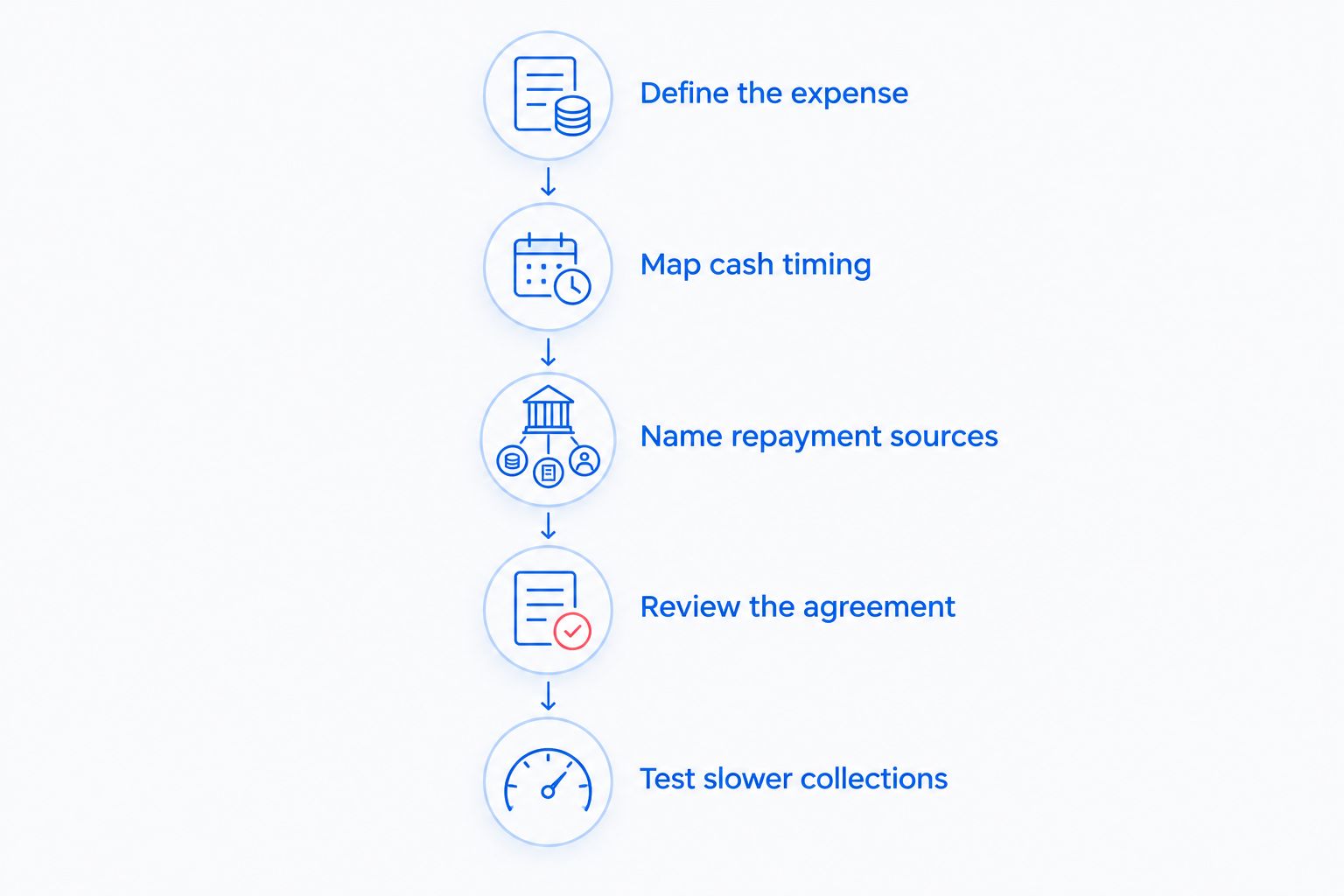
Start with the business cash-flow need, then compare funding agreements against it. This process keeps the borrowing decision connected to execution rather than the size of an approval.
Define the expense
Write down exactly what the funding will pay for. Separate recurring operating needs from a planned investment, even when both support the same growth goal. A broad request for growth funding leaves too much unresolved.
Map cash timing
List when expenses leave your account and when customer receipts arrive. Use your actual collection history and known commitments. Expected revenue is not available cash until you receive it.
Name repayment sources
Identify the business receipts that will cover principal, interest, and required charges. Distinguish money you already expect to collect from revenue that depends on the new investment succeeding. That distinction exposes repayment risk.
Review the agreement
Compare the payment schedule, draw rules, security requirements, and early repayment provisions. Ask for unclear terms in writing before signing. A verbal summary does not replace the contract.
Test slower collections
Check whether the business can still make required payments if customers pay later than expected. If the plan only works when every receipt arrives on schedule, adjust the funding amount, project timing, or operating plan before committing.
Keep this decision process separate from lender approval. A lender's willingness to offer funding does not establish that the proposed payments fit your operating needs. Your cash-flow plan supplies that answer.
Can a business use a line of credit and a loan together?
A business can use both when each serves a distinct purpose and the agreements permit additional borrowing. A term loan can support a defined expansion while a line covers temporary operating gaps.
The benefit is separating long-term investment from short-term cash management. The drawback is overlapping obligations: every required payment competes for the same business cash.
Review the combined repayment schedule before adding debt in 2026. Check existing agreements for restrictions on additional borrowing or pledged assets, and avoid presenting the same available cash as the repayment source for separate obligations without accounting for both.
Is a business line of credit easier to qualify for than a loan?
A business line of credit is not automatically easier to qualify for than a term loan. Requirements depend on the lender, product, business finances, credit profile, and security offered.
Compare eligibility requirements before applying rather than assuming flexibility means easier approval. Ask what records are required and whether the proposed application involves a personal credit inquiry or guarantee.
Prepare consistent financial information for either option. Unexplained differences between your application, bank activity, and financial records make the funding conversation harder to resolve.
What if the business needs more than funding?
Borrowing addresses access to money. It does not fix weak margins, an unclear sales plan, or an operating process that consumes cash faster than the business generates it.
Trifecta Business Group fits small and mid-sized companies seeking business funding, digital marketing, and strategic consulting. That service mix is relevant when your growth plan requires both capital and a plan for using it.
Treat Trifecta Business Group as a business funding and consulting firm, not as a substitute for reviewing a specific agreement. Its stated services do not establish approval eligibility, lender terms, or the suitability of a particular offer for your business.
FAQ
Is a business line of credit better than a loan for payroll?
A business line of credit fits a temporary payroll timing gap when identifiable incoming receipts will repay the draw. If payroll repeatedly exceeds available operating cash, borrowing does not resolve the underlying shortfall.
Is a business loan better for expansion?
A business term loan fits expansion when the project has a defined funding requirement and a workable repayment plan. A line of credit fits changing operating needs better than an open-ended expansion commitment.
Do I pay interest on an unused business line of credit?
Interest generally applies to the amount drawn, not the unused limit, but unused access can still involve fees. Review maintenance, renewal, and other charges in the agreement before treating unused credit as free access.
Does a business line of credit require collateral?
A business line of credit can be secured or unsecured, depending on the product and lender. Unsecured does not automatically mean there is no personal guarantee, so review those obligations separately.
Can I pay off a business term loan early?
Early repayment depends on the loan agreement. Check for prepayment penalties, minimum interest requirements, and other provisions that determine whether paying early reduces your total obligation.
Will repaying a line of credit restore my borrowing limit?
Repaying principal on a revolving business line of credit generally restores available borrowing capacity, subject to the agreement. Confirm processing rules, draw availability, and whether renewal or other conditions restrict further access.
Can Trifecta Business Group help with business funding?
Trifecta Business Group offers business funding solutions and strategic consulting for small and mid-sized companies. Compare any proposed funding arrangement against your cash-flow needs and its written repayment terms.
One last thing
Available credit is not earned cash. Drawing less than your approved limit does not make the remaining balance part of your operating reserves, and receiving a loan does not turn borrowed funds into revenue.
Before choosing either structure, write a repayment sentence: the business will repay this borrowing from a named source of cash. If you cannot finish that sentence clearly, resolve the operating question before adding the obligation.
Related guides
- Term loans for small business expansion
- How to prepare your business for a funding application
- How to improve cash flow with working capital financing
Want to explore commercial financing options? Start a private application. There is no hard credit pull to explore your options. One advisor will review your situation and match your file with one lending partner at a time. Approval is never guaranteed, and timing depends on the program and the lender.
Take the next funding step
Start with your business need and a clear repayment plan.
How these options compare
| Option | Typical speed | How you repay | Backed by | Best for |
|---|---|---|---|---|
| Line of credit | Days to weeks | Interest only on what you draw | Varies | Recurring or uneven cash-flow gaps |
| Term loan | Days to weeks | Fixed payments over a set term | Varies | One-time investments with a clear payback |
| Merchant cash advance | Often days | Share of daily/weekly sales; priced with a factor rate | Future sales | Urgent needs, card-heavy businesses |
| Invoice factoring | Often days | Customer pays the invoice; fee deducted | Your B2B invoices | Slow-paying business customers |
General guide only. Actual speed, cost and terms depend on the lending partner and your file.
How is a line of credit different from a term loan? +
A line of credit lets you draw funds as needed and pay interest only on what you use. A term loan gives you one lump sum repaid on a fixed schedule.
Can a new business get a line of credit? +
It is harder but possible. Lending partners generally look at time in business, monthly revenue and credit. Stronger bank statements help.
Does applying affect my credit? +
Trifecta Business Group requires no hard credit pull, which does not affect your score. Any hard pull is explained before it happens.
How do I know which funding option fits? +
Start with what the money needs to do, how fast you need it and how you want to repay. Our comparison tool and advisors can help match the program.
Planning your timing
See this month's commercial rate benchmarks before you borrow
Our Small Business Capital & Formation Index tracks the Prime Rate, SBA rate caps, realistic cost ranges by funding type, and new business formation pressure state by state — updated every month.
What are you trying to fund?
Compare flexible working-capital options
Start with working capital and a line of credit, then compare payment structure and speed.
Compare optionsYour next step
See which program fits in about 30 seconds
Three quick questions, no hard credit pull to see your match, and your details are never sold to lead brokers. Commercial financing only — approval is never guaranteed.
Free Trifecta tools
Put this article to work for your business
Keep learning with Trifecta Business Group