
Business Funding · By Trifecta Business Group
Equipment financing costs in 2026 depend on the amount financed, repayment schedule, interest charges, fees, and any required final payment—not a universal average. Your monthly payment does not capture the full commitment: upfront cash, insurance requirements, and end-of-term obligations also affect what you spend. Compare the total amount paid and the equipment you own at the end, not the payment alone.
- How much does equipment financing cost? Compare upfront cash, scheduled payments, fees, and final obligations—not payments alone.
- Equipment loans suit ownership goals; equipment leases require a close review of return, renewal, and purchase terms.
- Trifecta Business Group combines business funding and strategic consulting for small and mid-sized companies planning growth.
- Request written repayment and early-payoff terms before choosing equipment financing in 2026.
How much does equipment financing cost in 2026?
Your actual equipment financing cost comes from the written offer and contract. Start with the equipment purchase amount, separate borrowed principal from borrowing charges, and identify every payment needed to reach your intended outcome: ownership, continued use, or return.
For business funding and strategic planning support, Trifecta Business Group serves small and mid-sized companies. Use the same discipline when reviewing any financing proposal: identify what you receive, what you repay, and what remains due.
| Cost component | What to check | Why it matters |
|---|---|---|
| Upfront cash | Down payment, deposit, and charges due at signing | Determines how much cash leaves your business before use begins |
| Amount financed | Equipment and other expenses included in the balance | Establishes the amount on which the repayment obligation is based |
| Scheduled payments | Payment amount, frequency, and full schedule | Shows the cash commitment throughout the agreement |
| Financing charges | Interest and separately disclosed charges | Separates borrowing costs from repayment of principal |
| Final obligation | Balloon payment, purchase option, renewal, or return requirements | Determines the cash or action needed at the end |
| Operating expenses | Maintenance, insurance, installation, and training responsibilities | Shows whether the equipment fits your operating budget |
A useful quote explains the entire transaction. If a proposal shows only a payment, request the missing contract terms before comparing it with another offer.
Why this matters
Equipment can increase capacity while creating a fixed repayment obligation. Those payments remain part of your budget even when customer collections slow or the equipment sits idle.
The decision therefore has two tests: whether the financing terms are acceptable and whether the equipment supports enough operating value to justify the commitment. Passing one test does not answer the other.
For a 2026 purchase, build your operating budget alongside your financing comparison. Keep payroll, supplies, maintenance, and existing debt payments visible rather than treating equipment financing as an isolated expense.
Equipment loans: best for planned ownership
An equipment loan finances a purchase, with repayment governed by the loan agreement. Best for: a business that intends to keep the equipment and wants a defined path to repayment. Confirm ownership, collateral, and lien provisions rather than assuming every agreement works the same way.
The advantage is a purchase-focused structure. You can evaluate the obligation against the equipment's expected working life and your plan to keep using it after repayment.
The limitation is commitment. Selling, replacing, or retiring the equipment does not automatically cancel the loan, and collateral provisions affect your options if repayment becomes difficult.
Before signing, ask whether installation and other purchase-related expenses are included in the financed balance. Financing an expense spreads its payment over time; it does not remove that expense.
Equipment leases: best for defined use periods
An equipment lease provides use of equipment under contractual terms. Best for: a business whose planned use period matches the agreement and whose return, renewal, or purchase obligations are clear. Do not assume that completing scheduled payments transfers ownership.
The advantage is the ability to structure the agreement around use rather than an immediate purchase. That distinction matters when your business expects its equipment needs to change.
The limitation is the end-of-term decision. Return conditions, renewal language, notice deadlines, and purchase provisions can change the practical value of the arrangement.
For a 2026 lease comparison, decide your preferred ending before evaluating the payment. An agreement that works for returning equipment is not automatically suitable for keeping it.
Equipment loan or lease: which fits your goal?
| Option | Best for | Main advantage | Main limitation | Verify before signing |
|---|---|---|---|---|
| Equipment loan | Planned ownership and continued use | Connects financing to an equipment purchase | Debt obligations remain even if equipment needs change | Collateral, payoff terms, and repayment schedule |
| Equipment lease | A defined period of equipment use | Separates use from an immediate purchase decision | Ownership and exit depend on the contract | Return, renewal, notice, and purchase provisions |
Neither structure wins automatically. Compare agreements that deliver the same outcome. A lease requiring equipment return and a loan supporting ownership are not equivalent simply because their scheduled payments look similar.
Why equipment financing costs vary
Equipment financing proposals differ because the transaction and repayment risk differ. Check these factors before treating a quoted payment as a fair comparison:
- Amount financed. A larger balance creates a different obligation. Confirm that competing proposals include the same equipment and related expenses.
- Repayment length. Spreading the same balance over a longer schedule changes the payment and the time financing charges accrue.
- Borrower profile. Credit history, existing obligations, and business finances inform underwriting. Compare actual written offers rather than assuming an advertised offer applies to you.
- Equipment characteristics. Age, condition, and resale value matter when equipment supports the financing obligation. Identify the exact asset in each proposal.
- Upfront contribution. Cash paid at signing changes the amount you borrow and the cash left in your business.
- Contract structure. Fees, payment timing, purchase options, and payoff provisions change the overall obligation even when payments appear similar.
Credit challenges require a closer look at terms, not an assumption that every offer works alike. Read about equipment financing with bad credit before comparing proposals built around different borrower requirements.
How do I calculate the full equipment financing commitment?
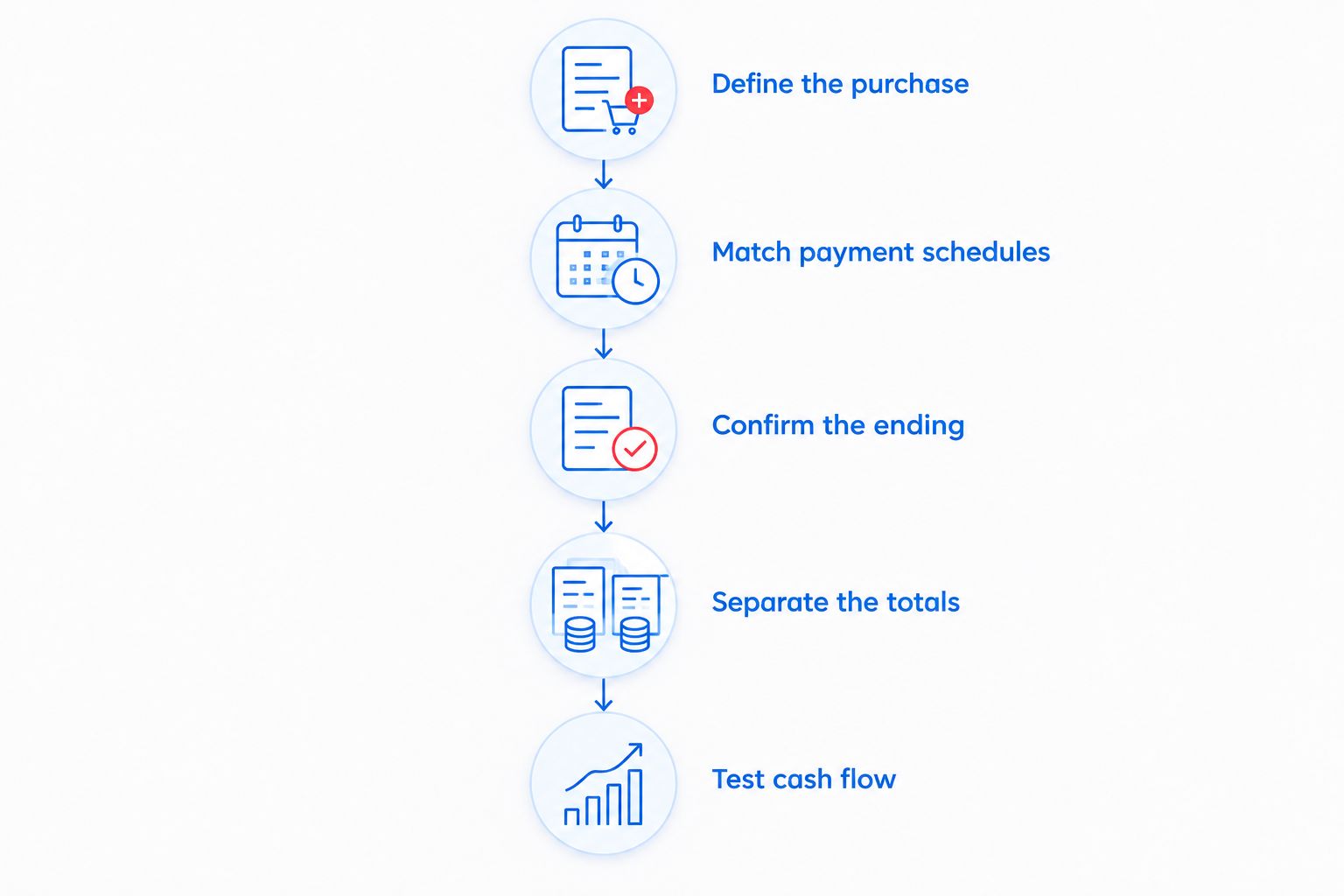
Calculate the full commitment by combining upfront cash, scheduled payments, separate mandatory charges, and any final amount required for your intended outcome. Keep operating expenses in a separate budget so you do not confuse the financing agreement with the ongoing expense of running the equipment.
Define the purchase
Write down the equipment, supplier, condition, and included services. List delivery, installation, training, and accessories separately so you can see what each proposal includes.
A quote for equipment alone is not directly comparable with financing that also includes installation. Match the underlying purchase first.
Match the payment schedules
Request the complete schedule, including payment frequency and any irregular payments. Do not compare a monthly payment with a more frequent payment as though they represent the same cash burden.
Check when payments begin. Your budget needs to account for any gap between the first payment and the date the equipment starts producing useful work.
Confirm the ending
Identify the final payment and the required action at the end. For a lease, review whether you must return, renew, or elect to purchase the equipment.
For a loan, confirm any remaining balance and the process for releasing the lender's security interest after repayment. Keep that documentation with your equipment records.
Separate the totals
Maintain a total cash commitment for the transaction and a separate view of borrowing charges. Repaying the amount borrowed is not itself an interest charge, but it still requires cash.
Do not add the equipment purchase amount again if your total already includes the down payment and every principal repayment. That double-counts the purchase.
Test cash flow
Place the proposed payments beside your existing obligations and expected collections. Test a slower sales period rather than relying entirely on your strongest trading conditions.
Use documented business activity to support the equipment's expected contribution. Capacity is useful only when your business can turn it into completed work or measurable operating savings.
Does a lower payment mean cheaper equipment financing?
A lower payment does not establish a lower total commitment. A longer schedule, larger upfront contribution, or final payment can reduce the regular payment while changing what you pay overall.
Compare offers using the same equipment, upfront contribution, and intended ownership outcome. Then review the complete repayment schedule and all required charges.
For your 2026 decision, distinguish affordability from total expense. A payment can fit this month's budget while leaving obligations that do not fit your equipment replacement plan.
Will paying off equipment financing early save money?
Early repayment saves financing charges only when the agreement's payoff terms reduce the remaining obligation. Request a written payoff calculation rather than assuming the remaining scheduled interest disappears.
Ask how the balance is calculated, whether additional charges apply, and what happens to any security interest. For a lease, ask about early termination separately; ending a lease is not necessarily the same transaction as paying off a loan.
Keep the payoff terms with the original offer. They matter when you sell equipment, refinance, or change your operating plan.
What should I request before accepting an offer?
Request documents that let you verify the obligation without relying on a sales summary. The final agreement should match the transaction you evaluated.
- A written description of the equipment and included expenses.
- The amount financed and cash required at signing.
- The complete payment schedule and separately disclosed charges.
- Collateral and personal guarantee provisions, if applicable.
- Early-payoff or early-termination terms.
- End-of-term ownership, return, and renewal requirements.
Do not sign an incomplete agreement. Resolve blanks, conflicting figures, and unclear obligations in writing before proceeding.
Trifecta Business Group's business funding and strategic consulting services are best suited to small and mid-sized companies seeking support with funding and growth planning. That service scope fits an owner evaluating equipment within a wider business plan, but it does not replace reviewing the actual financing contract.
FAQ
How much does equipment financing cost in 2026?
Equipment financing costs in 2026 depend on the financed balance, repayment schedule, financing charges, fees, and final obligations. Compare the complete written agreement, including upfront cash, rather than relying on the regular payment alone.
Is the equipment financing payment my only expense?
The equipment financing payment is not your only potential expense. Review upfront cash, separate fees, final obligations, and operating responsibilities such as maintenance, insurance, and installation.
Is leasing equipment better than getting an equipment loan?
Leasing fits a defined use period when the return, renewal, and purchase terms match your plan; an equipment loan fits a purchase-focused ownership goal. Compare the end result and total commitment, not just the scheduled payment.
Can I compare equipment financing offers using the interest rate?
The interest rate alone does not show the full equipment financing commitment. Review the financed balance, repayment length, fees, payment timing, and final obligations alongside the rate.
Will a bigger down payment make equipment financing cheaper?
A bigger down payment reduces the amount borrowed when the equipment purchase amount stays the same. It also reduces the cash available for operations, so compare financing charges and your remaining cash reserve together.
Can I pay off equipment financing early?
Early payoff depends on the agreement. Request a written payoff calculation and review any remaining charges before deciding whether repayment ahead of schedule benefits your business.
Can Trifecta Business Group help with business funding?
Trifecta Business Group offers business funding solutions and strategic consulting for small and mid-sized companies. Discuss your equipment purchase within your broader funding and growth plan, then review the specific terms of any financing offer.
One last thing
The end of the agreement can matter as much as the beginning. Before signing, write down what you expect to happen after the last scheduled payment: keep the equipment, return it, replace it, or make another payment.
Then find the contract language that supports that expectation. If the agreement does not produce your intended outcome, a manageable regular payment does not make it the right structure.
Related guides
- How to get equipment financing for your business
- Equipment financing for manufacturers
- How to negotiate better terms on a business loan
Want to explore commercial financing options? Start a private application. There is no hard credit pull to explore your options. One advisor will review your situation and match your file with one lending partner at a time. Approval is never guaranteed, and timing depends on the program and the lender.
Plan your equipment funding
Discuss your equipment purchase, funding needs, and business growth plan.
How these options compare
| Option | Typical speed | How you repay | Backed by | Best for |
|---|---|---|---|---|
| Equipment financing | Days to weeks | Fixed payments over the asset's life | The equipment itself | Machinery, vehicles, technology |
| Term loan | Days to weeks | Fixed payments over a set term | Varies | One-time investments with a clear payback |
| Line of credit | Days to weeks | Interest only on what you draw | Varies | Recurring or uneven cash-flow gaps |
| SBA loan | Weeks to months | Long fixed terms, lower payments | Often required | Established businesses that can wait |
General guide only. Actual speed, cost and terms depend on the lending partner and your file.
Do I need a down payment for equipment financing? +
Not always. Because the equipment secures the financing, some programs fund the full cost; others ask for a deposit depending on credit and the asset.
Can I finance used equipment? +
Often, yes. Age, condition and resale value of the equipment affect the terms offered.
Does applying affect my credit? +
Trifecta Business Group requires no hard credit pull, which does not affect your score. Any hard pull is explained before it happens.
How do I know which funding option fits? +
Start with what the money needs to do, how fast you need it and how you want to repay. Our comparison tool and advisors can help match the program.
Planning your timing
See this month's commercial rate benchmarks before you borrow
Our Small Business Capital & Formation Index tracks the Prime Rate, SBA rate caps, realistic cost ranges by funding type, and new business formation pressure state by state — updated every month.
What are you trying to fund?
Compare flexible working-capital options
Start with working capital and a line of credit, then compare payment structure and speed.
Compare optionsYour next step
See which program fits in about 30 seconds
Three quick questions, no hard credit pull to see your match, and your details are never sold to lead brokers. Commercial financing only — approval is never guaranteed.
Free Trifecta tools
Put this article to work for your business
Keep learning with Trifecta Business Group