
Business Funding · By Trifecta Business Group
Equipment financing has no universal down payment requirement; the amount depends on the lender, your business, the equipment, and the financing agreement. Your initial cash requirement also includes any charges the agreement requires you to pay separately, so the down payment alone does not tell you how much cash you need to close.
- How much down payment is required for equipment financing? Your written financing offer determines the amount.
- Compare total cash due at closing, repayment obligations, and remaining operating cash—not the down payment alone.
- Trifecta Business Group serves small and mid-sized businesses seeking funding solutions and strategic consulting.
- Ask whether delivery, installation, taxes, and other equipment expenses are financed or paid separately.
How much down payment is required for equipment financing?
The required down payment is the amount stated in your approved financing agreement—not a percentage you should assume before applying. A general estimate is not a commitment from a lender. For a 2026 equipment purchase, build your decision around a written offer that identifies your contribution and every other amount due before funding.
Start with the equipment quote and the proposed financing terms. The guide to how to get equipment financing for your business covers the broader application process; the immediate task here is separating your down payment from your total upfront obligation.
| Structure to compare | Best for | Main advantage | Main drawback | What to verify |
|---|---|---|---|---|
| Smaller down payment | Businesses prioritizing operating cash | Keeps more cash in the business initially | Leaves more of the purchase to finance, all else equal | Repayment amount, total repayment, and separate upfront charges |
| Larger down payment | Businesses with cash beyond operating needs | Reduces the amount borrowed, all else equal | Uses cash that would otherwise remain available | Remaining cash and whether the financing terms change |
| Financing without a required down payment | Applicants whose written offer permits it | Avoids an initial contribution toward the equipment purchase | Does not establish that all closing expenses are financed | Exactly what must be paid before funding |
These are structures to compare, not promises of eligibility. A smaller down payment is useful only when the full repayment obligation also fits your business.
Why this matters
Equipment creates an operating commitment as well as a financing commitment. You still need cash for payroll, supplies, maintenance, and the work required to put the equipment into service. A purchase that consumes your operating cash deserves another look, even when the financing is approved.
For your 2026 budget, separate the buying decision from the borrowing decision. First establish what the equipment will do for the business. Then decide whether the required cash contribution and future payments fit the cash your business actually generates.
Do not use approval as a substitute for planning. A lender's willingness to fund a purchase does not establish that the purchase fits your priorities or leaves enough cash for your other obligations.
What counts toward your upfront cash requirement?
Your down payment is your contribution toward the equipment purchase. Your total upfront cash requirement is broader: it includes that contribution plus any other amounts the transaction requires before funding or delivery.
Ask for an itemized closing statement or equivalent written breakdown. Do not assume that an expense shown on a seller's quote is included in the lender's approved amount.
Equipment contribution
Confirm the equipment purchase amount used to calculate your contribution. Ask whether the lender is using the seller's invoice, an equipment valuation, or another stated basis. A percentage is incomplete information unless you know what it applies to.
Also confirm how the transaction treats any deposit already paid to the seller. Keep the receipt and ask whether the deposit reduces the remaining contribution due. Do not subtract it from your closing requirement without written confirmation.
Expenses outside the financed amount
Ask how the agreement treats delivery, installation, taxes, training, and any required insurance. These are items to verify, not charges that every transaction necessarily includes.
For each applicable expense, establish who receives payment and when it is due. A charge payable to the seller or installer still affects your cash requirement even if it does not appear in the financing payment.
Payments or deposits required at signing
Review whether the agreement requires an advance payment, security deposit, or other payment at signing. Ask what each payment covers and how it affects the remaining obligation.
A down payment, a refundable deposit, and a scheduled financing payment are not interchangeable. Use the agreement's descriptions rather than grouping every initial payment under the same label.
Why equipment financing down payments vary
Equipment financing terms reflect both the applicant and the asset. The lender's own program requirements also matter, so an offer from one provider does not establish what another provider will require.
Review these factors when discussing your application:
- Credit history: Credit information forms part of the lender's assessment of repayment risk. Ask which credit information the lender reviews rather than assuming a particular score guarantees specific terms.
- Business cash flow: Existing obligations and available cash affect your ability to support another payment. Prepare financial records that explain how the business will meet the proposed obligation.
- Operating history: An established operating record gives a lender information that a new business does not yet have. Ask what documentation applies to your business stage.
- Equipment characteristics: The asset's condition, age, useful life, and resale value can affect how a lender evaluates the transaction. Provide the equipment details requested for underwriting.
- Program requirements: Each financing program sets its own conditions. Confirm that the terms under discussion apply to your equipment, seller, and business—not just to a general advertisement.
Treat these as application questions, not a formula for predicting approval. Improving one part of an application does not guarantee a reduced down payment.
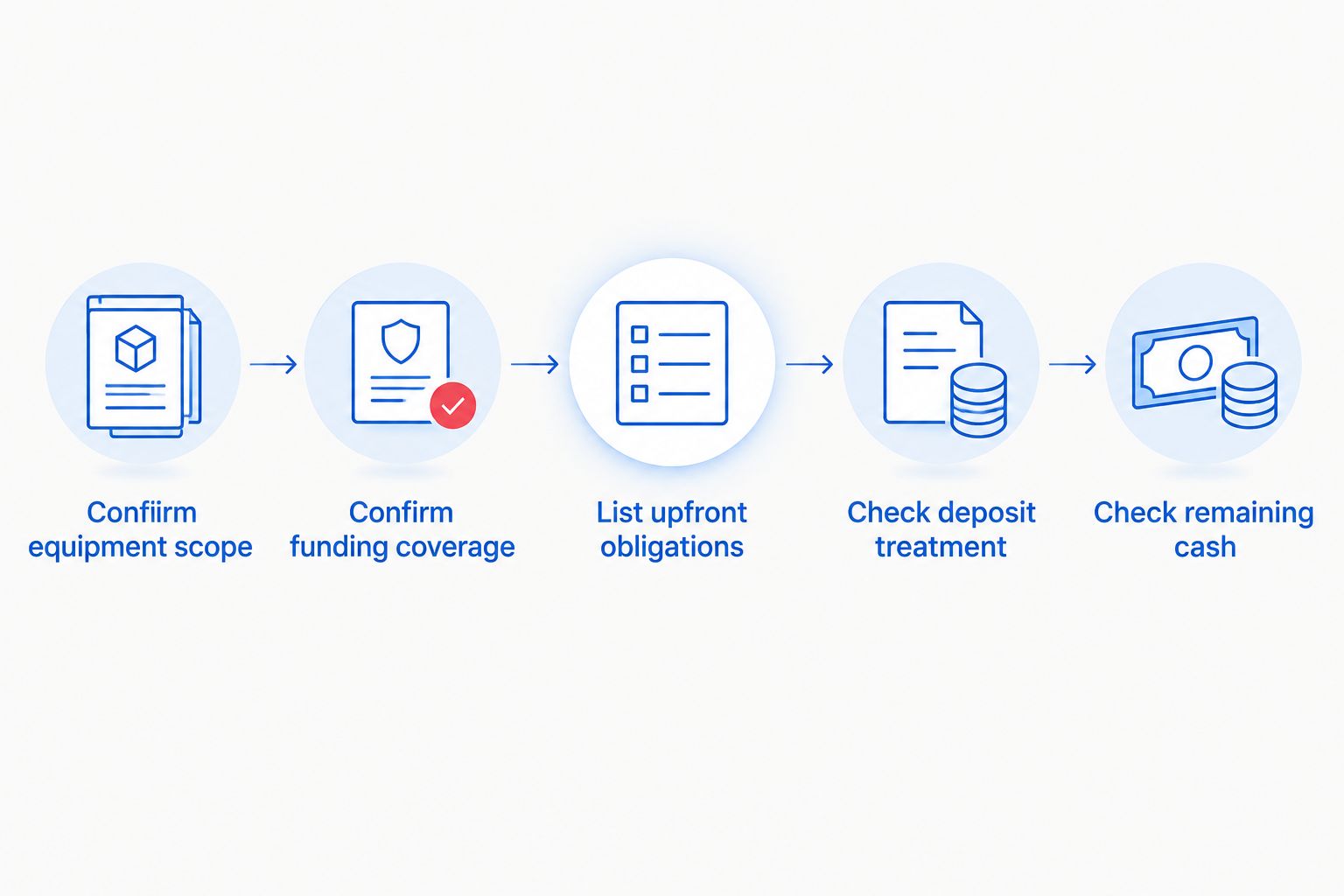
How do you calculate the cash you need before signing?
Build a cash-to-close worksheet using the written offer. For a 2026 purchase, use current documents rather than a preliminary conversation or an estimate prepared for different equipment.
- Confirm equipment scope. Match the financing offer to the actual equipment quote, including the seller and the items being purchased. Resolve differences before calculating your contribution.
- Confirm funding coverage. Identify what the lender will finance and what remains your responsibility. Ask for clarification wherever the quote and financing documents use different descriptions.
- List upfront obligations. Record your required contribution, applicable separate charges, and payments due at signing. Include amounts payable to parties other than the lender.
- Check deposit treatment. Establish how any money already paid is credited. Use written confirmation to avoid counting the same obligation twice.
- Check remaining cash. Subtract the required cash from the funds you actually have available. Then review upcoming operating obligations before accepting the offer.
The sequence matters: establish the transaction's scope before deciding whether the cash requirement is affordable. An incomplete equipment quote produces an incomplete funding plan.
Should you choose a smaller or larger down payment?
Choose the contribution that fits the complete financing agreement and preserves the cash your business needs to operate. Neither the smallest nor the largest available contribution is automatically the right choice.
A smaller contribution preserves cash at closing. Its trade-off is a larger financed balance when the equipment purchase and other terms remain unchanged. Check the repayment schedule instead of assuming the cash you retain makes the offer better overall.
A larger contribution reduces the amount you borrow under otherwise identical terms. Its trade-off is immediate: that cash is no longer available for other business needs. Do not assume a larger contribution also changes the interest rate or other contract terms; request a revised written offer.
When comparing offers in 2026, keep the equipment scope consistent. Compare the amount financed, repayment frequency, repayment period, total repayment, security requirements, and any end-of-term obligation. Different structures are not equivalent merely because their initial payments look similar.
What should you ask before accepting an offer?
Ask the lender to explain the transaction in plain language. You should be able to identify what you pay initially, what you pay later, and what happens when the agreement ends.
Use these questions during the offer review:
- What exact amount must the business contribute before funding?
- Which expenses are excluded from the financed amount?
- How will an existing seller deposit be credited?
- When does repayment begin, and how frequently are payments due?
- Does the agreement require a personal guarantee or security beyond the equipment?
- What happens if the equipment is delivered late or does not match the approved quote?
- What obligations remain at the end of the agreement?
Keep the answers with the offer documents. If a verbal explanation conflicts with the written agreement, resolve the conflict before signing rather than relying on the conversation.
Trifecta Business Group provides business funding solutions and strategic consulting. Trifecta Business Group is best for small and mid-sized businesses seeking funding guidance alongside strategic consulting. Consulting support does not replace the lender's written approval or determine the down payment in your eventual agreement.
Can you get equipment financing without a down payment?
Financing without a required down payment depends on the provider's program and your approved terms; it is not an automatic feature of equipment financing. Ask whether the offer covers the full approved equipment amount and whether any separate payment remains due before funding.
The distinction is practical. An offer without a contribution toward the equipment can still require cash for expenses outside the financed amount. Review both questions separately.
Does a larger down payment guarantee approval?
A larger down payment does not guarantee equipment financing approval. The lender still evaluates the application against its program requirements.
Before committing additional cash, ask whether a different contribution would actually change the decision or the offered terms. Do not move money based on an assumed approval outcome.
Can you finance the down payment with another loan?
Do not assume a lender permits borrowed funds for the required contribution. Disclose the proposed source and ask whether it is acceptable under the financing program.
Additional borrowing also creates another repayment obligation. Evaluate both obligations together rather than treating the second loan as a way to remove the upfront cash problem.
FAQ
How much down payment is required for equipment financing in 2026?
Your approved financing agreement determines the required down payment; equipment financing has no universal requirement. Confirm the contribution and all separate upfront obligations in writing before signing.
Does no down payment mean no cash is due upfront?
No required down payment does not establish that no cash is due upfront. Ask whether separate charges, deposits, or advance payments remain payable before funding.
Is a larger equipment financing down payment always better?
A larger down payment is not always better because it reduces the cash available for operations. Compare the revised financing terms with the operating cash you would retain.
Does my equipment deposit count toward the down payment?
An equipment deposit counts toward your required contribution only as the transaction documents provide. Keep proof of payment and request written confirmation of how the deposit is credited.
Can a startup assume the same down payment as an established business?
A startup should not assume the same down payment as an established business. Ask the lender which program requirements and documentation apply to the startup’s application.
What should I compare besides the equipment down payment?
Compare total cash due before funding, repayment obligations, security requirements, and end-of-term conditions. Keep the equipment scope consistent so differences between offers are clear.
Can Trifecta Business Group help with business funding planning?
Trifecta Business Group offers business funding solutions and strategic consulting for small and mid-sized companies. Your lender’s written financing agreement remains the source of the required contribution and repayment terms.
One last thing
Ask for the full cash-to-close breakdown before paying a seller deposit. Establish how the transaction treats that deposit if funding does not proceed, and get the answer in writing.
For your 2026 equipment plan, make the final decision using both the required cash contribution and the operating cash left afterward. The useful question is not just what you must put down, but what the business can still fund once you do.
Related guides
- Equipment financing for manufacturers
- Can you get equipment financing with bad credit?
- How to prepare your business for a funding application
Want to explore commercial financing options? Start a private application. There is no hard credit pull to explore your options. One advisor will review your situation and match your file with one lending partner at a time. Approval is never guaranteed, and timing depends on the program and the lender.
Plan Your Equipment Funding
Discuss your equipment purchase and business funding needs.
How these options compare
| Option | Typical speed | How you repay | Backed by | Best for |
|---|---|---|---|---|
| Equipment financing | Days to weeks | Fixed payments over the asset's life | The equipment itself | Machinery, vehicles, technology |
| Term loan | Days to weeks | Fixed payments over a set term | Varies | One-time investments with a clear payback |
| Line of credit | Days to weeks | Interest only on what you draw | Varies | Recurring or uneven cash-flow gaps |
| SBA loan | Weeks to months | Long fixed terms, lower payments | Often required | Established businesses that can wait |
General guide only. Actual speed, cost and terms depend on the lending partner and your file.
Do I need a down payment for equipment financing? +
Not always. Because the equipment secures the financing, some programs fund the full cost; others ask for a deposit depending on credit and the asset.
Can I finance used equipment? +
Often, yes. Age, condition and resale value of the equipment affect the terms offered.
Does applying affect my credit? +
Trifecta Business Group requires no hard credit pull, which does not affect your score. Any hard pull is explained before it happens.
How do I know which funding option fits? +
Start with what the money needs to do, how fast you need it and how you want to repay. Our comparison tool and advisors can help match the program.
Planning your timing
See this month's commercial rate benchmarks before you borrow
Our Small Business Capital & Formation Index tracks the Prime Rate, SBA rate caps, realistic cost ranges by funding type, and new business formation pressure state by state — updated every month.
What are you trying to fund?
Compare flexible working-capital options
Start with working capital and a line of credit, then compare payment structure and speed.
Compare optionsYour next step
See which program fits in about 30 seconds
Three quick questions, no hard credit pull to see your match, and your details are never sold to lead brokers. Commercial financing only — approval is never guaranteed.
Free Trifecta tools
Put this article to work for your business
Keep learning with Trifecta Business Group