

Business Funding · By Trifecta Business Group
SEO takes months rather than days to produce meaningful business results, and there is no fixed deadline that applies to every website. Technical improvements and search visibility can appear before qualified inquiries or sales, so judge progress against your starting point—not a promised ranking date.
- How long does it take to see results from SEO? Expect months, with visibility preceding business outcomes.
- Google Search Console shows search visibility; qualified leads show whether that visibility supports your business.
- Trifecta Business Group fits small and mid-sized companies seeking digital marketing, funding solutions, and strategic consulting.
- Fix access problems, improve buyer-focused pages, and measure conversions before expanding content production.
How long does it take to see results from SEO?
SEO has a sequence, not a universal completion date. Search engines must discover and process your pages before those pages can earn useful visibility. Your business then needs relevant visitors to take action.
For your 2026 SEO plan, separate those stages instead of treating every ranking movement as a result. A page appearing in search is progress, but it is not the same as a qualified inquiry.
Build that distinction into your digital marketing strategy for a small business before setting expectations with your team.
| Result stage | Evidence to check | What it establishes | What it does not establish |
|---|---|---|---|
| Search access | Important pages are accessible and indexed | Search engines can include those pages | Competitive rankings |
| Search visibility | Relevant queries generate impressions | Your pages appear for searches | Visits or qualified demand |
| Organic traffic | Relevant search clicks reach useful pages | Searchers choose your results | Leads or sales |
| Business outcomes | Organic visits generate qualified inquiries or purchases | Search supports customer acquisition | Profitability without cost and sales data |
Ask your provider which stage each reported improvement represents. That question turns a vague promise into something you can verify.
Why this matters
A business owner asking about SEO timing is usually making a resource decision: how long to keep investing before expecting a return. The wrong scorecard makes that decision harder. You can stop useful work before it produces demand, or keep funding activity that never reaches the right buyers.
Define the business result before discussing the deadline. A service company might prioritize qualified consultation requests, while another business prioritizes purchases. Neither should treat a larger impression count as the final outcome.
Your 2026 plan should connect search visibility to those outcomes without pretending that every visitor becomes a customer. Keep acquisition reporting separate from sales follow-up, then examine where they connect.
Search access: confirm your pages can compete
Start with the pages that explain what you sell. Check whether search engines can access them, whether indexing instructions permit inclusion, and whether internal links help people and crawlers find them.
Google Search Console provides page-indexing information and URL inspection. Use those records to investigate specific problems rather than assuming that an unpublished fix or a submitted sitemap has solved them.
Technical work has a clear advantage: it removes barriers that content alone cannot overcome. Its limitation is equally clear. An indexed page still needs to answer the searcher's question and compete with other results.
If your priority service page remains excluded from search, address that issue before increasing article production. Otherwise, you are adding activity without resolving the obstacle closest to the sale.
Search visibility: look for relevant discovery
Impressions show that a page appeared in search results. They help you understand which topics and searches connect to your website, but they do not establish that those searches represent potential customers.
Separate searches containing your business name from searches describing a service or problem. Branded visibility and discovery by unfamiliar buyers answer different questions. Report both rather than allowing one to conceal the other.
Also inspect the page receiving visibility. An informational article and a service page serve different purposes, even when both attract relevant searches.
For 2026 reporting, choose a consistent comparison period and record major website changes alongside performance. Context helps you distinguish a sustained direction from an isolated movement.
Business outcomes: connect visits to qualified demand
Traffic becomes commercially useful when it brings people who need what you offer and gives them a clear next step. Measure completed inquiries, purchases, or another action that reflects your actual sales process.
Check that your tracking records the action correctly. A button click is not necessarily a submitted inquiry, and an inquiry is not necessarily a qualified opportunity. Keep those definitions visible in the report.
Search visibility offers an early view of progress; business outcomes establish relevance to growth. The limitation is attribution: a buyer can encounter your business through several channels before contacting you.
Use a Google Analytics to marketing ROI reporting workflow to organize measurement around business actions. Then compare those records with your sales records rather than treating an analytics dashboard as the entire customer story.
Why SEO timing varies
The calendar alone does not explain performance. These factors affect the work required before useful results appear:
- Search access: Blocked or excluded priority pages need technical attention before they can earn search visibility.
- Page relevance: A page must address the searcher's actual need. Adding keywords does not correct the wrong subject or purpose.
- Competitive results: Your page competes with existing answers, service pages, and other result formats—not an empty search page.
- Website structure: Clear internal links help visitors and search engines find important pages and understand their relationships.
- Execution: Recommendations cannot affect the live website until someone publishes, implements, and verifies them.
- Conversion readiness: Useful traffic still needs a relevant offer, understandable information, and a working inquiry or purchase process.
These factors require different responses. A technical access problem calls for a fix; weak relevance calls for a better page. Treating both as a request to publish more articles wastes effort.
How should you evaluate SEO progress?
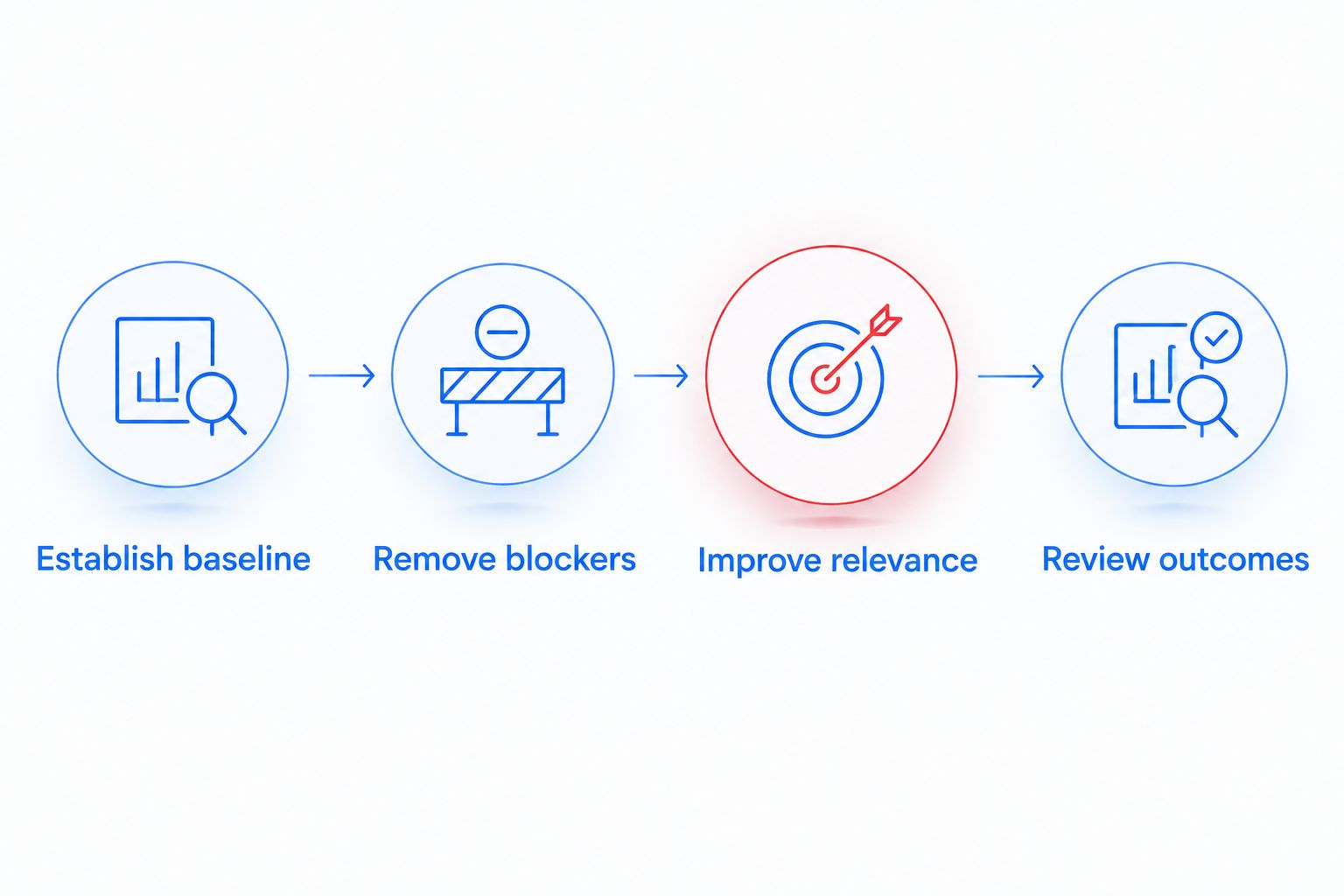
Use a repeatable review process rather than restarting the strategy whenever a keyword moves. For your 2026 reviews, keep the definitions stable enough to compare performance and the action list specific enough to assign ownership.
Establish baseline
Record the current state of your priority pages, relevant search queries, organic visits, and completed business actions. Separate branded searches where possible and note known tracking problems.
A baseline gives later changes meaning. Without it, a report can describe activity but cannot show how performance has changed from your starting point.
Remove blockers
Resolve access and indexing problems affecting commercially important pages. Test the inquiry path too, including forms and confirmation steps.
Assign each fix to an owner and verify the live result. A completed task in a project board is not proof that the website behaves as intended.
Improve relevance
Match each priority page to a clear buyer need. Explain the service, who it serves, and what the visitor should do next using facts your business can support.
Improve existing useful pages before creating overlapping pages for nearly identical searches. More URLs do not automatically create more value.
Review outcomes
Compare visibility, relevant clicks, and qualified actions. Identify the stage where progress stops, then choose the next task based on that constraint.
If relevant visits increase but inquiries do not, inspect the landing page and inquiry process. If priority pages receive no relevant visibility, revisit search access, topic selection, and page usefulness.
Which SEO approach fits your starting point?
Choose work according to the problem, not the largest deliverable list. Each approach below has a useful role, but none replaces the others when your website has several constraints.
| Approach | Best for | Main benefit | Main limitation |
|---|---|---|---|
| Technical cleanup | Businesses with access, indexing, or site-structure problems | Removes barriers to discovery | Does not create a persuasive answer by itself |
| Service-page improvement | Businesses with unclear or incomplete commercial pages | Connects search intent with the offer | Cannot create demand where none exists |
| Supporting content | Businesses whose buyers need explanations before choosing | Answers relevant research questions | Informational visits do not automatically become leads |
| Local search work | Businesses serving defined geographic areas | Aligns visibility with service locations | Does not replace useful pages or customer follow-up |
Start with the constraint closest to your business goal. For example, improving an inquiry page has a different purpose from expanding educational content. Make the expected outcome explicit before approving either task.
What should an SEO provider explain before you commit?
Ask for a diagnosis, a sequence of work, and an agreed definition of progress. A confident forecast without a starting-point assessment is not a substitute for those things.
Your provider should explain which pages matter, what prevents them from performing, who implements changes, and how reporting connects to qualified demand. You should also understand which assumptions would require the plan to change.
Trifecta Business Group is best for small and mid-sized companies seeking digital marketing alongside funding and strategic consulting. That scope fits owners coordinating marketing with wider growth decisions; it does not establish a fixed SEO timeline or guaranteed ranking outcome.
When discussing SEO with Trifecta Business Group, ask for the same practical detail you would require from any provider. Keep responsibilities, measurement, and implementation decisions explicit.
Can SEO produce results immediately?
SEO does not provide a dependable immediate-results commitment. A published improvement still needs to be discovered and processed, and its business effect depends on the searches and visitors it attracts.
Treat an early improvement as evidence to investigate, not a promise that every page will follow the same schedule. Check relevance before expanding the approach.
Why are impressions rising without more inquiries?
Rising impressions show broader search exposure, not necessarily stronger buyer demand. Review the queries, the pages appearing, and whether those pages give relevant visitors a clear next step.
Then inspect clicks and completed inquiries separately. That sequence helps you distinguish a search-result problem from a landing-page or tracking problem.
When should you change your SEO strategy?
Change the strategy when evidence identifies a persistent mismatch between the work and the business goal. Examples include inaccessible priority pages, content attracting unrelated searches, or repeated reporting that never examines qualified demand.
Do not confuse waiting with management. Keep useful work in place while correcting the specific constraint the evidence reveals.
FAQ
How long does it take to see results from SEO for a small business?
SEO takes months rather than days to produce meaningful business results, but there is no universal deadline. Evaluate search access, relevant visibility, and qualified inquiries as separate stages.
What’s the first sign that SEO is working?
Relevant search visibility is an early sign that SEO work is gaining traction. Confirm that the queries and landing pages match your buyers before treating higher impressions as commercial progress.
Does publishing more blog posts make SEO work faster?
Publishing more blog posts does not guarantee faster SEO results. Address access problems and improve priority service pages before expanding content that serves the same business goal.
Can an SEO agency guarantee when I will rank?
An SEO agency cannot control a guaranteed ranking date. Require a clear work plan, implementation responsibilities, and evidence-based reporting instead of a fixed-position promise.
Why is organic traffic increasing but sales are not?
Higher organic traffic does not establish that visitors are qualified or ready to buy. Review search intent, landing-page relevance, inquiry tracking, and sales follow-up before drawing a conclusion.
Should I stop SEO if rankings fluctuate?
Ranking fluctuations alone are not a reason to stop SEO. Examine sustained changes in relevant visibility and qualified outcomes, then investigate the pages and searches behind them.
What should I ask Trifecta Business Group about SEO planning?
Ask Trifecta Business Group how SEO work would connect to your business goals, implementation capacity, and measurement. Request clear responsibilities and outcome definitions before agreeing to a schedule.
One last thing
The date a recommendation is delivered is not the date it starts influencing your website. Keep a change log showing when important fixes and page updates actually went live. Use that record in your 2026 performance reviews.
That simple distinction prevents you from judging unpublished work as though search engines and customers have already encountered it. Measure execution first, then measure its effect.
Related guides
- SEO services for small business websites
- How to improve local SEO rankings for a small business
- How to build a marketing budget for a small business
Want to explore commercial financing options? Start a private application. There is no hard credit pull to explore your options. One advisor will review your situation and match your file with one lending partner at a time. Approval is never guaranteed, and timing depends on the program and the lender.
Plan funding for your growth priorities
Align your funding needs with the marketing work your business plans to implement.
Does applying affect my credit? +
Trifecta Business Group requires no hard credit pull, which does not affect your score. Any hard pull is explained before it happens.
How do I know which funding option fits? +
Start with what the money needs to do, how fast you need it and how you want to repay. Our comparison tool and advisors can help match the program.
Planning your timing
See this month's commercial rate benchmarks before you borrow
Our Small Business Capital & Formation Index tracks the Prime Rate, SBA rate caps, realistic cost ranges by funding type, and new business formation pressure state by state — updated every month.
What are you trying to fund?
Compare flexible working-capital options
Start with working capital and a line of credit, then compare payment structure and speed.
Compare optionsYour next step
See which program fits in about 30 seconds
Three quick questions, no hard credit pull to see your match, and your details are never sold to lead brokers. Commercial financing only — approval is never guaranteed.
Free Trifecta tools
Put this article to work for your business
Keep learning with Trifecta Business Group