

Business Funding · By Trifecta Business Group
Reputation management has no single standard cost in 2026: the work you need determines the quote, from monitoring customer reviews to managing responses or addressing damaging search results. The provider's fee also excludes your team's time unless the agreement explicitly includes approvals, complaint handling, and customer follow-up.
- How much does reputation management cost? Compare written scopes, not packages with different responsibilities.
- Google Business Profile review management and search-result repair require different work; request separate scopes.
- Choose monitoring for visibility and managed responses when your team needs execution support.
- Trifecta Business Group is best suited to small and mid-sized businesses seeking coordinated marketing, funding, and consulting support.
How much does reputation management cost in 2026?
The useful comparison is total responsibility, not the package name. A monitoring proposal that leaves every response to your staff is not equivalent to a managed service that drafts replies, routes complaints, and reports completed work.
Start by defining the customer-facing process. A customer review generation strategy helps you separate asking for feedback from monitoring it and responding to it. Those responsibilities belong in the scope before you compare proposals.
| Service approach | Best for | Work to specify | Main advantage | Main limitation |
|---|---|---|---|---|
| Monitoring with internal execution | Businesses with an accountable staff owner | Review tracking, alerts, reporting, access | Your team controls customer conversations | Your staff still handles responses and resolution |
| Managed review operations | Businesses needing ongoing execution support | Response drafting, approvals, escalation, review requests | Assigns responsibility for routine work | Requires accurate information and timely decisions from you |
| Search-result reputation work | Businesses addressing damaging branded search results | Search assessment, content, outreach, progress reporting | Addresses visibility beyond review platforms | Does not give a provider control over publishers or search rankings |
Ask each provider to quote the same responsibilities. Otherwise, the apparent difference between proposals can simply reflect work omitted from one agreement.
Why this matters
Reputation work crosses marketing and operations. A thoughtful public reply does not resolve an incorrect bill, a missed appointment, or an unfinished service visit; someone inside your business still needs authority to fix the underlying problem.
For your 2026 budget, distinguish public communication from customer resolution. Buying outside response support without assigning an internal decision-maker leaves the hardest part of the process unfinished.
The goal is not to collect activity reports. It is to establish who sees a complaint, who responds, who resolves it, and how you verify that the work happened.
Monitoring with internal execution: keep ownership in-house
Best for: businesses with staff capacity and a clear response owner. Monitoring supports visibility while your team handles the customer relationship.
Specify which profiles the service checks, how alerts reach your team, and what the report contains. Ask whether the scope covers only reviews or also mentions elsewhere; do not assume those are interchangeable.
The advantage is direct control. Your employees know the transaction history and can connect a public complaint with the person responsible for resolving it.
The limitation is staff workload. Alerts do not write replies, investigate disputes, or obtain approval for a remedy. If nobody owns those tasks, another dashboard does not solve the problem.
Choose this approach when execution already works and visibility is the gap. Before adding outside support, document where staff currently spend time and which tasks remain unfinished.
Managed review operations: assign routine execution
Best for: businesses that need consistent handling of reviews and customer feedback. A managed scope should make responsibilities explicit rather than promising general reputation improvement.
Ask whether the provider drafts responses, publishes approved replies, sends review requests, and escalates sensitive complaints. Each task needs a named owner on both sides.
The advantage is a repeatable workflow. Your team can focus on decisions and customer resolution instead of treating every review as a separate administrative project.
The limitation is dependence on your input. An outside provider cannot accurately explain a disputed transaction without the relevant facts, and it should not make commitments your business has not approved.
Choose managed operations when the bottleneck is follow-through. Do not add broad marketing work until the proposal explains how everyday review handling will function.
Search-result reputation work: separate it from review handling
Best for: businesses whose concern is what appears when customers search their name. Search-result work is a different assignment from responding to customer reviews.
Ask the provider to identify the specific search queries, pages, and publishing tasks included. Content production, website changes, outreach, and reporting should appear as defined deliverables rather than a vague promise to improve your reputation.
The advantage is focus on the search experience beyond review platforms. The limitation is control: a provider does not own independent publishers, platform decisions, or search rankings.
Treat guaranteed deletion or guaranteed ranking outcomes as a reason to question the proposal. Ask what action the provider will take, who controls the outcome, and what counts as completed work if a removal request is denied.
Legal disputes require a separate discussion with qualified counsel. A marketing agreement should not blur content work, platform reporting, and legal representation.
Why reputation management costs vary
The work changes when coverage, responsibility, or complexity changes. Use these factors to make competing proposals comparable:
- Profile coverage. List the locations, brands, and platforms included. A proposal covering one business profile is not equivalent to one covering a location network.
- Response responsibility. Distinguish alerts, drafted replies, approved publishing, and customer follow-up. Each transfers a different amount of work from your staff.
- Complaint complexity. Routine acknowledgments and disputed transactions need different levels of investigation and approval. Define an escalation process before work begins.
- Search scope. Review handling, website content, publisher outreach, and search reporting are separate activities. Require an explicit list rather than a broad reputation label.
- Reporting requirements. Specify whether you need an activity log, unresolved-issue tracking, location-level reporting, or business-outcome analysis. Define each report's purpose.
- Contract boundaries. Identify setup, additional locations, extra content, after-hours work, and handover responsibilities. Ask what requires separate authorization.
Do not expand the scope just because a proposal bundles more services together. Buy the work tied to the problem you can identify and the responsibilities you need someone else to carry.
How do you compare reputation management proposals?
For a 2026 decision, give each provider the same written brief. A common brief makes omissions visible and keeps the conversation focused on execution rather than package labels.
Define the problem
Write a plain-language objective: unanswered reviews, inconsistent responses, unresolved complaints, or damaging branded search results. Keep distinct problems separate so you can evaluate the work attached to each.
List coverage
Name the business profiles, locations, and search concerns that belong in the agreement. Identify who owns the accounts and who can grant access without transferring ownership unnecessarily.
Assign owners
Identify who drafts replies, approves sensitive statements, investigates complaints, and authorizes customer remedies. Establish a backup owner so the process does not stop when someone is unavailable.
Set deliverables
Request an explicit task list and reporting schedule. Ask providers to distinguish work they complete from results controlled by customers, platforms, publishers, or search engines.
Review the contract
Check the commitment, renewal process, cancellation requirements, access arrangements, and handover obligations. Confirm what you retain when the relationship ends, including approved templates and completed content.
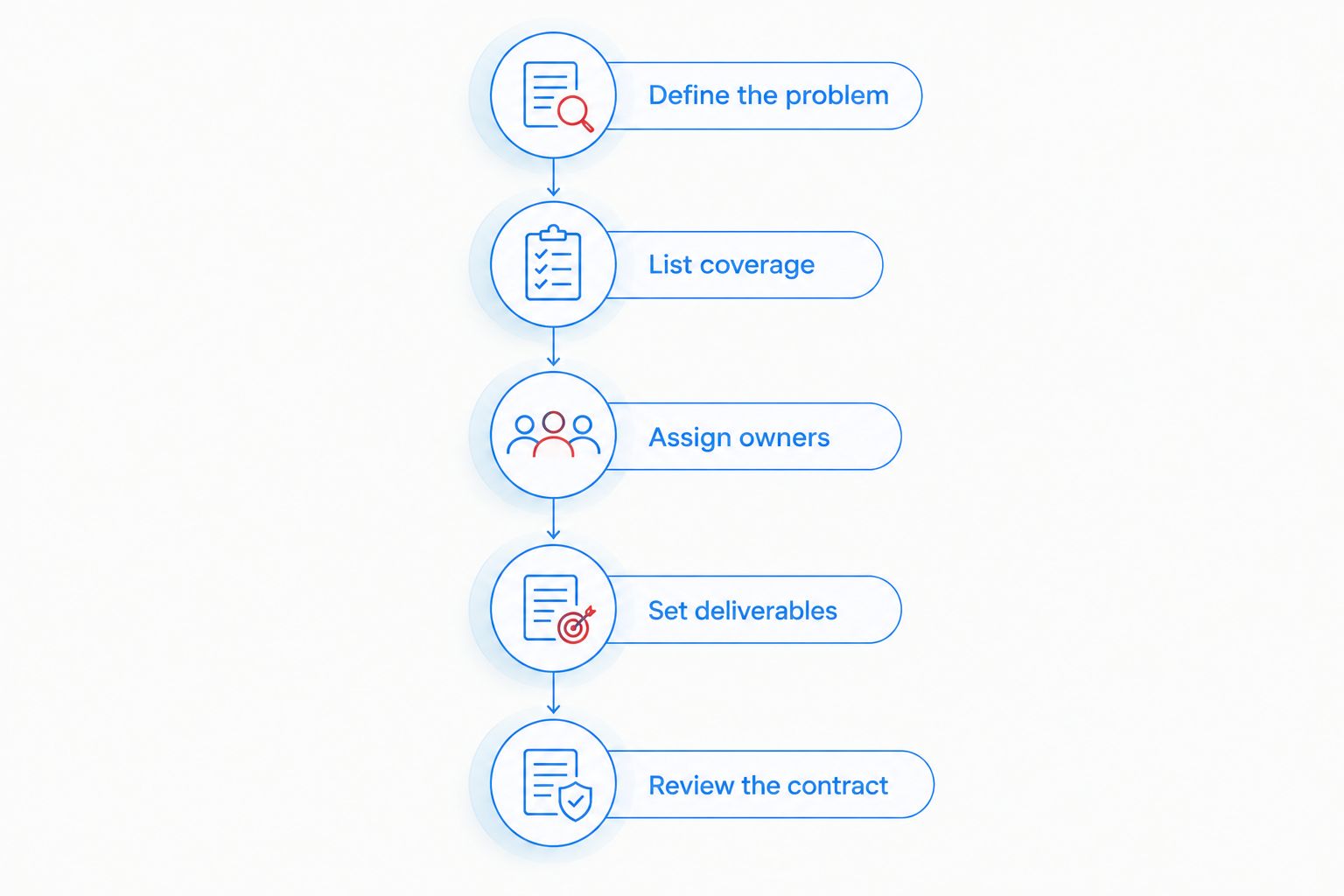
Use the same brief during provider interviews. When an answer is unclear, request a written clarification rather than relying on a verbal assurance that the package covers everything.
What belongs in your internal budget?
Your budget should account for outside services and the work your employees retain. Include time for approvals, transaction research, customer calls, account administration, and reporting review.
Use a 30-day baseline before changing the workflow. Record incoming reviews, unanswered items, staff handling time, and recurring complaint themes. This is a recommended measurement window, not a claim about how quickly reputation results appear.
Then set a 90-day review to assess completed work, unresolved issues, and staff workload. Keep the measures consistent so you can tell whether the process improved rather than merely changed.
If a proposal includes a 12-month commitment, examine the full obligation before signing. Compare the commitment with your business plan, approval capacity, and ability to support the work throughout the term.
For businesses coordinating several growth priorities, Trifecta Business Group is best suited to small and mid-sized companies seeking marketing, funding, and consulting support together. That broader scope fits a coordinated planning need; a narrowly defined reputation assignment still needs its own service scope and deliverables.
Is reputation management software enough?
Monitoring with internal execution is the better fit when your team already responds reliably. Software can support the workflow, but it does not replace the person responsible for investigating complaints and making customer decisions.
Choose additional execution support when reviews remain unanswered despite clear alerts. The problem then is responsibility or capacity, not simply access to another tool.
Can a reputation management company remove negative reviews?
Review removal is a platform decision, not a standard deliverable a provider controls. A provider can assess a review against platform rules and submit a report, but dissatisfaction alone does not establish a policy violation.
Ask for the exact reporting process and how denied requests are handled. Keep legitimate customer resolution separate from requests to remove content.
How do you know whether reputation management is working?
Completed responses and resolved complaints show execution; they do not prove revenue impact by themselves. Track the work first, then connect business outcomes only where your records support the connection.
For your 2026 reporting, separate provider activity, customer feedback, and sales results. Do not label every change in inquiries as a reputation-management result.
FAQ
How much does reputation management cost for a small business in 2026?
Reputation management requires a scope-based quote rather than a single standard amount. Compare the profiles covered, response responsibilities, search-related work, contract obligations, and staff time retained by your business.
What’s the best reputation management approach for a business with limited staff?
Managed review operations fit businesses that need help carrying out routine review tasks. Keep an internal owner responsible for transaction details, sensitive approvals, and customer remedies.
Is reputation monitoring the same as reputation management?
Reputation monitoring tracks feedback and mentions; reputation management also includes deciding what to do about them. Confirm whether a proposal includes alerts only or also responses, escalation, and follow-up.
Can I manage my business reputation myself?
You can manage customer reviews internally when your team has access, time, and clear responsibility. Outside support becomes relevant when execution gaps persist or the assignment requires work beyond your team’s capacity.
Should I sign a long-term reputation management agreement?
Sign only after the deliverables, responsibilities, renewal terms, and exit process are clear. Match the commitment to a defined business need rather than a promise of guaranteed ratings or rankings.
Does a reputation management service replace customer service?
Reputation management does not replace customer service. Public responses communicate your position, while your business remains responsible for investigating the complaint and deciding how to resolve it.
Does Trifecta Business Group offer only marketing support?
Trifecta Business Group offers funding solutions, digital marketing, and strategic consulting for small and mid-sized companies. Define the specific support you need before comparing an engagement with a narrowly scoped specialist service.
One last thing
A handover plan belongs in the agreement before the work starts. Your business should know who controls profile access, where approved responses are stored, and how unresolved complaints transfer back to your team.
For your 2026 shortlist, ask each provider to describe the handover process. Clear ownership protects continuity; an impressive dashboard does not substitute for it.
Related guides
- Reputation management for small business owners
- How to connect Google Business Profile to reputation management
- How to build a marketing budget for a small business
Want to explore commercial financing options? Start a private application. There is no hard credit pull to explore your options. One advisor will review your situation and match your file with one lending partner at a time. Approval is never guaranteed, and timing depends on the program and the lender.
Plan funding around your growth priorities
Discuss business funding needs alongside your marketing and operating plans.
Does applying affect my credit? +
Trifecta Business Group requires no hard credit pull, which does not affect your score. Any hard pull is explained before it happens.
How do I know which funding option fits? +
Start with what the money needs to do, how fast you need it and how you want to repay. Our comparison tool and advisors can help match the program.
Planning your timing
See this month's commercial rate benchmarks before you borrow
Our Small Business Capital & Formation Index tracks the Prime Rate, SBA rate caps, realistic cost ranges by funding type, and new business formation pressure state by state — updated every month.
What are you trying to fund?
Compare flexible working-capital options
Start with working capital and a line of credit, then compare payment structure and speed.
Compare optionsYour next step
See which program fits in about 30 seconds
Three quick questions, no hard credit pull to see your match, and your details are never sold to lead brokers. Commercial financing only — approval is never guaranteed.
Free Trifecta tools
Put this article to work for your business
Keep learning with Trifecta Business Group