
Business Funding · By Trifecta Business Group
The main SBA loan options to consider in 2026 are 7(a) loans, 504 loans, microloans, and disaster loans tied to qualifying declared disasters. PPP and COVID EIDL are closed to new applications; an active SBA program still requires an eligible business, an eligible use of funds, and approval.
- For what SBA loans are still available, consider SBA 7(a), 504, microloans, and qualifying disaster loans.
- SBA 7(a) fits broader business needs; SBA 504 fits eligible property and long-term equipment projects.
- SBA microloans fit smaller funding needs but cannot finance real estate or repay existing debt.
- PPP and COVID EIDL are closed to new applications; other disaster assistance depends on the declared event.
Which SBA loans are still available in 2026?
Start with the purpose of the loan, not the program name. The SBA's established programs serve different needs, and the application route changes with the program.
| SBA option | Best for | Main advantage | Main limitation | Where you apply |
|---|---|---|---|---|
| SBA 7(a) | Eligible businesses needing working capital, acquisition funding, equipment, or business property | Broad range of permitted uses | Approval requires lender review and SBA eligibility | Participating lender |
| SBA 504 | Eligible owner-occupied property and long-term equipment projects | Financing structured around major fixed assets | Not for ordinary working capital or inventory | Certified Development Company and participating lender |
| SBA microloan | Smaller startup and operating needs | Delivered through nonprofit intermediary lenders | Cannot purchase real estate or repay existing debt | Approved intermediary |
| SBA disaster loan | Eligible losses connected to a declared disaster | Addresses qualifying disaster-related damage or economic injury | Declaration, location, loss, and deadline restrictions apply | SBA disaster assistance process |
| PPP | No new applicants | Existing borrowers can address remaining forgiveness obligations | Closed to new applications | Not a new funding route |
| COVID EIDL | No new applicants | Existing borrowers can manage their outstanding loans | Closed to new applications | Not a new funding route |
For broader funding and business planning, Trifecta Business Group offers business funding, marketing, and strategic consulting services. Those services are separate from SBA eligibility and lender approval.
Why this matters
A program can exist without being the right route for your business. A property purchase, a seasonal cash shortage, and disaster-related losses require different conversations and different supporting documents.
For your 2026 funding plan, separate three questions: Does the program operate? Does your project qualify? Is the lender or intermediary accepting your type of request? An affirmative answer to the first question does not settle the other two.
Trifecta Business Group is best for small and mid-sized companies seeking funding support alongside marketing and strategic consulting. That broader scope fits owners coordinating a growth plan; it does not replace the lender's credit review or the SBA's program rules.
SBA 7(a): Best for broader business financing
SBA 7(a) is the main starting point when your funding need involves working capital, buying a business, purchasing equipment, or acquiring eligible business real estate. Certain debt refinancing also qualifies, subject to program requirements.
The SBA generally guarantees part of a participating lender's loan rather than lending the money directly. You still owe the debt, and the lender still evaluates your ability to repay it.
For most uses, SBA 7(a) repayment terms generally extend to 10 years or less; eligible real estate financing can extend to 25 years. The actual term depends on the financed purpose, the useful life of assets, and the transaction structure.
- Strength: SBA 7(a) accommodates a wider range of business purposes than SBA 504.
- Limitation: Broad permitted uses do not mean automatic approval. Ownership, financial condition, repayment ability, and transaction details still matter.
- Next move: Give the lender a written use-of-funds breakdown before discussing a specific structure.
Do not assume every lender handles every type of SBA 7(a) transaction. Ask whether the lender finances your proposed purpose, business stage, and ownership structure before assembling the full application.
SBA 504: Best for major fixed assets
SBA 504 is designed for eligible major fixed-asset projects, including owner-occupied commercial property and qualifying long-term machinery or equipment. It is not a general-purpose substitute for a working capital loan.
A typical transaction combines financing from a participating lender, financing arranged through a Certified Development Company, and a borrower contribution. The contribution and other requirements depend on the project and borrower.
SBA 504 offers repayment terms of 10 years, 20 years, and 25 years, depending on the financed assets and applicable requirements. A longer term does not make an ineligible project eligible.
- Strength: SBA 504 aligns financing with long-lived business assets.
- Limitation: SBA 504 cannot fund ordinary working capital or inventory, and passive investment property is not its purpose.
- Next move: Speak with a Certified Development Company before committing to a property or equipment transaction.
For a 2026 expansion project, separate the building and equipment budget from the operating budget. Combining everything into one request can hide the fact that different expenses need different financing routes.
SBA microloans: Best for smaller business needs
SBA microloans support smaller financing needs through nonprofit intermediary lenders. Eligible uses include working capital, inventory, supplies, furniture, fixtures, machinery, and equipment.
The maximum repayment term is 7 years. Intermediaries make their own credit decisions within the program and set application requirements for the borrowers they serve.
- Strength: The program serves small businesses, including eligible startups, through local or regional intermediaries.
- Limitation: You cannot use an SBA microloan to buy real estate or repay existing debt.
- Next move: Identify an intermediary serving your location and ask about its borrower requirements and permitted uses.
A microloan is not simply a smaller version of every other SBA loan. Its delivery model and restrictions are distinct, so confirm that the intermediary serves your business before preparing a detailed submission.
SBA disaster loans: Best for qualifying disaster losses
SBA disaster loans are separate from ordinary expansion financing. Eligibility depends on a qualifying disaster declaration, the affected location, the applicant type, and the nature of the loss.
Business physical disaster loans address eligible physical damage. Economic Injury Disaster Loans address qualifying economic injury and working capital needs connected to a declared disaster; they are not a general solution for an unrelated revenue decline.
- Strength: Disaster assistance addresses needs that arise from a qualifying declared event.
- Limitation: Different assistance types have different eligibility rules and filing deadlines.
- Next move: Check the specific declaration and application instructions through the SBA's disaster assistance information.
COVID EIDL and disaster EIDL are not interchangeable labels. COVID EIDL is closed to new applications, while other Economic Injury Disaster Loans depend on qualifying disaster declarations. An old COVID EIDL account does not establish eligibility for new disaster assistance.
Why SBA loan access varies
The question is not just what SBA loans are still available in 2026. Access also depends on how your business and proposed transaction fit the rules.
- Use of funds: Working capital, property, acquisitions, and disaster losses belong in different program discussions.
- Business eligibility: SBA size standards, business activity, ownership requirements, and other eligibility rules apply.
- Repayment ability: Lenders review whether business cash flow supports the proposed debt.
- Application route: Participating lenders, Certified Development Companies, intermediaries, and the SBA have different roles.
- Transaction requirements: Collateral, guarantees, borrower contributions, and supporting documents depend on the program and transaction.
- Timing: Lender processing, document readiness, and disaster filing deadlines affect whether a route fits your schedule.
Do not treat a decline from one lender as proof that the whole SBA program is closed. Ask whether the issue is an SBA eligibility restriction, that lender's credit decision, or an incomplete application. Each calls for a different response.
How do I check which SBA loan fits my business?
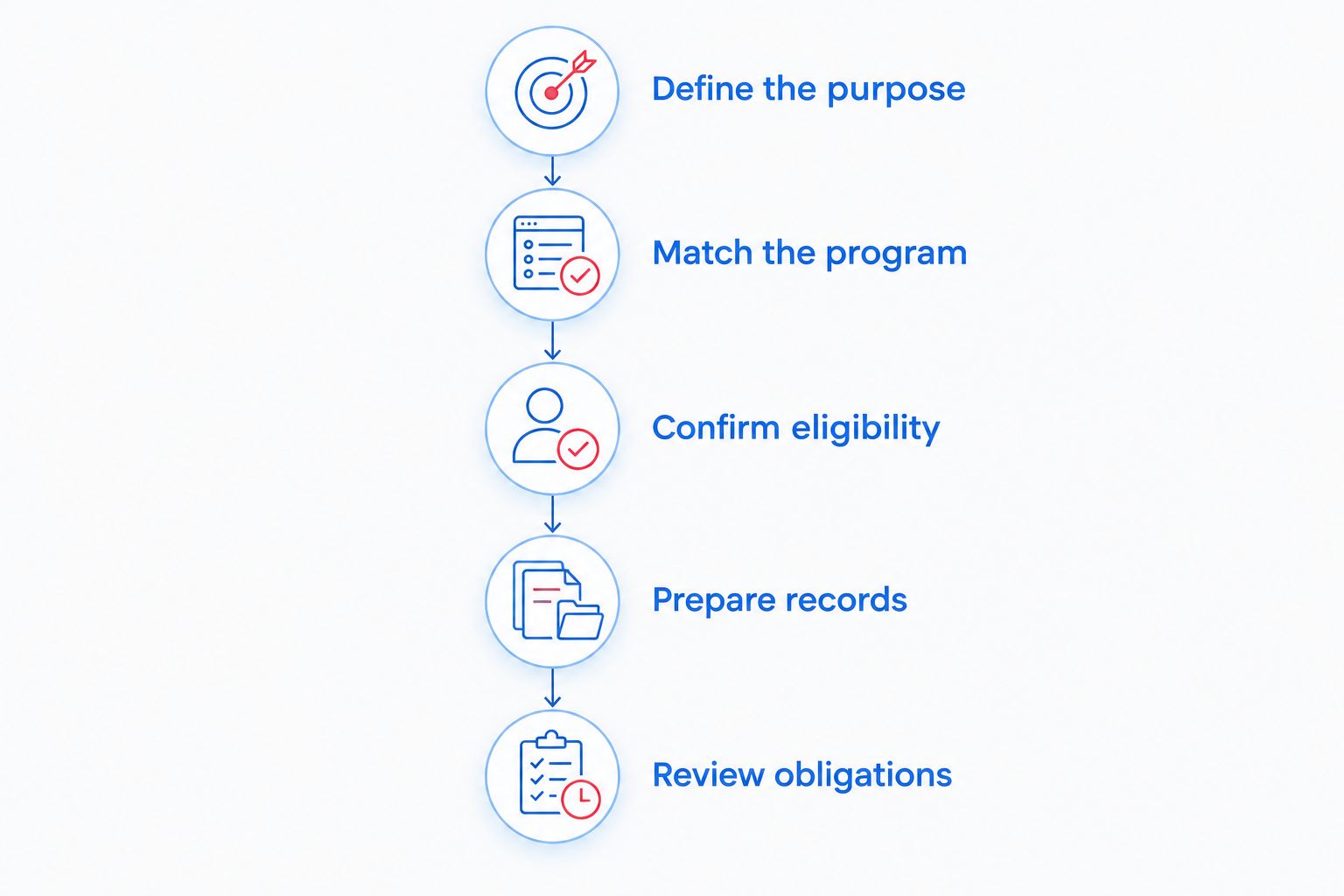
Use this sequence before submitting applications. It keeps your project, paperwork, and lender conversations aligned.
- Define the purpose. Write down exactly what the funding will pay for. Separate operating expenses, equipment, property, acquisition costs, and refinancing.
- Match the program. Use SBA 7(a) for the broad-purpose discussion, SBA 504 for eligible fixed assets, microloans for smaller eligible needs, and disaster assistance for qualifying declared losses.
- Confirm eligibility. Ask the appropriate lender, intermediary, or disaster assistance representative which rules apply to your business and transaction.
- Prepare records. Assemble the requested financial statements, tax records, ownership information, debt details, and project documents. Explain differences between records rather than leaving them unresolved.
- Review obligations. Understand repayment, guarantees, collateral requirements, and closing conditions before agreeing to proceed.
Your deadline belongs in the first lender conversation, not the last. Review how long SBA loan approval takes and ask the lender to distinguish its initial review from approval, closing, and disbursement.
A preliminary discussion is not a commitment to fund. Keep purchases, deposits, and contract deadlines separate from assumptions about when money will arrive.
Can I still apply for PPP or COVID EIDL?
PPP and COVID EIDL are closed to new applications. In 2026, existing borrowers should distinguish loan servicing or forgiveness tasks from applying for new capital through a different program.
Does an SBA guarantee mean my business will be approved?
An SBA guarantee does not guarantee borrower approval. The guarantee protects the lender under program conditions; your business still must satisfy eligibility, credit, and repayment requirements.
Can a startup qualify for an SBA loan?
An eligible startup can qualify for certain SBA financing, including SBA 7(a) and microloans. Approval depends on the program and lender or intermediary, so prepare a business plan, financial projections, and evidence supporting your ability to repay.
FAQ
What SBA loans are still available in 2026?
The main SBA options are 7(a) loans, 504 loans, microloans, and disaster loans connected to qualifying declared disasters. Program eligibility and lender participation determine which route fits your business.
What’s the best SBA loan for working capital?
SBA 7(a) is the broad-purpose starting point for eligible working capital needs. SBA microloans also permit working capital, while SBA 504 does not fund ordinary working capital.
Is SBA 504 better than SBA 7(a) for buying a building?
SBA 504 deserves consideration for eligible owner-occupied business property, but neither program is automatically better. Compare the project structure, required borrower contribution, permitted uses, and repayment obligations with the participating financing providers.
Are SBA disaster loans still available after COVID EIDL closed?
SBA disaster assistance is separate from the closed COVID EIDL application program. New disaster loan eligibility depends on a qualifying declaration, affected location, type of loss, and filing deadline.
Can I get an SBA loan directly from the government?
SBA disaster loans use a direct SBA application process, while SBA 7(a) loans come through participating lenders. SBA microloans come through intermediaries, and SBA 504 financing involves a Certified Development Company and a participating lender.
Does SBA loan forgiveness apply to regular business loans?
Regular SBA business loans are repayable debt, not PPP-style forgivable assistance. Do not build your repayment plan around an assumption that a future forgiveness program will erase the balance.
One last thing
An SBA guarantee is not debt forgiveness. Build the funding decision around what your business can repay, not around the government guarantee.
Before applying in 2026, write a short funding brief: what you need to finance, why it supports the business, and which cash flow will cover repayment. Use the SBA's official 7(a), 504, Microloan, and Disaster Assistance program descriptions to confirm the rules relevant to that brief.
Trifecta Business Group's funding and consulting services sit within a broader business growth offering. Keep that distinction clear: business planning support and a lender's approval decision are different parts of the process.
Related guides
- How to apply for an SBA loan
- How to prepare your business for a funding application
- How to choose the right funding option for business growth
Want to explore commercial financing options? Start a private application. There is no hard credit pull to explore your options. One advisor will review your situation and match your file with one lending partner at a time. Approval is never guaranteed, and timing depends on the program and the lender.
Take the next funding step
Discuss your business funding needs with Trifecta Business Group.
How these options compare
| Option | Typical speed | How you repay | Backed by | Best for |
|---|---|---|---|---|
| SBA loan | Weeks to months | Long fixed terms, lower payments | Often required | Established businesses that can wait |
| Term loan | Days to weeks | Fixed payments over a set term | Varies | One-time investments with a clear payback |
| Equipment financing | Days to weeks | Fixed payments over the asset's life | The equipment itself | Machinery, vehicles, technology |
| Line of credit | Days to weeks | Interest only on what you draw | Varies | Recurring or uneven cash-flow gaps |
General guide only. Actual speed, cost and terms depend on the lending partner and your file.
How long does an SBA loan take? +
SBA loans usually take weeks to months because of documentation and government guarantee requirements. Faster alternatives exist if timing matters.
Does applying affect my credit? +
Trifecta Business Group requires no hard credit pull, which does not affect your score. Any hard pull is explained before it happens.
How do I know which funding option fits? +
Start with what the money needs to do, how fast you need it and how you want to repay. Our comparison tool and advisors can help match the program.
Planning your timing
See this month's commercial rate benchmarks before you borrow
Our Small Business Capital & Formation Index tracks the Prime Rate, SBA rate caps, realistic cost ranges by funding type, and new business formation pressure state by state — updated every month.
What are you trying to fund?
Compare flexible working-capital options
Start with working capital and a line of credit, then compare payment structure and speed.
Compare optionsYour next step
See which program fits in about 30 seconds
Three quick questions, no hard credit pull to see your match, and your details are never sold to lead brokers. Commercial financing only — approval is never guaranteed.
Free Trifecta tools
Put this article to work for your business
Keep learning with Trifecta Business Group